
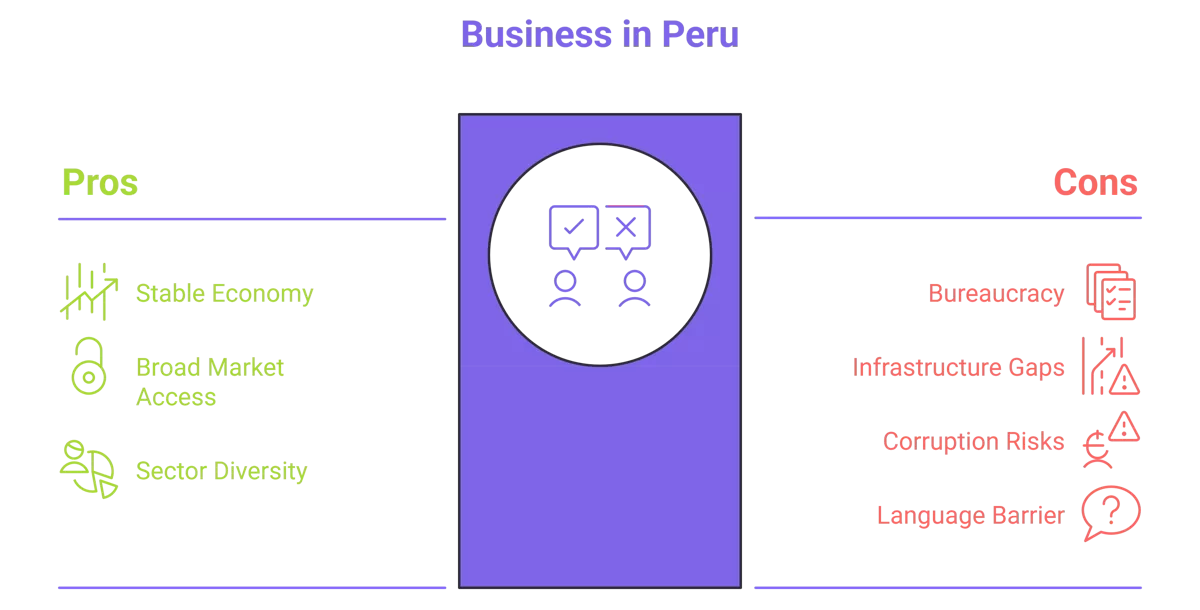
Doing business in Peru offers genuine commercial opportunities, but it is not a low-effort route to profitability. The country combines an established private-investment framework, international trade relationships and diverse industries with administrative complexity, widespread informality and significant differences in regional infrastructure.
The strongest advantages usually matter when a business has a clear local customer base, a reliable supply chain, appropriate licences and access to competent staff. The disadvantages become more serious when an entrepreneur relies on informal arrangements, underestimates compliance costs or chooses a location without understanding its operating conditions.
For foreign entrepreneurs, the central question is not whether Peru is good or bad for business in general. It is whether a specific business model can function legally, competitively and profitably within the Peruvian market.
Business in Peru — advantages and disadvantages at a glance
Peru is neither a universally easy market nor an unusually difficult one for every type of enterprise.
Its attractiveness depends on the distinction between the legal environment, the actual market and the practical conditions under which a business must operate.
The following comparison summarises the principal factors a prospective entrepreneur should examine.
| Potential advantage | Corresponding challenge |
|---|---|
| Established investment framework Foreign capital generally receives equal legal treatment |
Sector restrictions, formalities and compliance requirements still apply |
| Domestic demand A diverse population and commercial markets |
Purchasing power, customer behaviour and informality vary considerably |
| International trade agreements Access to multiple overseas markets |
Rules of origin, standards, customs and logistics affect actual benefits |
| Sector diversity Opportunities in services, tourism, agriculture and other industries |
Specialised licences, technical knowledge and investment needs differ |
| Business formation options Established company structures and digital procedures |
Registration is only the beginning of tax and operational compliance |
| Regional specialisation Different locations serve different markets |
Transport, infrastructure, labour and customer access vary by region |
| Potential for smaller enterprises Opportunities for focused products and services |
Cash flow, informal competition and operating costs can constrain growth |
Is Peru a good place for foreign entrepreneurs?
It can be a suitable destination for entrepreneurs who have identified a real commercial need and can organise a compliant local operation.
Peru offers recognised legal structures for company formation, formal investment protections and established commercial relationships with international partners.
However, the decision should be based on projected customers, operating costs, risk tolerance and the entrepreneur's ability to manage the business.
A low-cost registration process cannot compensate for weak demand or an unworkable supply chain.
The Peruvian economy offers opportunity without eliminating risk
Peru has a history of relatively prudent macroeconomic management compared with some countries in the region.
International institutions have identified factors such as monetary policy credibility, financial supervision and comparatively manageable public debt as important sources of resilience.
These characteristics can support business planning, but they do not imply uninterrupted growth or political stability.
Macroeconomic stability is different from business stability
The World Bank identifies low productivity, informality, regional disparities and institutional weaknesses among Peru's structural economic challenges.
These conditions can affect small enterprises even when national inflation or public-debt indicators appear comparatively favourable.
For example, a company may operate in a relatively stable monetary environment while facing unpredictable administrative delays or difficulties collecting payments from customers.
Business decisions should therefore distinguish between national economic indicators and conditions affecting the specific industry.
Political and regulatory uncertainty
Political changes can influence investor expectations, public spending, institutional priorities and legislative proposals.
The International Monetary Fund has repeatedly identified political uncertainty and related governance problems as risks to Peru's economic outlook.
It would be inaccurate to treat the country's political environment as consistently stable simply because certain macroeconomic policies have proved resilient.
Companies considering long-term investments should evaluate how potential regulatory changes may affect licences, taxes, public contracts and project implementation.
Currency and financial exposure
Many Peruvian transactions are denominated in soles, while international investors may hold capital or receive revenue in US dollars or other currencies.
Exchange-rate movements can change the cost of imported equipment, foreign-currency debt and repatriated profits.
Businesses should consider the currency of their revenue in relation to the currency of their major expenses.
A company receiving soles but servicing debt in dollars faces a different risk profile from a business earning foreign-currency export revenue.
Current macroeconomic information is available through the World Bank's Peru country overview and the IMF country assessment.
Can foreigners own and operate a business in Peru?
Peru generally provides foreign investors with treatment comparable to that available to domestic investors, subject to constitutional and sector-specific exceptions.
This principle is reflected in the country's foreign-investment legislation and the information published by ProInversión.
Foreign entrepreneurs may participate in legally established companies and acquire shares under the applicable rules.
What makes Peru accessible to foreign investors?
The country's investment framework provides for broad participation by foreign capital across many areas of economic activity.
ProInversión identifies principles including equal treatment, private-property protection, access to credit and the transfer of capital and investment proceeds under applicable conditions.
These are relevant legal advantages, particularly for entrepreneurs comparing countries in which foreign participation is restricted more extensively.
Nevertheless, individual industries may require special authorisation, and the legal position of a foreign shareholder must not be confused with the personal immigration status of that shareholder.
Official reference — ProInversión's foreign investment framework.
Business ownership does not automatically give residency
A foreign national may hold shares in a Peruvian company without thereby obtaining the right to reside permanently or perform unrestricted work in Peru.
Investor, worker, family and other residence categories have separate legal requirements.
Peru's Investor Visa, for example, involves a qualifying documented investment and specific immigration procedures. It is not granted merely because a person has registered a company.
For the dedicated immigration analysis, see Peru Investor Visa — Requirements and Residency.
Investment protections do not guarantee commercial returns
A favourable legal framework can protect certain investor rights, but it does not guarantee that a business will be profitable.
Commercial results still depend on customers, management, competition, finance and the quality of the underlying assets.
Foreign investors should conduct ordinary financial and legal due diligence rather than treat investment protections as a substitute for assessing the opportunity itself.
International trade agreements are an advantage — with conditions
Peru participates in an extensive network of international trade agreements, including arrangements with the United States, the European Union, China and several other commercial partners.
This provides opportunities for companies engaged in importing, exporting and participating in cross-border supply chains.
However, an agreement between countries does not mean that every product can be imported or exported without duties, documentation or restrictions.
Export opportunities from Peru
Businesses engaged in agricultural production, processed foods, textiles, manufactured goods and selected specialised products may be able to benefit from access to foreign markets.
The practical opportunity depends on the product, the destination and the applicable trade rules.
Exporters need to examine quality standards, packaging, certification, transport and customs documentation.
In some sectors, sanitary or phytosanitary requirements can be as important as tariff preferences.
Rules of origin and customs procedures
Preferential tariff treatment generally depends on satisfying the relevant agreement's conditions.
A company cannot assume that a product receives favourable treatment merely because it passes through Peru.
The origin of goods, the way they are produced and the supporting documents may determine whether a preference is available.
Importers and exporters should consult the relevant agreement and obtain customs advice appropriate to the transaction.
Logistics can determine export profitability
Transport costs, cold-chain requirements, shipping schedules, storage and delivery reliability can materially affect profit margins.
A product with strong international demand may still be commercially unattractive if moving it to the customer consumes too much of its selling price.
This is especially relevant for businesses operating far from major ports or distribution centres.
Current trade agreements can be reviewed through the Peruvian government's trade-agreement portal.
Business opportunities in Peru by industry
Peru's economy includes industries with very different levels of capital intensity, regulation and commercial risk.
An entrepreneur should avoid choosing a sector based only on its general reputation for growth.
The better question is whether a particular customer problem can be solved profitably with the resources available.
Agro-processing and export
Potential opportunities include processing, packaging, quality control and services supporting agricultural value chains. Producers must consider certification, supply reliability and logistics.
Accommodation and specialist travel
Businesses may serve leisure travellers, domestic visitors or specialist interests. Performance depends on demand, reputation, infrastructure, licences and operating costs.
Business-to-business services
Companies may serve local organisations needing technical, administrative, digital or professional support. Customer acquisition and contractual discipline are central.
Digital services and e-commerce
Possible models include software, business systems, online retail and digital service delivery. Payments, customer trust, taxation and data protection need attention.
Supply-chain services
Transport, warehousing and last-mile distribution can address real commercial needs, provided infrastructure, equipment and operating costs are realistic.
Nature-based services
Projects involving ecological monitoring, restoration or suitable sustainable tourism require defined customers, technical competence and compliance with land-use and environmental rules.
Agriculture requires more than fertile land
Agriculture and agro-processing are important components of Peru's economy, but the quality of the commercial model depends on reliable production and distribution.
Soil, water availability, climate, technical knowledge, labour and access to buyers all influence feasibility.
An investment in production capacity should not be made solely on the assumption that a tropical climate guarantees high yields.
In the Amazon region, land classification and forest restrictions may also limit permissible agricultural activities.
Tourism opportunities depend on execution
Peru's cultural and natural attractions provide an established foundation for tourism-related businesses.
However, visitor demand is not evenly distributed across locations or seasons.
Accommodation operators must manage staffing, maintenance, transport, guest safety, marketing and applicable tourism regulations.
Small hospitality operations may be particularly sensitive to changes in occupancy or unexpected repair costs.
For preliminary financial scenarios, the WELES Nature-Based Tourism ROI Calculator can help examine assumptions about occupancy, pricing and operating costs.
Digital businesses still need local compliance
Businesses selling software, digital services or products online may avoid some costs associated with physical retail premises.
But they still need an appropriate legal structure, tax treatment, payment arrangements and compliant customer practices.
Depending on the activity, intellectual-property protection, consumer rules and personal-data requirements can also be relevant.
A digital business should not be described as unregulated simply because its products or services are delivered online.
Where in Peru should you establish a business?
The location of a business can influence its customers, labour supply, logistics, operating expenses and exposure to particular risks.
Peru's regions differ substantially. An approach that makes sense in Lima may be unsuitable in an Amazonian city or a smaller regional market.
Lima and the national business market
Lima is the country's principal commercial and administrative centre.
For many businesses, its advantages include access to a broad range of professional services, customers, suppliers and financial institutions.
These advantages may come with stronger competition, more expensive premises in desirable commercial areas and the operational challenges of a large metropolitan environment.
Businesses serving national or international markets may find a Lima presence useful, but the choice should be justified by customers and logistics rather than prestige alone.
Arequipa and regional industrial services
Arequipa offers a different regional environment, with business activities connected to commerce, services, industry and the broader economy of southern Peru.
Its suitability depends on the intended sector and the availability of relevant suppliers, workers and clients.
A company serving local industry may have strong reasons to operate there, while a business reliant on customers in Lima may prefer another location.
Cusco and tourism-related businesses
Cusco is closely associated with Peru's tourism economy, which can create demand for accommodation, hospitality and visitor services.
However, businesses dependent on tourism should assess seasonality, competition, staffing and external shocks affecting travel.
High visitor numbers at a regional level do not guarantee demand for a particular hotel, restaurant or tour service.
Iquitos and the Peruvian Amazon
Iquitos is an important urban centre in Loreto and the principal base of WELES Group.
Businesses in the region may serve tourism, local commerce, river transport, food production and other activities connected to Amazonian conditions.
However, distribution and access operate differently from those in parts of coastal Peru.
River transport, seasonal water levels, regional supply chains and the cost of moving equipment can influence the economics of a business.
For an eco-lodge, the relevant question may be how reliably guests and supplies can reach the site. For a production business, the decisive issue may be the delivered cost of inputs and the price obtainable in the final market.
These differences mean that a business opportunity should be assessed according to its specific location rather than described simply as an investment in Peru.
Is it difficult to register a company in Peru?
Peru has established company-registration procedures and digital services that can make some administrative steps more accessible.
The Ministry of Production identifies a general incorporation sequence involving company-name verification, preparation of formation documents, capital contribution, a public deed, registration and tax identification.
However, the existence of a defined process does not mean every applicant will complete it without complications.
Company registration is a legal beginning
Registering a company creates a legal entity under the appropriate structure.
The business may then need to establish accounting procedures, a tax regime, a bank account, appropriate contracts and the permits needed for its activities.
A newly incorporated company may be legally registered but not yet authorised to operate from a particular premises.
These should be treated as separate stages.
Common legal structures
Peru provides different forms of business organisation, including the Sociedad Anónima Cerrada, commonly abbreviated as SAC, and the Sociedad Comercial de Responsabilidad Limitada, or SRL.
The appropriate choice depends on the shareholders, governance, capital arrangements and intended activities.
The SAC is commonly relevant to privately held companies, but no structure should be chosen solely because it is familiar or frequently used by foreign entrepreneurs.
SUNARP and SUNAT have different functions
SUNARP is Peru's public registry authority and handles relevant company registration matters.
SUNAT administers tax registration and associated taxpayer obligations.
The RUC, or Registro Único de Contribuyentes, identifies the taxpayer and is required for formal tax administration and invoicing.
Company registration and tax registration are related procedures but are not identical.
Why the correct sequence matters
Foreign entrepreneurs may also need a locally appropriate representative, notarial documentation, banking arrangements and evidence supporting the company's ownership and capital.
The details depend on the legal structure and circumstances.
For the full registration process, consult Visas and Company Registration in Peru.
Official procedural information is available through Peru's company incorporation guide and SUNAT's business-opening guidance.
What taxes do businesses pay in Peru?
Tax compliance is one of the most important ongoing responsibilities of a formally established business.
The applicable obligations depend on the company's activity, size, tax classification and individual transactions.
Entrepreneurs should avoid treating Peru as a universally low-tax country merely because particular small-business regimes exist.
Corporate income tax
Under Peru's General Income Tax Regime, the published corporate income-tax rate is 29.5% of taxable net income.
This is a tax on the relevant taxable profit, not simply a percentage of gross sales.
Taxable income is calculated under applicable accounting and tax rules, which may differ from a basic cash calculation of money received minus money spent.
The MYPE Tax Regime
Qualifying businesses may be eligible for the Régimen MYPE Tributario, commonly called the RMT.
Under SUNAT's published rules, the annual income-tax calculation applies a rate of 10% to the first 15 UIT of taxable net income and 29.5% to the excess.
Eligibility is subject to the relevant conditions and restrictions.
The UIT is Peru's official tax reference unit. Its monetary value is set under the applicable rules and can change over time.
A new business should not assume it qualifies for the MYPE regime without verifying its activities, income and ownership circumstances.
IGV and sales tax
The combined standard rate charged on operations subject to Peru's IGV system is 18%, incorporating the relevant municipal promotion tax component.
Not every sale, service or transaction is necessarily taxed in the same way. Exemptions, exclusions, special regimes and export treatment may apply.
For businesses subject to the ordinary system, qualifying input tax may be offset against tax generated on sales under the applicable rules.
This means a business should distinguish between revenue received, taxable profit and amounts collected on behalf of the tax system.
A common budgeting error is to treat the full amount received from a customer as available operating revenue without accounting for IGV, income-tax obligations, payroll costs and other liabilities.
Electronic invoices and bookkeeping
Businesses must meet the invoicing, record-keeping and filing obligations applicable to their tax regime.
Electronic payment documents and digital tax procedures are important parts of Peru's formal business administration.
Entrepreneurs should set up an accounting process before the first substantial transactions occur.
Waiting until the end of the financial year to reconstruct records can create unnecessary compliance problems.
Are there tax advantages in the Amazon region?
Peru has legal provisions addressing investment and certain activities in the Amazon region.
However, incentives are not universal exemptions for every business located in Loreto or another Amazonian department.
Eligibility may depend on the activity, location, legal status, transaction and applicable conditions.
A business should obtain a tax assessment before including any regional incentive in its financial forecasts.
Official references include SUNAT's tax-regime comparison and SUNAT's IGV guidance.
Hiring staff in Peru — advantages and responsibilities
People are central to the success of most local businesses.
Peru offers access to workers with different professional backgrounds and regional experience, but labour requirements must be incorporated into the operating model.
Employing staff should not be evaluated solely on the basis of an agreed monthly wage.
Formal employment and payroll
SUNAFIL, Peru's labour inspection authority, emphasises that qualifying employees must be properly registered in the relevant payroll system.
Employment rules include applicable minimum remuneration, working-time limits, social-security arrangements and other legal benefits.
The precise obligations depend on the employment relationship and the regime applicable to the employer.
Small-business labour regimes
Qualifying micro and small enterprises may be eligible for particular labour rules and benefits under the relevant MYPE framework.
These conditions are not automatically available to every company describing itself as small.
Formal registration and compliance with the applicable requirements are important.
Employers should also distinguish between genuine independent service providers and people working under an employment relationship.
Changing the title of a contract does not necessarily change its legal nature.
The full cost of hiring
An employment budget should account for more than the employee's base salary.
Depending on the legal regime, relevant costs may include social contributions, paid leave, bonuses, severance-related obligations, training and protective equipment.
A business should calculate the complete cost of a position before setting its pricing or staffing plan.
Language and management
Spanish is the principal language of most commercial and administrative activities in Peru.
Regional linguistic and cultural differences may also be relevant depending on the location.
Clear communication matters for contracts, employee instructions, customer service and compliance.
International entrepreneurs who do not speak Spanish can work with translators and local professionals, but they should understand the limitations of relying entirely on intermediaries.
Official references — SUNAFIL on MYPE employment rights and SUNAT's electronic payroll guidance.
Business licences and sector regulations in Peru
A registered company does not automatically have permission to carry out every commercial activity.
The intended premises, type of business and specific sector may create additional licensing or authorisation requirements.
Municipal operating licences
Businesses using commercial premises may need a municipal licencia de funcionamiento.
The procedure depends in part on the establishment's risk classification and the municipality responsible for the location.
Peru distinguishes between certain lower-risk establishments and businesses requiring more extensive safety checks.
ITSE building safety inspections
The Inspección Técnica de Seguridad en Edificaciones, or ITSE, is relevant to the safety assessment of business premises.
For qualifying low- and medium-risk premises, certain procedures allow the operating licence to be issued before the ITSE certificate is obtained, subject to the applicable deadline.
Higher-risk premises generally require a different sequence.
Businesses should establish the correct classification rather than assume that an apparently simple operation requires no safety inspection.
Official reference — Business operating licences for lower-risk establishments.
Industry-specific approvals
Some activities are regulated by additional authorities.
Examples can include accommodation, food production, health services, transport, regulated resource activities and specific environmental projects.
The necessary approvals depend on what the business actually does.
A company that intends to operate in a regulated sector should identify those requirements before signing a long lease, purchasing equipment or advertising services.
Why permits belong in the financial model
Licensing may involve preparation costs, inspections, modifications to premises and time before commercial activity can begin.
Those requirements affect working capital.
Revenue projections should not assume that a business can begin operating immediately after incorporation if further authorisations are necessary.
Banking, payments and access to finance
A business needs reliable arrangements for receiving customer payments, paying suppliers, handling payroll and meeting tax obligations.
For foreign-owned companies, banking may also involve international transfers and verification of the source and purpose of funds.
Opening a corporate bank account
Financial institutions establish their own account-opening procedures within the applicable regulatory framework.
Documents may concern the company's registration, tax identification, representatives, beneficial ownership and intended activities.
A company that has been legally incorporated should not assume that every bank will automatically approve an account.
Requirements should be checked with the institution concerned.
International capital transfers
Peru's investment framework provides legal protections for foreign investment and relevant transfer rights, subject to applicable taxes and requirements.
However, banking transactions remain subject to compliance procedures, including measures concerning money laundering and the identification of funds.
Large or unusual transactions may require additional supporting evidence.
Entrepreneurs should coordinate capital contributions with their banking and corporate documents before moving substantial funds.
Credit and working capital
Access to credit depends on the lender, business history, financial statements and other considerations.
A newly formed company without operating records may face different financing conditions from an established business.
Even where finance is available, interest, collateral and repayment schedules can materially affect profitability.
Foreign investors should not treat local credit as a guaranteed substitute for adequate starting capital.
Cash flow is more important than projected sales
A business may appear profitable on paper while facing a shortage of cash because customers pay late or supplies must be purchased well in advance.
The difference between issuing an invoice and receiving payment matters.
Entrepreneurs should calculate how much working capital is needed to cover expenses before customer revenue becomes available.
The principal risks of doing business in Peru
The disadvantages of the Peruvian business environment should be evaluated specifically rather than reduced to a general warning about bureaucracy.
Different risks affect different industries, locations and types of transaction.
Administrative complexity
Entrepreneurs may need to deal with SUNARP, SUNAT, municipalities, labour authorities and sector regulators.
These institutions have different responsibilities and procedures.
Digital services can make certain tasks easier, but they do not eliminate the need for correct documents or professional judgment.
Informal competition
Informality remains an important structural feature of Peru's economy.
Businesses that operate without meeting all formal obligations may incur fewer visible compliance costs, creating uneven competition in some markets.
At the same time, informal businesses can face restrictions on financing, government contracts and relationships with larger corporate customers.
A formal entrepreneur must decide how to compete through reliable service, product quality, reputation and other advantages rather than simply attempt to match the lowest informal price.
Corruption and improper payment requests
Corruption risk is a legitimate concern in public procurement, permitting and certain administrative interactions.
It is not supported to claim that corruption is consistently declining across Peru without an appropriate measure and time period.
Entrepreneurs should maintain clear payment records, avoid informal promises of preferential treatment and work through documented legal procedures.
Where a request appears improper, legal advice and official reporting channels may be appropriate.
Crime and security
Security conditions vary by region and type of business.
Retail stores, warehouses, transport companies and tourism operations face different exposures.
Appropriate precautions may include secure premises, careful payment handling, reliable transport arrangements and procedures for staff and customers.
The costs of necessary security measures should be included in the business plan.
Infrastructure gaps and operational delays
Transport, water, electricity and telecommunications differ substantially between locations.
In some rural areas, a business may need to manage systems that would ordinarily be supplied through municipal or commercial infrastructure.
Unexpected interruptions can influence production, deliveries and customer satisfaction.
A site assessment is therefore part of commercial due diligence rather than a secondary technical matter.
Disputes and weak contracts
Unclear contracts can create problems concerning payment, delivery, ownership, performance and responsibility for unexpected costs.
Contracts should identify the parties, scope of work, payment obligations, deadlines and applicable dispute-resolution arrangements.
Foreign entrepreneurs should obtain an appropriate legal review for material transactions rather than rely on informal translations or verbal assurances.
What do foreign entrepreneurs often underestimate?
Many business plans focus on revenue potential while leaving practical details unresolved.
These omissions may appear minor during the planning stage but become decisive when the business begins to operate.
The time needed to understand the local market
Customer preferences, payment methods, expectations about service and supplier relationships cannot always be understood through general country statistics.
A product that succeeds in Europe or North America may require a different price, package or distribution model in Peru.
Direct market research is more reliable than assuming that foreign demand patterns will transfer unchanged.
The cost of managing operations from abroad
Foreign shareholders may wish to retain control while spending limited time in Peru.
This can be workable when reporting, management responsibilities and internal controls are properly organised.
However, an absentee owner may find it difficult to monitor inventory, staff, service quality and customer relationships without dependable local management.
The cost and reliability of that management must be considered.
Dependence on one supplier or business partner
A business relying on a single contractor, transport provider or manager may be exposed to interruptions.
Alternative suppliers, clear contracts and basic contingency arrangements can reduce some of this vulnerability.
Where alternatives are limited, the business plan should acknowledge the risk rather than assume it can be eliminated.
The difference between turnover and profit
High sales do not necessarily produce attractive returns.
Taxes, wages, rent, maintenance, transportation, finance and delayed customer payments may consume a large portion of revenue.
Financial projections should distinguish sales, gross margin, operating profit and cash flow.
Overestimating the value of a local contact
Reliable local knowledge can be extremely valuable.
But a personal introduction, a helpful intermediary or an experienced partner is not a substitute for legal documentation and independent verification.
Important agreements should be written, and material claims should be supported by evidence.
Four business scenarios that illustrate Peru's real advantages and disadvantages
The following examples show how the same national business environment can create very different outcomes depending on the model.
They are hypothetical situations intended to illustrate commercial analysis, not projections of guaranteed profitability.
Scenario 1 — An international online-services company
A foreign entrepreneur establishes a company providing digital services to clients outside Peru.
The business may benefit from access to local professional services and a formal company structure.
Its principal challenges may include appropriate tax treatment, banking, international payments, contractual arrangements and the founder's immigration status if working in Peru.
Because the customers are abroad, the local consumer market may be less important than operational reliability and international compliance.
Decisive question: does operating through a Peruvian entity create commercial and legal advantages compared with the alternatives?
Scenario 2 — A small hotel or specialist tourism business
An entrepreneur considers purchasing or establishing accommodation in a tourism destination.
Potential advantages include regional visitor demand and the ability to offer a specialised experience.
Challenges include occupancy variation, property maintenance, staff management, guest safety, licensing and marketing.
For remote properties, transport and infrastructure become particularly important.
Decisive question: can the operation generate sufficient revenue during realistic periods of occupancy to cover fixed costs and capital expenditure?
Scenario 3 — An agricultural export project
An investor plans to produce and export a specialised agricultural product.
Trade agreements and overseas demand may offer an attractive commercial opportunity.
However, the business must establish lawful production, technical suitability, reliable yields, sanitary standards, processing capacity and efficient transport.
The costs of rejected shipments or interrupted production can materially affect profitability.
Decisive question: can the business consistently deliver the required product specification at a cost that leaves an adequate margin?
Scenario 4 — A nature-based operation in the Peruvian Amazon
An entrepreneur considers an eco-lodge, research-support service or another activity connected to Amazonian landscapes.
The natural environment may be a distinctive part of the offering.
But the project cannot rely on the appeal of the rainforest alone. It must account for legal land use, environmental restrictions, access, infrastructure, staffing and realistic customer demand.
An existing operating asset and undeveloped rainforest land present very different investment profiles.
Decisive question: does the site already support the intended activity legally and operationally, or will substantial additional capital and permissions be required?
For related analysis, see Investing in Jungle Land in Peru.
How to determine whether Peru is right for your business
Country-level advantages are useful background, but an investment decision needs a more specific test.
The most productive approach is to analyse the business according to its customers, legal feasibility, required capital and practical operating conditions.
Questions to answer before investing
- Who will buy the product or service, and what evidence supports the demand?
- Why would customers choose this business over existing alternatives?
- Which legal structure is appropriate for the owners and activity?
- What licences, tax registrations and sector approvals are required?
- What are the full costs of employees, suppliers, premises and services?
- How much capital is needed before positive cash flow becomes realistic?
- Can the business operate reliably in the proposed location?
- How will the owner monitor finances, payments and operational performance?
- Which risks could interrupt the business or materially reduce its margin?
- What happens if revenue is lower or costs are higher than expected?
Test demand before making large commitments
Where the business model permits it, preliminary customer research, supplier discussions and limited commercial tests can provide useful information.
Such testing must still comply with any applicable requirements.
The purpose is to learn whether customers want the proposed offering before committing to premises, equipment or a large operating team.
Build a realistic downside scenario
A financial model should not contain only the expected case.
It should also test lower sales, delayed payments, increased transport costs, currency changes and unplanned maintenance.
The business does not need to be profitable under every imaginable circumstance, but the investor should understand how much uncertainty the available capital can absorb.
Evaluate the possibility of an exit
Before acquiring a business or substantial assets, the investor should consider how the position might eventually be sold or transferred.
A private company, a tourism operation and a rural property have different levels of liquidity and different potential buyer markets.
The possibility of resale should not be confused with a guarantee that a buyer will be available at the desired price.
A practical sequence for entering the Peruvian market
There is no single sequence appropriate to every enterprise, especially when the business involves regulated activities or foreign investment.
However, the following framework can help entrepreneurs organise the main decisions before beginning substantial operations.
Define the commercial objective
Identify the customers, product, proposed business model and reasons for considering Peru. Separate the objective of operating a profitable business from any personal relocation or property-ownership goals.
Assess the market and location
Investigate competitors, customer spending, relevant suppliers, distribution costs and practical access. Compare suitable locations using the needs of the business rather than general impressions of the country.
Verify the legal requirements
Establish the appropriate company structure, tax classification, permits and employment obligations. If the project involves foreign residence, regulated products or land, assess those legal matters separately.
Prepare a credible operating budget
Calculate capital expenditure, recurring costs, working capital and contingency reserves. Test realistic sales and margin assumptions rather than relying on optimistic market projections.
Organise registration and banking
Complete the relevant SUNARP and SUNAT procedures, establish appropriate accounting, organise payment arrangements and prepare the documentation required by financial institutions.
Complete operating authorisations
Obtain the licences, inspections and sector approvals required for the intended activity and premises. Confirm which activities may legally begin and under what conditions.
Establish management and controls
Define responsibilities for accounting, payments, inventory, contracts, payroll and reporting. Clear internal controls are especially important where owners are not present full-time.
Begin operations and measure results
Monitor revenue, customer acquisition, costs, service quality and cash flow. Adjust the plan based on actual performance rather than assuming that the initial forecast will remain accurate.
The sequence is more important than a promise of fast registration or immediate market entry.
Delays and additional requirements can arise, particularly when a business involves several authorities or specialised commercial activities.
Frequently asked questions about doing business in Peru
What are the main advantages of doing business in Peru?
Advantages include a generally open framework for foreign investment, established company structures, a domestic consumer market, international trade agreements and commercial opportunities across multiple industries. Their value depends on the specific business and location.
What are the disadvantages of starting a business in Peru?
Challenges may include bureaucracy, political uncertainty, informal competition, security risks, variable infrastructure, tax compliance, labour obligations and difficulties managing operations from abroad.
Can a foreigner start a company in Peru?
Foreigners can generally participate in qualifying Peruvian companies, subject to applicable restrictions and legal requirements. The business must complete appropriate registration and comply with tax, licensing and operational obligations.
Is Peru a good country for small businesses?
Peru may be suitable for small businesses with a clearly defined market and realistic operating costs. However, informality, working-capital constraints, compliance expenses and local competition can affect results. Success is not guaranteed by the size of the market alone.
How much corporate income tax do businesses pay in Peru?
The General Income Tax Regime generally applies a 29.5% rate to taxable net income. Qualifying businesses under the MYPE Tax Regime may apply a 10% rate to the first 15 UIT of taxable net income and 29.5% to the excess. Eligibility and the applicable calculation require verification.
What is the IGV tax rate in Peru?
The combined standard rate charged on operations subject to the IGV system is 18%. Particular transactions may have different treatment under applicable exemptions, exclusions or special rules.
How long does it take to open a company in Peru?
There is no universal timeframe covering every situation. The duration depends on the corporate structure, documents, registration, banking and any additional approvals. Incorporating a company and obtaining permission to operate are separate stages.
Can foreign investors own 100% of a Peruvian company?
Peru generally permits broad foreign ownership under its investment framework, subject to sector-specific and constitutional restrictions. The appropriate company structure and any applicable ownership limitations must be reviewed individually.
Does registering a company give me residency in Peru?
No. Company ownership and immigration status are separate. Investor residence and other migration categories have specific eligibility requirements and require approval through the applicable immigration procedure.
What are the best business opportunities in Peru?
There is no universally best sector. Potential areas include agriculture, processing, tourism, logistics, digital services and specialised business-to-business activities. The best opportunity depends on demand, experience, capital, regulations and competitive conditions.
Is Peru a good country for an export business?
Peru has an extensive network of trade agreements that can support certain export activities. Profitability depends on the product, destination, rules of origin, quality requirements, transport and market access.
Do I need to speak Spanish to do business in Peru?
Spanish is highly useful for dealing with customers, employees, government procedures and contracts. Foreign entrepreneurs may work with translators and bilingual professionals, but they should ensure important legal and commercial information is understood accurately.
Can a company operate immediately after SUNARP registration?
Not necessarily. The company may still need tax activation, banking arrangements, a municipal operating licence, safety inspection or sector-specific authorisations before beginning the intended activity.
Is it better to buy an existing business or start a new one in Peru?
Starting a new business offers flexibility but requires building operations and customer demand. An existing business may provide infrastructure and revenue history but can also carry liabilities and contractual obligations. Both approaches require appropriate due diligence.
Are there business opportunities in the Peruvian Amazon?
Potential opportunities include tourism, local services, logistics and legally compatible production or environmental activities. Projects in Loreto must account for regional infrastructure, river transport, land-use restrictions, staffing and operating costs.
When does starting a business in Peru make sense?
Peru deserves consideration when an entrepreneur has a business model that fits a real market and can be operated within the country's legal and practical conditions.
The framework for foreign investment and the range of commercial sectors are meaningful advantages. Yet they are not enough to make a poorly researched project successful.
Likewise, bureaucracy, political uncertainty and informality are genuine challenges, but their impact is not identical for every business.
A well-organised professional-services company may face a different combination of risks from a remote hospitality operation or an agricultural exporter.
The decisive question is not whether Peru offers opportunities. It is whether your business can turn one of those opportunities into sustainable revenue after accounting for its real costs and obligations.
Foreign entrepreneurs should assess the country, industry, specific location and proposed transaction as separate parts of the same decision.
Clear legal documentation, realistic financial assumptions and competent local execution provide a stronger foundation than broad promises about economic growth or inexpensive market entry.
Exploring business opportunities in Peru with WELES Group
WELES Group S.A.C. is based in Iquitos, Loreto, and works with international clients evaluating business, property and nature-based opportunities in Peru.
Our work includes practical information and coordination relating to company formation, business development, relocation and selected property transactions.
These activities involve different legal and commercial requirements. A company registration, an investment opportunity and an immigration application should not be treated as one automatic process.
Company formation and market-entry planning
For entrepreneurs exploring a local business, the starting point is the proposed activity, available resources and the practical requirements of the intended market.
WELES Group provides information and coordination that may help clients identify the documentation and professional services relevant to their plans.
Regulated legal, tax and other specialist work should be conducted by appropriately qualified professionals.
Business acquisition and nature-based projects
Some investors may prefer to examine an existing operating asset rather than establish a completely new business.
WELES Group's published portfolio includes an established Amazon eco-lodge and a separate rainforest landholding in Loreto.
These are different assets with different commercial and legal characteristics. A functioning hospitality business requires different due diligence from undeveloped forest land.
Information is available through WELES Group Projects and About WELES Group.
Any investment decision should follow independent examination of the relevant legal rights, financial information, existing obligations and intended use.
Considering starting or acquiring a business in Peru?
If you are assessing a company, commercial project or operating property, begin with a clear description of the activity, intended location, available capital and commercial objectives.
WELES Group can discuss its published areas of work and possible next steps. Legal approvals, profitability, financing and immigration outcomes remain subject to the applicable procedures and independent evaluation.
Contact WELES Group →Official sources and further reading
The information in this guide draws on official Peruvian institutions and international economic organisations. Tax rates, administrative requirements and market conditions should be verified against the rules and information applicable when a business decision is made.
- World Bank — Peru Country Overview. Macroeconomic performance, structural challenges, productivity and development conditions. World Bank Peru.
- International Monetary Fund — Peru Article IV Consultation. Economic resilience, fiscal and monetary conditions, political uncertainty and downside risks. IMF Peru assessment.
- ProInversión — Foreign Investment Framework. Legal treatment of foreign investors, relevant protections and investment principles. Official investment framework.
- ProInversión — Foreign Investment Registration. Registration procedures and investment transfer rights under applicable law. Foreign investment registration.
- Ministry of Foreign Trade and Tourism — Trade Agreements. Information on agreements in force and relevant international trade arrangements. Official trade-agreement portal.
- Ministry of Production — Company Incorporation. General sequence for registering a legal entity and obtaining tax identification. Company formation procedure.
- SUNAT — Opening a Business in Peru. Information on choosing the appropriate form of business and meeting tax-registration requirements. Official business guidance.
- SUNAT — Peruvian Tax Regimes. Comparison of tax classifications and relevant income-tax treatment. Tax-regime comparison.
- SUNAT — IGV. The standard combined rate, taxable operations and applicable input-tax principles. IGV guidance.
- SUNAFIL — MYPE Employment Rights. Employment registration, labour rights and applicable small-business conditions. Employment guidance.
- SUNAT — Electronic Payroll. Employer registration and electronic payroll obligations. Electronic payroll information.
- Government of Peru — Municipal Operating Licences. Requirements for businesses operating from establishments classified as low or medium risk. Operating licence procedure.
- INDECOPI — Trademark Registration. Official procedure for protecting a business name, brand or other eligible commercial mark. Trademark registration.
This article provides general educational information about starting and operating a business in Peru. It is not legal, tax, financial or investment advice. The commercial suitability of a project, applicable tax treatment, regulatory approvals, financing and foreign-investor eligibility require individual assessment. Economic conditions and legal requirements may change.