
Ayahuasca 2025–Feb 12, 2026: A Global Field Report on Research, Regulation, Safety, Retreat Markets, and Platform Constraints
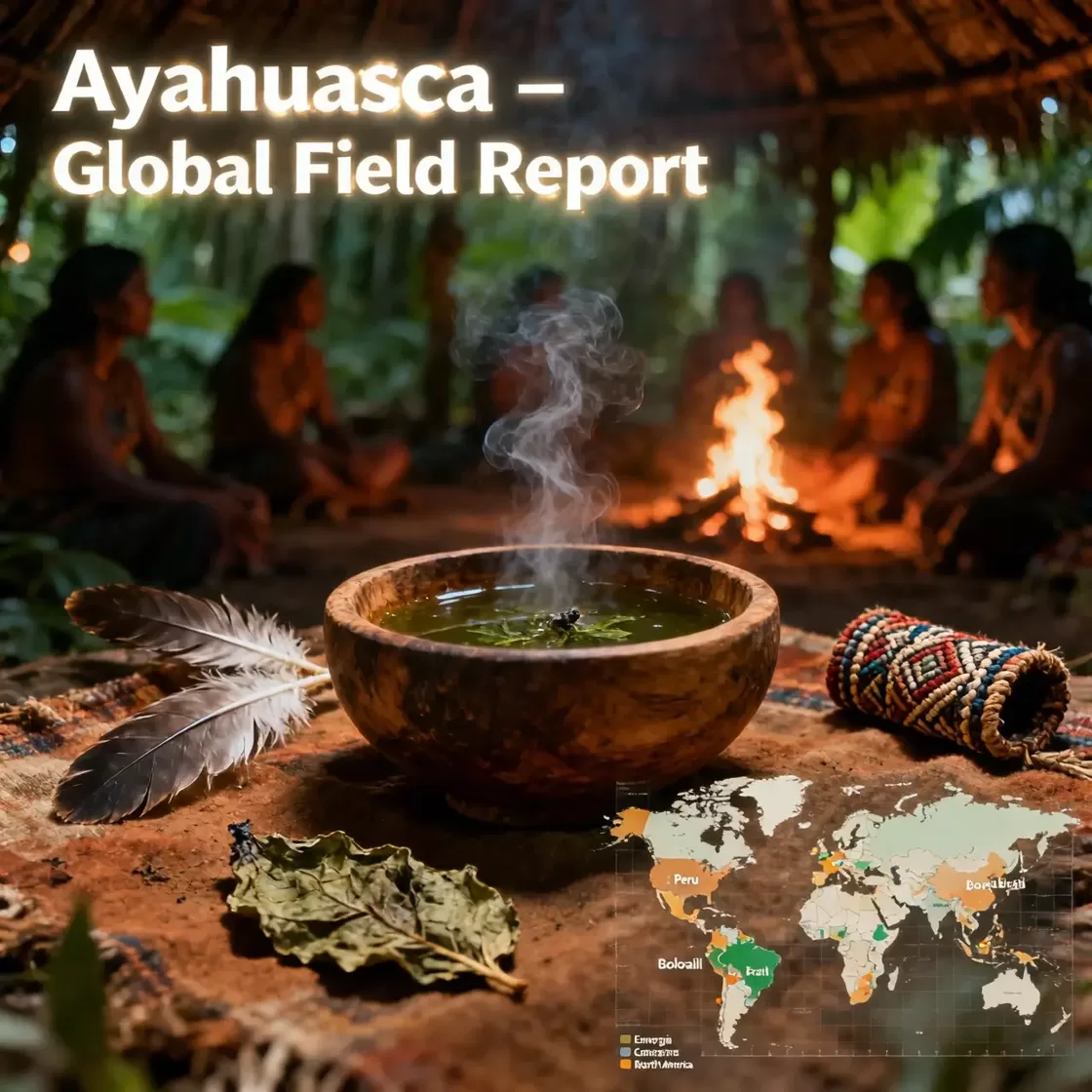
Executive summary
-
Between 2025 and early 2026, the most clearly documented changes were not “global legalization,” but governance signals: public safety enforcement actions, official travel-health warnings, and policy frictions in payments/advertising that shape how the market can operate online.
-
Peer-reviewed literature during the period strengthened two parallel points: (1) outcomes are heterogeneous and context-dependent, and (2) commercially advertised retreat settings show wide variation in safety practices.
-
Market mapping work based on publicly advertised organizations continued to show rapid geographic spread and productization (packages, concierge positioning, multi-country offerings), while investigative journalism documented both scaling ambitions and reputational crises.
-
The legal picture remained structurally asymmetric: in many jurisdictions the DMT molecule is controlled, while plant materials and ceremonial claims move through gray zones that differ sharply by country and by enforcement posture.
-
Retreat Centers in Peru’s Amazon - Prices, Demand, Supply, and a Due-Diligence Framework
-
The Ayahuasca Industry Under Siege
Scope and method
What this report covers
This report summarizes verifiable, high-salience events and publications related to ayahuasca from 1 January 2025 to 12 February 2026. “Ayahuasca” here includes the brew and closely linked terms used internationally (yagé, hoasca, Daime contexts, “pharmahuasca” discussions when explicitly tied to ayahuasca practice).
Source hierarchy (strict)
-
Official documents and regulator outputs (public health warnings, prohibition orders, statutes, official travel advisories)
-
Peer-reviewed research (journals)
-
High-reputation journalism (major outlets)
-
Platform policies (ads, payments, commerce) as primary texts
Social media is treated only as an indicator; it is not used to assert factual events.
Languages and retrieval logic
The underlying OSINT workflow prioritizes multilingual retrieval (English/Spanish/Portuguese/German/French/Italian/Russian) and then consolidation. Because a blog post must stay readable, I include only items that can be anchored to stable primary texts or peer-reviewed publications.
What “changed” means in this report
A “change” is counted when at least one of the following occurs within the time window:
-
A new peer-reviewed study or reanalysis with nontrivial implications
-
A new or newly effective official action (warning, prohibition order, statute)
-
A documented enforcement action (raid/arrests/seizures) reported by major outlets
-
A material platform/policy constraint that affects distribution or monetization
Limitations (important for citation hygiene)
This is not a census of all incidents or all publications worldwide. It is a structured synthesis of the most documentable, high-impact signals within the period, designed to be citation-clean.
The global field in 2025–early 2026: what actually moved
Safety governance became more visible than “legal reform”
A consistent pattern across regions is that formal regulation of ayahuasca practice remains uneven, but safety governance intensified through indirect instruments: travel-health warnings, non-medical practitioner oversight, and criminal enforcement tied to controlled substances or consumer protection.
This is anthropologically important: the field is being shaped less by a single “ayahuasca law” and more by the boundary work of institutions that do not define themselves as “psychedelic regulators” (health complaint bodies, travel advisory systems, payment platforms, ad networks).
Commercial scaling narratives met reputational scrutiny
Investigative reporting in 2025 described large-scale, multi-country retreat businesses presenting themselves as professionalized wellness providers while facing allegations that raised questions about screening, ethics, and accountability. In practice, such stories function as “market signals”: they can change consumer expectations, insurer risk models, and platform enforcement even without new legislation.
Europe showed the clearest “gray-zone market” story
By early February 2026, travel journalism explicitly framed Spain as a European node where ayahuasca retreats expanded in a legal gray zone, attracting travelers who previously associated ayahuasca with Amazonian geographies. This is not simply tourism: it is a redistribution of ritual supply chains, labor, and cultural authority into hotel and boutique retreat infrastructures.
Science and medicine 2025–early 2026: what the literature added
Research map: key peer-reviewed contributions in the period
1) A market-facing “landscape” baseline for retreat organizations (PLOS ONE, 2025)
A peer-reviewed landscape analysis catalogued publicly advertised psychedelic retreat organizations and documented how retreat offerings are packaged and geographically distributed. While not ayahuasca-only, the dataset is highly relevant because ayahuasca appeared as the most common offering among the mapped organizations, and because the paper operationalizes what “the commercial retreat market” looks like when measured through publicly visible offerings.
Why it matters:
-
It provides a reproducible method for tracking retreat market growth without relying on anecdotal “industry size” numbers.
-
It shows how ayahuasca sits inside a multi-substance retreat economy, which affects safety standards (screening, contraindications) and regulatory exposure (different legal statuses across substances).
Limitations:
-
Publicly advertised organizations are not the entire market; underground and invitation-only networks are undercounted.
-
“Offering listed” is not the same as “clients served” or “outcomes achieved.”
Evidence level:
-
Descriptive, medium-to-high reliability for what is publicly advertised; not a clinical evidence source.
2) Safety practices in publicly advertised retreats (JAMA Network Open, 2026)
A 2026 study in JAMA Network Open reported safety practices among publicly advertised psychedelic retreat organizations. Its value is not in claiming that retreats are “safe” or “unsafe” in general, but in documenting variability: what is screened, what is disclosed, and what emergency planning is visible.
Why it matters:
-
It supports a governance argument: even without new laws, the field can be shaped by measurable safety practice expectations.
-
It offers a structured checklist logic that journalists, consumers, and regulators can use.
Limitations:
-
Based on publicly available information and/or reporting; may not capture internal protocols.
-
“Stated policy” may differ from “practice on the ground.”
Evidence level:
-
High for the narrow question “what practices are reported/disclosed”; not a clinical trial.
3) Reanalysis of adverse mental states and mediating roles (PLOS Mental Health, 2025)
A 2025 PLOS Mental Health reanalysis of the Global Ayahuasca Survey (GAS) explored how adverse mental states relate to mental health outcomes and mediating variables. The core contribution is conceptual discipline: “adverse” is not treated as a single category, and outcomes are considered in relation to context and individual history.
Why it matters:
-
It moves the discourse away from binary narratives (“healing medicine” versus “dangerous drug”) toward more falsifiable claims about heterogeneity and mediators.
-
It supports the practical conclusion that screening, setting, and follow-up are not ethical “extras” but central variables.
Limitations:
-
Survey data is self-reported and observational.
-
Selection bias is likely (who answers such surveys, and after which experiences).
Evidence level:
-
Medium: informative for associations and hypothesis refinement, not causal proof.
4) Biological and pharmacological lines: Banisteriopsis caapi and harmala-related research (Frontiers, 2026)
A 2026 Frontiers in Pharmacology paper examined anti-inflammatory effects of Banisteriopsis caapi and β-carbolines in a cellular model relevant to neuroinflammation. This does not demonstrate clinical efficacy in humans, but it provides mechanistic plausibility that often appears in public narratives about “healing.”
Why it matters:
-
It helps separate mechanistic plausibility from clinical evidence.
-
It clarifies what can and cannot be claimed without trials.
Limitations:
-
In vitro/cellular model; translation to human outcomes is uncertain.
-
Dose, preparation, and real-world mixtures are not equivalent to controlled lab conditions.
Evidence level:
-
Low-to-medium for clinical claims; high for the narrow mechanistic observation.
5) Conservation science: psychedelic species of conservation concern (Frontiers in Conservation Science, 2025)
A 2025 Frontiers in Conservation Science review discussed “psychedelic species” that may face conservation pressures, including culturally and economically significant plants. The relevance to ayahuasca is direct: global demand can alter harvesting patterns, supply chains, and ecological pressure points.
Why it matters:
-
It reframes ayahuasca not only as a health/ritual commodity but as part of a biodiversity and governance problem.
-
It suggests that the “market story” includes ecological externalities that are often invisible in wellness marketing.
Limitations:
-
Conservation risk is complex; the paper addresses broad patterns and concern signals rather than precise population counts in every region.
Evidence level:
-
Medium: strong for risk framing; specific local status requires local ecological data.
What is well supported vs. what remains uncertain
What is well supported (within the period’s evidence)
-
Outcomes and after-effects are heterogeneous; context and individual history matter, and “adverse” experiences are not equivalent to “harm” but are not trivial either.
-
Publicly advertised retreats vary widely in what they disclose and how they describe safety screening and emergency planning.
-
The retreat market can be described empirically through publicly advertised offerings, and ayahuasca remains a central product within that larger market.
What remains uncertain (do not overclaim)
-
Precise incidence rates of severe adverse outcomes across the global market (no comprehensive denominator exists).
-
Causal claims that ayahuasca “treats” specific diagnoses outside controlled clinical contexts.
-
Cross-country comparability of enforcement intensity (legal texts are stable; enforcement is situational).
FAQ (Science & health) 1
Q: Does the 2025–2026 research prove that ayahuasca is “safe” or “dangerous”?
A: No. The strongest research signal in this period is variability: outcomes
and after-effects differ by person and context, and retreat safety practices
are inconsistent. The literature supports nuanced risk framing rather than a
single label.
Q: Are “adverse mental states” always a sign of harm?
A: Not always. Survey reanalysis suggests some adverse states may coexist with
later perceived benefits, but this does not remove the need to take them seriously
as risk signals—especially for vulnerable individuals.
Q: What type of evidence is missing most?
A: High-quality prospective studies with clear denominators, standardized follow-up,
and transparent adverse-event reporting across real-world contexts.
Regulation and law: the durable asymmetry
The structural baseline: DMT is controlled in many jurisdictions
In much of Europe, the controlled-substance regime focuses on DMT as a molecule. This creates a practical asymmetry: ayahuasca as a botanical preparation sits at the intersection of controlled substances law, customs enforcement, and judicial interpretation of intent and preparation.
Examples of primary legal texts frequently cited in Europe:
-
Germany’s BtMG schedules (Anlage I) list non-marketable narcotics and are used as the backbone for DMT control.
-
The UK’s Misuse of Drugs Regulations list DMT under Schedule 1 controlled drugs.
-
France maintains a list of substances classified as narcotics that includes DMT.
These are not “ayahuasca legalization” instruments; they are frameworks that shape enforcement risk and the feasibility of open commercialization.
Brazil: a different type of legal signal (Acre, 2025)
A notable 2025 signal in Brazil was not a national legalization shift but a subnational statute in Acre that addresses collection and transport of Banisteriopsis caapi and Psychotria viridis under a simplified regime. This points to governance of supply chains and plant movement—an issue that grows in importance as market demand expands.
Anthropological reading:
When the state begins to legislate plant logistics rather than only “drug control,”
it implicitly acknowledges an existing social reality: plants move, economic
actors exist, and enforcement needs administrative categories.
Peru: official warnings as a governance instrument (2025)
Official U.S. government communications in 2025 warned travelers in Peru against using ayahuasca/kambo, citing serious illness, deaths, and risks of assault/robbery while under influence. These warnings are not Peruvian law, but they shape the international field by affecting consumer behavior, insurance decisions, and reputational risk for retreat providers operating in Peru’s loosely regulated environment.
Europe: enforcement posture can matter as much as statutes
Spain illustrates how a gray zone can support growth while also remaining vulnerable to raids and seizures. In 2025, major reporting described Spanish police raids on “spiritual retreats,” with seizures including ayahuasca and other psychoactive materials. This demonstrates that “gray zone” does not equal “stable permission”; it can mean “market growth under intermittent enforcement.”
FAQ (Law & regulation) 2
Q: Is ayahuasca “legal in Europe”?
A: There is no single European answer. Many countries control DMT explicitly.
How that maps onto ayahuasca as a plant brew depends on national law, judicial
interpretation, and enforcement practice.
Q: Does a travel article describing a “legal loophole” mean it is safe to operate
commercially?
A: No. “Loophole” language is descriptive, not a legal guarantee. Enforcement
actions can still occur under controlled substances, consumer protection, or
public health frameworks.
Q: Why do laws focus on molecules (DMT) rather than plants?
A: Modern drug control systems historically classify substances chemically.
Botanical mixtures create interpretive and enforcement challenges, which is why
practice often lives in gray zones.
Industry and market: what we can say without inventing numbers
What the best public datasets can show
The strongest market descriptions in this period come from peer-reviewed mapping of publicly advertised retreat organizations. This approach avoids the common failure mode of “market size claims” without methods.
Key market-relevant observations supported by mapping studies:
-
Ayahuasca remains among the most frequently advertised offerings in the international retreat market.
-
Retreat products are commonly sold as packages (duration + lodging + facilitation + multiple sessions).
-
Geographic spread includes both “origin regions” (Amazon basin) and “consumer regions” (Europe and elsewhere), indicating a decoupling of practice from original geography.
Productization and the “hotelization” of ceremony
The 2026 Spain travel journalism story is useful not because it is a market report with revenue numbers, but because it documents a format shift: ceremonies hosted in boutique hotels and European retreat infrastructures. Anthropologically, this is a transformation of ritual ecology:
-
Space: from forest and maloca to hotel and wellness facilities
-
Authority: from lineage-based roles to hybrid “facilitator” branding
-
Risk management: from community norms to consumer expectations and liability narratives
Corporate scaling and reputational friction
The 2025 investigative story about a multinational retreat business illustrates the tension between scaling (standardization, marketing, cross-border operations) and the difficulty of accountability in transnational ceremonial markets. Even when allegations are contested, the existence of such reporting becomes part of the field: it shapes how journalists frame the sector, how platforms evaluate it, and how consumers demand evidence of safeguards.
Why “pricing” and “growth numbers” are hard to do honestly
Without transparent audited data, any claim like “the ayahuasca market is worth X” tends to be speculative. The more defensible approach is:
-
Count publicly advertised providers and locations (a proxy for supply)
-
Track format shifts (hotel retreats, concierge offerings, short packages)
-
Track governance signals (warnings, raids, prohibition orders)
This combination is slower but citation-clean.
Incidents, safety, and ethics: the documented fault lines
Regulatory enforcement on safety grounds (Australia, 2025)
A clear governance signal in 2025 is the Australian Health Care Complaints Commission prohibition order against a non-registered practitioner described as facilitating ayahuasca ceremonies, explicitly prohibiting provision of ceremonies/services where ayahuasca/DMT/kambo is present, administered, or promoted. The decision text describes concerns including minimal screening, lack of records, unclear sober supervision, and emergency planning failures.
Why it matters:
-
It demonstrates a model of intervention that does not require “ayahuasca legalization debate” to act.
-
It treats ceremonies as a form of health service when marketed as such, making consumer protection standards relevant.
Police raids and seizures (Spain, 2025)
Major reporting in 2025 described raids on spiritual retreats in Spain with seizures including ayahuasca and other substances, plus allegations of cash-based revenue and inadequate conditions for handling poisoning emergencies.
Why it matters:
-
It’s a concrete example of how a gray-zone market can remain enforcement-exposed.
-
It shows that “natural origin” does not shield providers from drug law enforcement or public safety framing.
Ethics as infrastructure, not ideology
In transnational ayahuasca markets, “ethics” is often treated as branding language. A more realistic view is to treat ethics as infrastructure:
-
Screening and contraindication handling
-
Informed disclosure of risks
-
Emergency response capacity
-
Boundaries and protection against exploitation
-
Transparent sourcing and ecological responsibility
When those infrastructures fail, the result is not only harm risk; it is reputational collapse that can trigger broader enforcement and platform restriction.
FAQ (Safety & ethics) 3
Q: What is the single most reliable safety signal a reader can look for in advertised
retreats?
A: Evidence of structured screening, transparent contraindication criteria,
and explicit emergency planning (including sober supervision). Marketing language
alone is not a safety signal.
Q: Are raids proof that “most retreats are criminal”?
A: No. A raid is evidence of an enforcement action in a specific case. The correct
inference is narrower: enforcement risk exists, and some operators run models
that authorities treat as illegal or unsafe.
Q: Does “traditional” automatically mean safe?
A: No. Traditionality can encode safety knowledge, but safety still depends
on context, participant selection, preparation quality, and accountability structures.
Online environment: platform and payment constraints as hidden regulators
Ads: major networks restrict drug-related promotion
Google Ads’ “Dangerous products or services” policies prohibit promotion of recreational drugs and content that facilitates drug use. In practice this affects discoverability of retreats, education content, and any direct sales funnel that platforms interpret as facilitating controlled substances.
Payments and commerce: restricted business categories
Payment processors and commerce ecosystems commonly list illegal drugs and drug-related products as prohibited or restricted categories. Even when a provider frames itself as “wellness” or “spiritual,” the presence of controlled substances in the offering can trigger account termination or refusal of service.
Anthropological implication:
Platforms and payment rails function as “private regulators.” They can reshape
markets faster than legislatures, because they control the everyday mechanics
of monetization.
What this means for the ayahuasca field (interpretive conclusions)
-
The field’s center of gravity is shifting from “Is it legal?” to “What governance can be enforced?”
-
Public safety instruments (warnings, prohibition orders, raids) are becoming the clearest documented drivers of behavior change.
-
Peer-reviewed research is converging on heterogeneity and mediators, undermining simplistic narratives used in marketing and moral panic alike.
-
Europe’s gray-zone growth is a key structural development: it changes who participates, where supply chains route, and what kinds of accountability conflicts emerge.
-
Platform/payment constraints are not secondary; they shape which actors can scale, which narratives circulate, and how visible the market becomes.
Questions that are likely to shape 2026–2027 (hypotheses, not facts)
-
Will regulators expand “health service” oversight to more non-medical psychedelic facilitation contexts?
-
Will ecological governance (plant sourcing, transport, harvesting standards) become a mainstream compliance layer as demand grows?
-
Will safety disclosure standards (screening, emergency planning) become de facto requirements for reputational survival, even without formal laws?
-
Will Europe’s gray-zone markets move toward formal licensing, or toward periodic enforcement cycles that keep the market unstable?
-
Will platform/payment policies become stricter as media investigations and enforcement actions accumulate?
Peer-reviewed research
- S1 — PLOS ONE (2025): Landscape analysis of psychedelic retreat organizations (full text)
https://journals.plos.org/plosone/article?id=10.1371/journal.pone.0313129 - S2 — JAMA Network Open (2026): Reported Safety Practices of Publicly Advertised Psychedelic Retreat Organizations
https://jamanetwork.com/journals/jamanetworkopen/fullarticle/2829322 - S3 — PLOS Mental Health (2025): Reanalysis & perspectives on adverse effects from the Global Ayahuasca Survey (GAS)
https://journals.plos.org/mentalhealth/article?id=10.1371/journal.pmen.0000134 - S4 — Frontiers in Pharmacology (2026): Anti-inflammatory effects of Banisteriopsis caapi and β-carbolines (cell model)
https://www.frontiersin.org/articles/10.3389/fphar.2026.1473593/full - S5 — Frontiers in Conservation Science (2025): Psychedelic species as conservation concerns (review)
https://www.frontiersin.org/articles/10.3389/fcosc.2025.1569528/full
Official / legal / regulator documents
- S6 — U.S. Embassy in Peru (2025-01-23): Health Alert: Do Not Use Ayahuasca/Kambo
https://pe.usembassy.gov/health-alert-do-not-use-ayahuasca-kambo/ - S7 — U.S. Department of State (2025-05-16): Peru Travel Advisory (Ayahuasca and Kambo section)
https://travel.state.gov/content/travel/en/traveladvisories/traveladvisories/peru-travel-advisory.html - S8 — NSW Health Care Complaints Commission (updated 2025-09-26): Permanent Prohibition Order — “Counsellor who facilitates ayahuasca ceremonies”
https://www.hccc.nsw.gov.au/decisions-orders/prohibition-orders/soulore-solaris-counsellor-who-facilitates-ayahuasca-ceremonies - S9 — Germany (federal law portal): BtMG Anlage I (schedule; includes DMT context via controlled substances framework)
https://www.gesetze-im-internet.de/btmg_1981/anlage_i.html - S10 — United Kingdom: Misuse of Drugs Regulations 2001 — Schedule 1 (includes Dimethyltryptamine)
https://www.legislation.gov.uk/uksi/2001/3998/schedule/1/made - S11 — France (Legifrance): Arrêté du 22 février 1990 — liste des substances classées comme stupéfiants (includes DMT)
https://www.legifrance.gouv.fr/loda/id/JORFTEXT000000533085 - S12 — Brazil, Acre State Legislative Assembly (2025-09): Lei Ordinária Nº 4645 (PDF) — collection/transport of Banisteriopsis caapi & Psychotria viridis
https://app.al.ac.leg.br/legisla-e/legislacao/visualizar/9628/pdf
Major journalism (documented enforcement / market narratives)
- S13 — The Guardian (2025-08-11): Spain raids/seizures linked to spiritual retreats (ayahuasca referenced)
https://www.theguardian.com/world/2025/aug/11/ayahuasca-toad-poison-seized-spiritual-retreats-spain - S14 — Euronews Travel (2026-02-07): “Ayahuasca retreats are booming in Spain…” (legal gray-zone framing)
https://www.euronews.com/travel/2026/02/07/ayahuasca-retreats-are-booming-in-spain-one-of-the-only-european-countries-with-a-legal-lo
Platform / payments / commerce policies (primary texts)
- S15 — Google Ads policy help: Dangerous products or services
https://support.google.com/adspolicy/answer/6014299?hl=en - S16 — Google Ads policy help: Recreational drugs
https://support.google.com/adspolicy/answer/16489299?hl=en - S17 — Stripe: Prohibited and Restricted Businesses
https://stripe.com/legal/restricted-businesses - S18 — Shopify: Prohibited products on Shop
https://help.shopify.com/en/manual/online-sales-channels/shop/eligibility/prohibited-products - S19 — PayPal (US): Acceptable Use Policy
https://www.paypal.com/us/legalhub/paypal/acceptableuse-full