
Jungle Off-Grid Living: The Complete Guide to Building, Moving, and Living Self-Sufficiently in the Tropics
Jungle Off-Grid Living: Can You Really Live in the Jungle Full Time?
Yes, jungle off-grid living is possible, and some people do live in the jungle full time, but it only works under specific legal, climatic, logistical, financial, and personal conditions.
The fantasy version is a beautiful house hidden in dense greenery, powered by solar panels and surrounded by fruit trees. The real version is tropical off-grid living as a daily system: managing water, heat, humidity, drainage, insects, supplies, access roads, repairs, health risks, legal compliance, and isolation.
That is why living in the jungle is so often misunderstood. In most real-world cases, successful long-term jungle off-grid living is not deep wilderness survival. It is life on a rural tropical property, a rainforest-edge homesite, or a remote humid-climate homestead that still depends on some combination of road access, local labor, fuel, medical care, mobile coverage, satellite internet, nearby towns, and legally usable land.
This distinction matters because off-grid living in the tropics usually fails for predictable reasons: poor land selection, weak drainage, the wrong house design for a rainforest climate, unclear permits, unreliable water systems, undersized solar power, unrealistic budgets, and a maintenance burden that proves far heavier than expected.
Anyone researching how to build a house in the jungle, buy remote tropical land, or create a self-sufficient life in the tropics needs to understand that the workable version is not fantasy. It is a complete system.
Featured article
How much does it cost to live in the Amazon rainforest?
A practical cost breakdown for living in the Peruvian Amazon, including land prices, housing, monthly expenses, infrastructure, internet, and realistic startup costs.
Read the full Amazon cost of living guideBest Countries to Live in the Jungle (2025–2026): Peru, Colombia, Ecuador, Costa Rica, Panama, Bali & More — Honest Comparison
What “jungle off-grid living” actually means
Jungle off-grid living usually means long-term residence on rural or remote tropical land where the home is not fully served by conventional public utilities and where daily life depends on self-managed systems.
That overlaps with several related ideas:
- Off-grid living: generating or managing your own essentials instead of relying fully on public utilities.
- Tropical remote living: living far from dense urban infrastructure in a hot, humid, high-rainfall environment.
- Rainforest living: living in or near humid forest ecosystems where moisture, biological growth, and environmental constraints shape everything.
- Self-sufficient living: producing some share of your water, food, energy, or waste handling on site.
- Homesteading: building a place-based life with land use, growing, maintenance, and practical resilience.
- Relocation: treating the site as a full-time home, not a short retreat.
In practice, the realistic model is usually a tropical off-grid property with partial self-sufficiency, not complete independence. Even strong setups still depend on outside supply chains for tools, medicine, replacement parts, fuel, building materials, and professional services.
Fantasy vs Real Jungle Off-Grid Living
| Fantasy version | Real long-term version |
|---|---|
| Total freedom from systems | Continuous management of systems |
| Dense forest equals privacy and simplicity | Dense forest often means harder access, more moisture, more pests, and more maintenance |
| Buying land means you can build anything | Land rights, zoning, environmental rules, sanitation approval, and legal access can all limit what you can do |
| Solar solves electricity | Solar needs storage, load planning, maintenance, and often backup for extended cloudy periods |
| Rainwater solves water | Water still needs collection design, storage, treatment, and ongoing safe-management checks |
| Nature keeps the house cool | Hot-humid climates punish poor ventilation, weak shading, and moisture-trapping construction |
| Isolation feels peaceful forever | Isolation changes work, education, healthcare, repairs, social life, and emergency response |
| Cheap land equals cheap living | Cheap land can hide access, drainage, permitting, and build-cost problems |
Can you really live in the jungle full time?
Yes, but not casually.
It can work when five conditions are in place: secure land rights, legal ability to build and reside there, climate-appropriate construction, durable core infrastructure, and a household that accepts ongoing maintenance and limited convenience.
It usually fails when people treat the site as a mood instead of an operating environment.
The common failure pattern looks like this: someone buys attractive cheap land, underestimates water and drainage, builds with the wrong materials or the wrong floor elevation, oversimplifies solar and sanitation, learns too late that road access degrades in the wet season, and then discovers that routine life — groceries, school, healthcare, repairs, waste handling, deliveries, paperwork, and internet reliability — is harder than expected.
Jungle off-grid living is therefore realistic for disciplined households with capital, patience, local knowledge, and tolerance for maintenance. It is not realistic for people who want a low-effort retreat that somehow functions as a permanent residence.
Who this lifestyle is for — and who it is not for
Usually a better fit for
Practical solo residents
A capable solo person can run a small system more easily than a larger household,
especially if expectations are modest and the site is not too isolated.
Couples with shared tolerance for maintenance
This lifestyle works better when both adults accept the same tradeoffs around
repairs, routines, budget discipline, and limited convenience.
Remote workers with redundancy
It can work for remote workers only when power, connectivity, and weather backup
are treated as mission-critical, not optional.
People seeking autonomy rather than cheapness
The strongest candidates want control over land use, pace of life, and self-managed
systems. They are not looking for effortless savings.
Experienced rural or off-grid households
Anyone who has already managed septic, tanks, generators, road issues, or seasonal
maintenance will adapt faster.
Usually a poor fit for
People chasing a fantasy of escape
If the main appeal is emotional distance from modern life, the day-to-day burden
often comes as a shock.
People assuming it will be cheap
Initial setup, hidden repairs, logistics, and replacements can erase the low
sticker price of raw land.
Households that need constant convenience
Long supply runs, system failures, intermittent weather problems, and maintenance
windows are part of the deal.
Families without a plan for education, healthcare, and social structure
Children make every weak point in the system more serious.
Retirees with significant medical needs
The more care, medication, or emergency dependence a person has, the less forgiving
remote tropical living becomes.
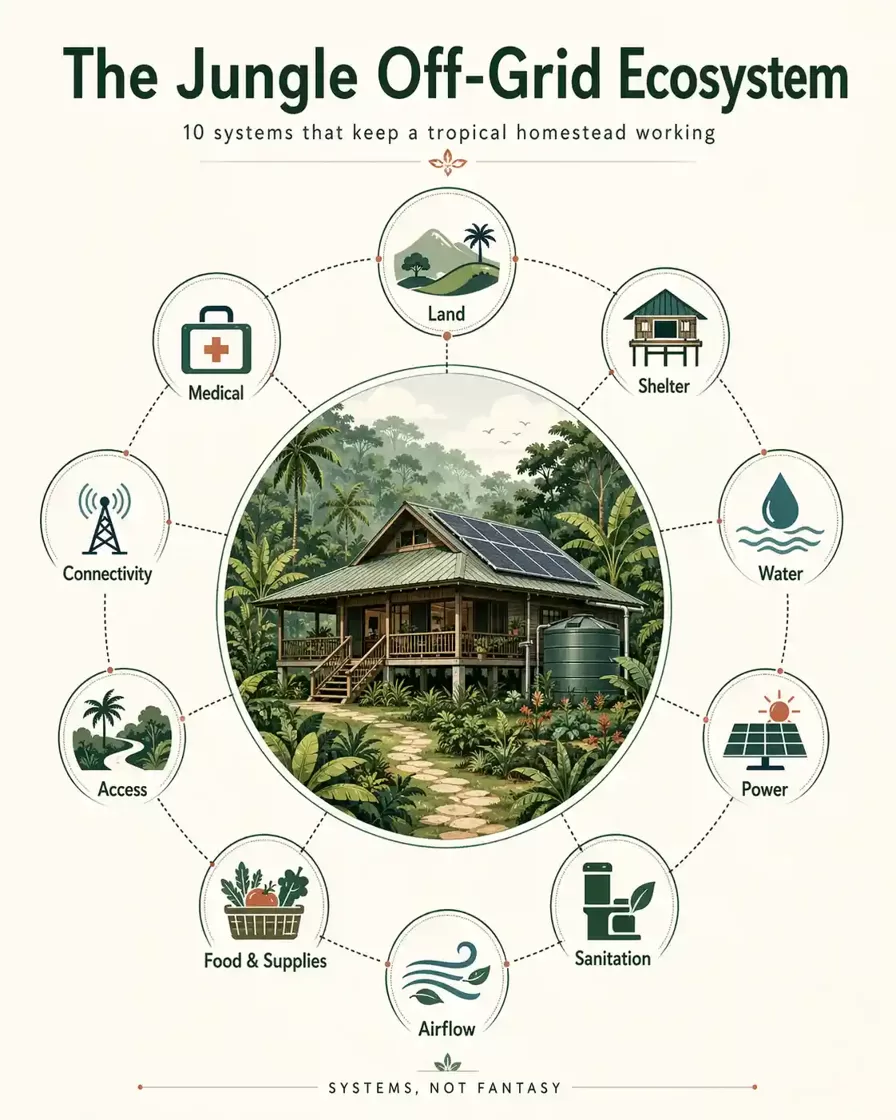
The 10 core systems that make jungle off-grid living possible
A jungle property is not a house first. It is a stack of systems. If the systems are weak, the lifestyle is weak.
1. Legal land access
The first system is legal, not physical.
You need more than a seller and a plot. You need to know who legally owns the land, whether boundaries are clear, whether there is recorded access, what land-use rules apply, whether any protected-area or watershed restrictions exist, whether subdivision rules matter, and whether residential use is actually allowed. Modern building-regulatory frameworks commonly include land-use planning, zoning, building regulation, fire regulation, and enforcement; ownership alone does not answer any of those questions.
2. Shelter and building design
In hot, humid climates, shelter is mainly about moisture control, airflow, rain management, shading, and maintainability. Cross-ventilation, orientation, passive ventilation strategies, and protection from solar gain matter because thermal comfort in tropical climates depends heavily on air movement and climate-responsive design.
3. Water sourcing and storage
A viable site needs dependable water, not just seasonal water. That may mean rain capture, a well, a spring, trucked water, or a hybrid system. WHO notes that safe and readily available water is fundamental to public health, and small supplies need ongoing inspection and management, not just initial installation.
4. Power generation and storage
Tropical off-grid properties often rely on solar, but solar alone is not the full answer. Power planning must include storage, load discipline, surge handling, protection from humidity and heat, and sometimes generator backup for extended low-production periods. The U.S. Department of Energy notes that solar production can be low after sunset or on cloudy days, and NREL’s resilience guidance explicitly pairs storage with backup generation for sustaining critical loads.
5. Sanitation and waste
Waste systems are not optional because the site is remote. They are more important because it is remote. WHO states that improved sanitation has major health benefits, and EPA guidance on onsite wastewater systems stresses design, construction, operation, maintenance, and local regulation. In real terms, this means your toilet decision is a land, water, legal, and maintenance decision all at once.
6. Ventilation and humidity control
Humidity is one of the hardest realities of tropical living. Moisture is not just discomfort; it becomes mold, rot, corrosion, swollen doors, damaged finishes, ruined fabrics, insect pressure, and respiratory problems. EPA guidance recommends keeping indoor relative humidity below 60%, ideally around 30% to 50% where possible, and preventing wet foundations through drainage and grading.
7. Food and supply logistics
Even a productive jungle homestead rarely produces everything. Most households still need regular supply chains for staples, tools, fuel, medicine, spare parts, animal feed, packaging, and repairs. The question is not whether you can grow food. The question is how much of your weekly life still depends on outside resupply.
8. Transport and site access
A site that looks reachable in the dry season may become slow, costly, or unsafe in heavy rain. NOAA warns that flash floods can develop rapidly when rainfall exceeds what ground can absorb, and heavy rainfall is also a major landslide trigger on slopes. In tropical terrain, access is part of the life-support system.
9. Communication and internet
A remote property that cannot communicate reliably is not just inconvenient. It is exposed. You need some combination of mobile signal, antenna improvement, fixed wireless where available, or satellite internet, plus backup power for routers and devices.
10. Medical access and emergency planning
Tropical rural living raises the value of time-to-care. Mosquito-borne disease, injury, infection, heat stress, and storm-related access problems all become harder when the clinic is far away. WHO states that malaria is mostly found in tropical countries and that dengue is more common in tropical and subtropical climates; both can become serious, especially when diagnosis and treatment are delayed.
Building a house in the jungle
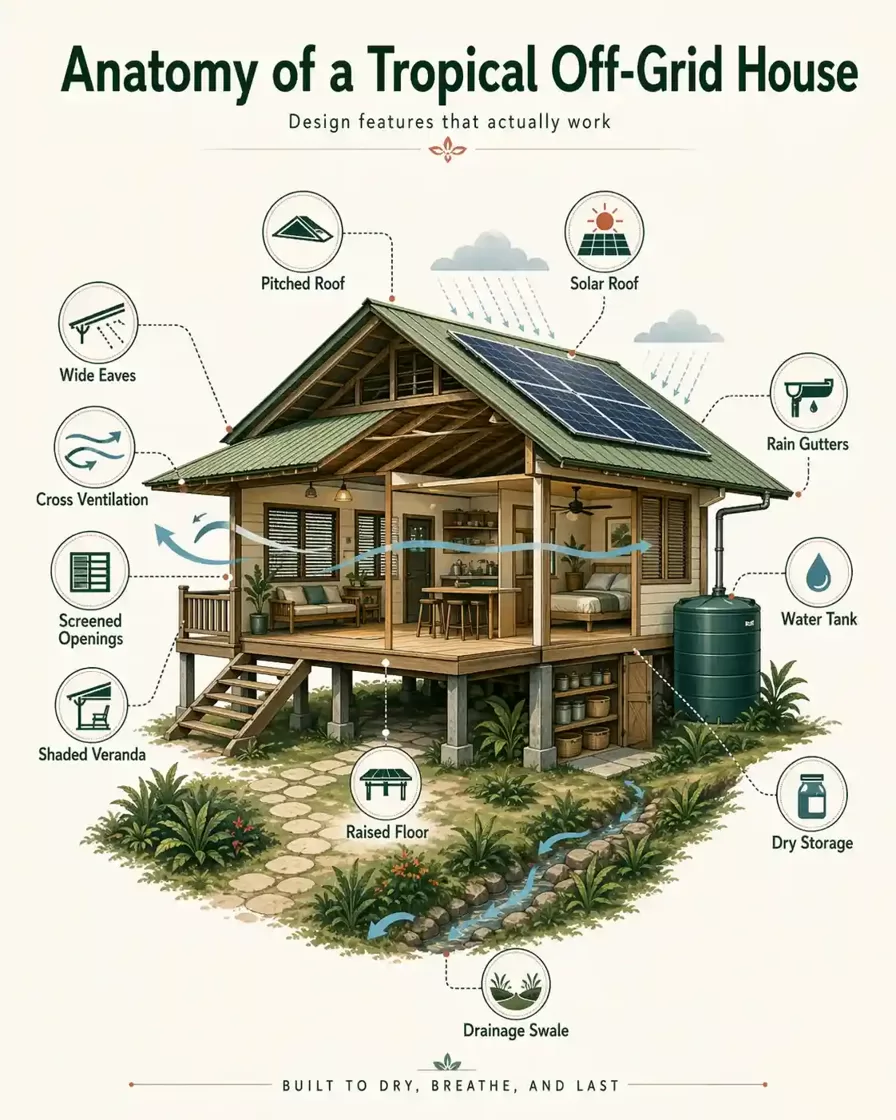
Building in the jungle is not standard rural construction with more plants around it. The climate changes the logic of the building.
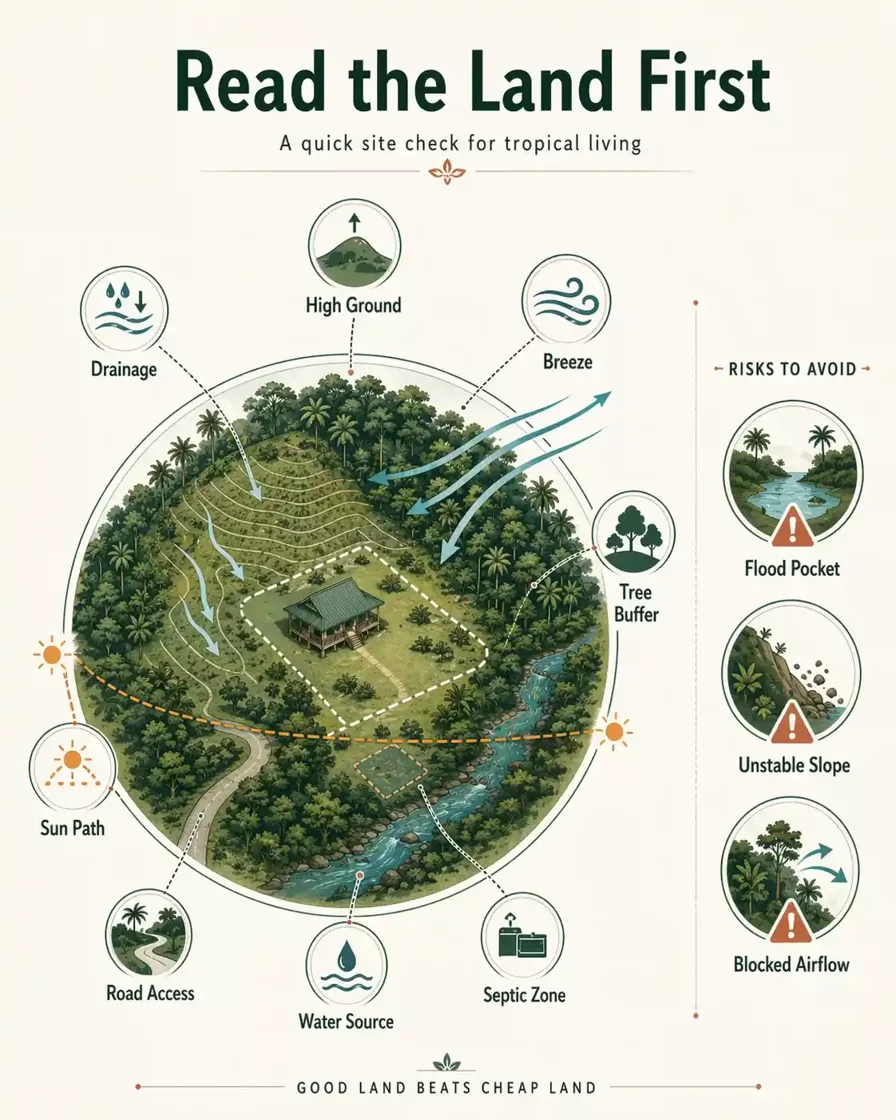
Start with site selection, not floor plan
The best tropical house design cannot rescue a bad site. Before thinking about layout, look at:
- natural drainage paths
- flood patterns
- slope stability
- prevailing wind
- solar exposure
- wet-season access
- soil behavior
- trees that threaten roof or foundation
- distance from water sources and sanitation fields
- room for utility separation and maintenance access
Drainage is not a side issue
In wet tropical conditions, drainage is one of the main determinants of durability. Water that sits under, around, or against the building becomes a structural and health problem. EPA and related federal building guidance stress sloping grades away from foundations, keeping foundations from staying wet, using drainage features, and managing runoff aggressively.
Elevation matters
A jungle house usually benefits from being elevated above grade, whether on piers, a raised slab, or another climate-appropriate system. Elevation can improve airflow, reduce splash-back, protect against minor flooding, make inspections easier, and create distance from damp soil and crawling pests.
Airflow is design, not decoration
Tropical comfort depends heavily on moving air. Cross-ventilation, high and low openings for stack effect, building orientation, and shaded outdoor transition spaces all matter. Climate-responsive building guidance for hot and tropical climates consistently prioritizes ventilation, air movement, and solar protection.
Roofing and overhangs do real work
Roofs in the tropics are rain-management systems first. They need to shed water fast, protect walls and openings, and work with collection systems where rainwater harvesting is planned. In heavy-rain locations, federal building guidance highlights roof forms, overhangs, gutters, diverters, and properly directed runoff as part of water management.
Moisture protection must be built in from the start
Materials that trap moisture or fail to dry quickly tend to age badly in hot-humid sites. The question is not only whether a material is strong or cheap. It is whether it dries, resists rot, tolerates insects, and can be maintained locally.
Pest pressure is part of the design brief
Screens, sealed penetrations, protected storage, clean drainage, inspection access, and thoughtful landscaping matter. Jungle pests are not a one-time problem; they are a permanent operating condition.
Local vs imported materials
Imported materials can look attractive on paper and fail in practice because replacements, repairs, and skilled labor are unavailable. Local materials can perform well when they are understood locally and detailed properly. The right answer is often a hybrid: locally serviceable structure with carefully chosen imported components only where there is clear value.
Temporary shelter vs permanent structure
Many people should start with a small, durable, serviceable base rather than trying to build the final house immediately. A modest first structure lets you learn the wind, rainfall, access problems, storage needs, and real maintenance pattern of the land.
Land, permits, legal constraints, and what people miss
Remote tropical land is often sold as if ownership answers every question. It does not.
Owning land vs building legally vs living full time
| Situation | What it means | What it does not guarantee |
|---|---|---|
| You own the land | You have some recognized property interest | You can build, subdivide, clear, drill, install septic, run a business, or reside full time |
| You can build legally | The jurisdiction allows a compliant structure on that site | You can ignore environmental rules, sanitation approvals, access requirements, or occupancy rules |
| You can live there full time | Residential use is allowed and practically workable | The site is safe, healthy, insurable, financially smart, or suitable for children or aging residents |
What people miss most often
Ownership is not the same as buildability
Land-use planning, zoning, building rules, environmental restrictions, and enforcement
all sit between purchase and construction.
Environmental constraints can override your plans
Forest-edge, watershed, protected habitat, floodplain, and slope-risk issues
can limit clearing, building footprint, access roads, and wastewater options.
Legal access matters as much as the plot itself
A land parcel with weak road rights, seasonal access, or disputed entry can
become functionally unusable.
Water and sanitation are often regulated separately
A site may support a house in theory but fail practical approval because water
sourcing, wastewater disposal, setbacks, or soil conditions do not work.
Cheap land can be deceptive
The lower the raw-land price, the more aggressively you should question access,
drainage, title clarity, utilities, environmental limitations, and hidden infrastructure
cost.
What to verify before buying remote tropical land
- Confirm legal title and boundary records.
- Confirm legal road or easement access in all seasons.
- Confirm the actual land-use designation and whether residential use is allowed.
- Check for environmental, watershed, floodplain, coastal, forestry, or protected-area restrictions.
- Verify whether tree clearing, road cutting, grading, or water extraction require approvals.
- Confirm whether onsite sanitation is allowed and under what standards.
- Verify whether water rights, drilling, springs, or stream use are regulated.
- Check slope stability, flood exposure, and runoff behavior in the wet season.
- Ask where the nearest clinic, hospital, fuel, hardware, and food supply point are.
- Test mobile coverage and realistic internet options.
- Ask local builders what fails fastest on similar sites.
- Verify foreign ownership, entity ownership, residency, and inheritance rules for the exact country and region if you are not a citizen.
Cost of jungle off-grid living
There is no honest universal number for the cost of jungle off-grid living. It varies enormously by country, remoteness, land quality, terrain, labor market, material access, legal process, and how comfortable or resilient you want the setup to be.
What matters more than headline price is cost structure.
Main cost categories
Land
Raw price, survey work, legal review, access rights, title cleanup, and transaction
costs.
Legal and setup
Permits, consultants, environmental review where required, road or driveway
work, grading, drainage, and site preparation.
House construction
Structure, roof, raised foundation, shading, screened openings, storage, service
rooms, moisture detailing, and labor.
Water system
Catchment, storage tanks, filtration, pumps, treatment, pipe runs, pressure
management, and backup supply.
Solar and batteries
Panels, racking, charge control, inverters, batteries, protection hardware,
monitoring, and backup generation.
Sanitation
Septic or other approved system, trenching, venting, inspection, and ongoing
maintenance.
Transport and access
Road improvement, vehicle wear, wet-season contingencies, bridging, retaining,
or delivery surcharges.
Maintenance and repairs
Roofing, pumps, filters, batteries, sealants, insect control, corrosion, mold
mitigation, wood treatment, tools, and spare parts.
Connectivity
Internet equipment, service plans, signal improvement, and backup power for
communication devices.
Recurring living costs
Food, fuel, school transport, medical travel, insurance where available, hired
labor, and replacement cycles.
Hidden costs people miss
- bringing materials to difficult sites
- redoing drainage after the first rainy season
- replacing components damaged by humidity
- rebuilding access after washouts
- oversizing storage after discovering solar shortfalls
- pest-proofing food and equipment
- maintaining backup transport
- paying for professional fixes after DIY systems fail
- living costs during build delays
- the cost of “small” mistakes repeating for years
Minimal Setup vs Durable Long-Term Setup vs Family-Capable Setup
| Level | What it usually includes | Main weakness |
|---|---|---|
| Minimal setup | Basic shelter, small solar, simple water storage, basic sanitation, limited access | High fragility, little redundancy, hard to scale, stressful in bad weather |
| Durable long-term setup | Climate-adapted structure, proper drainage, serious water storage and treatment, robust solar with storage, legal sanitation, spare parts | Higher upfront cost and more planning |
| Family-capable setup | Durable systems plus reliable access, communication redundancy, stronger medical planning, larger storage, safer layout, schooling strategy, better comfort control | Requires much more capital, discipline, and long-term commitment |
Safety, climate, health, and comfort
The jungle does not usually defeat people through dramatic survival events. It wears them down through climate, biology, and logistics.
Humidity and mold
Hot-humid living is fundamentally a moisture problem. EPA guidance recommends keeping indoor humidity below 60%, ideally 30% to 50% where possible, because dampness and poor moisture control support mold growth. In tropical conditions, the challenge is often not achieving perfect humidity but designing the building so it can dry, breathe, and be cleaned continuously.
Mosquitoes and vector-borne disease
In many tropical settings, mosquitoes are a quality-of-life issue and a health issue. WHO states that vector-borne diseases account for more than 17% of infectious diseases globally, with over 700,000 deaths each year, and that dengue is more common in tropical and subtropical climates while malaria is mostly found in tropical countries. That does not mean every jungle property carries the same risk, but it does mean location-specific disease ecology matters before you move.
Heat stress and poor sleep
Heat, stagnant air, and high night humidity can degrade sleep, work output, and decision quality. Good tropical design is partly about comfort, but it is also about protecting physical and mental functioning.
Heavy rain, flooding, and slope failure
NOAA warns that flash floods can rise rapidly when heavy rainfall exceeds what ground can absorb, and USGS notes that prolonged or heavy rainfall is a major trigger of damaging landslides. Tropical land with poor drainage or steep unstable slopes can become dangerous quickly in extreme rain.
Isolation and delayed response
Remote living changes the consequences of ordinary problems. A fever, deep cut, vehicle failure, blocked road, or supply shortage becomes more serious when help is far away.
Wildlife and pests
Wildlife risk is often less about dramatic animal encounters and more about constant low-grade exposure: bites, stings, contamination, nesting, chewing, and crop loss. Most households find that insects and rodents are more persistent than larger animals.
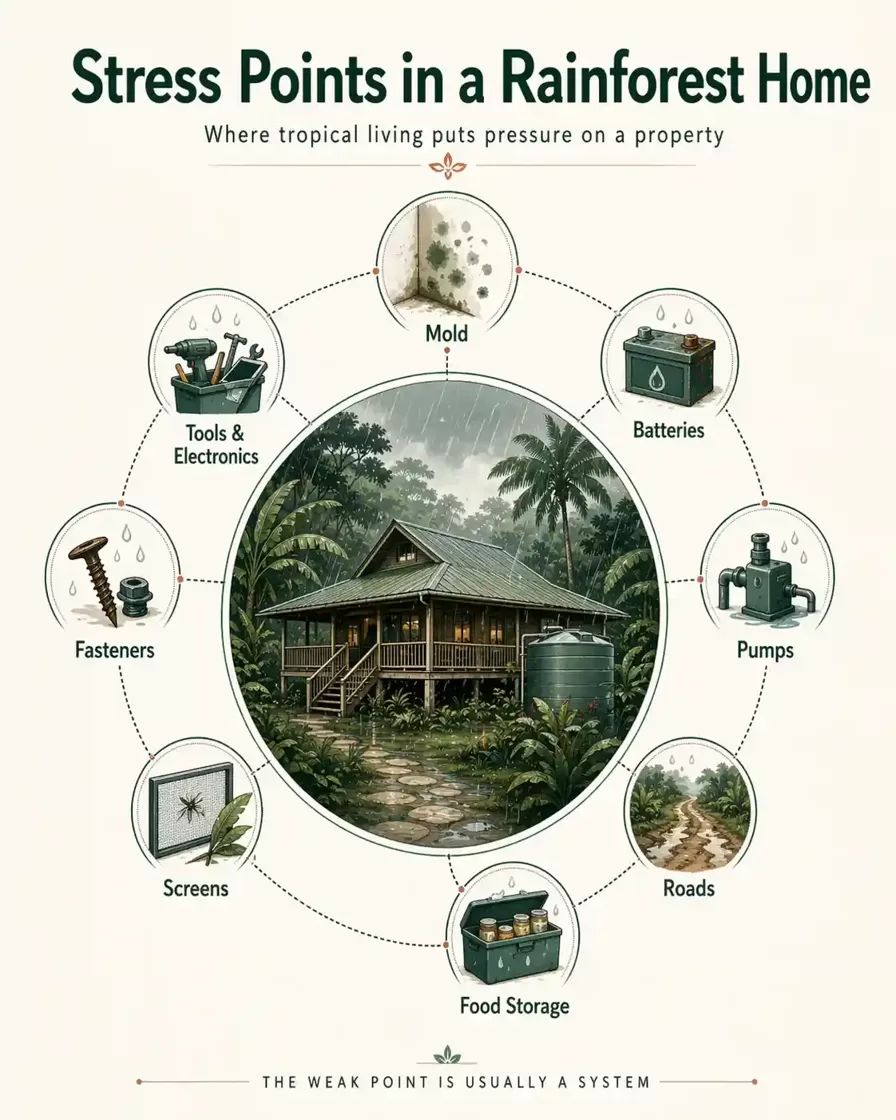
What most people underestimate about jungle off-grid living
- how fast mold can take over an under-ventilated house
- how much rain changes access, storage, and repairs
- how often pumps, filters, fittings, and batteries need attention
- how tiring wet-season maintenance becomes
- how much screened, dry, organized storage matters
- how hard it is to keep tools, clothing, bedding, and electronics dry
- how difficult waste handling can be on poor soils or steep ground
- how expensive “small” transport problems become
- how quickly a weak backup plan becomes a major problem
- how much discipline full-time remote living requires
Family life, children, aging, and long-term sustainability
A couple can tolerate a lot of inconvenience that becomes unacceptable with children or aging parents.
Families with children
The main questions are not romantic. They are structural:
- Is there reliable medical access?
- What is the education plan?
- How long is the wet-season trip to town?
- Is there safe play space away from water, roads, tools, and slope edges?
- Can the house stay dry, cool enough, and bug-controlled?
- Is there enough routine and social contact for healthy development?
Family-capable jungle living is therefore much more than “bigger house plus garden.” It means stronger infrastructure, stronger routines, and stronger access.
Retirees and older residents
Retirement in a tropical off-grid setting can work for healthy people with moderate needs and strong support systems. It becomes much less suitable when medication, mobility limits, recurrent medical care, or emergency dependence increase.
Daily burden and sustainability
The long-term question is not “Can I do this for six intense months?” It is “Can I still do this after five wet seasons, a failed pump, a road washout, a battery replacement cycle, and a period of illness?” That is the real test.
Best regions or country types for this lifestyle
There is no honest universal ranking of the “best countries” for jungle off-grid living without country-by-country legal and market verification.
What you can evaluate, however, is what makes a country or region more workable:
Look for these traits
Legal clarity
Clear title systems, understandable land-use rules, predictable permitting,
and enforceable access rights.
Moderate climate burden
Not all tropical areas are equally punishing. Elevation, rainfall pattern, storm
exposure, and temperature swings matter.
Usable infrastructure nearby
You do not need a city next door, but you need some practical link to healthcare,
supplies, trades, and transport.
Medical access
Distance to basic and emergency care can determine whether the lifestyle is
merely inconvenient or genuinely risky.
Security
Property crime, land disputes, conflict risk, and weak enforcement can outweigh
natural beauty very quickly.
Land availability with workable terrain
The best site is often not the densest forest but the most buildable, drainable,
legally usable piece of land near it.
Language fit
If you cannot handle local paperwork, contracts, builders, and officials, you
are taking on avoidable risk.
Residency and foreign ownership clarity
If you are relocating internationally, the property question is only half the
question. The other half is whether you can legally stay.
In practical terms, the best region is often one with humid tropical conditions but not maximum remoteness. Many households do better on a rainforest-edge site near a small service town than on isolated land that feels more dramatic.
Common myths about jungle off-grid living
Myth 1: “It’s cheap”
Raw land can be cheap. Functional living rarely is. The true cost includes access, legal review, drainage, storage, sanitation, replacement cycles, and transport.
Myth 2: “You can just buy land and build”
Not reliably. Ownership, zoning, land use, environmental restrictions, sanitation approval, and access can all constrain the project.
Myth 3: “Solar solves everything”
Solar is one system inside a larger system. Cloudy periods, night loads, storage limits, component failure, and maintenance all matter.
Myth 4: “A beautiful house is enough”
A beautiful house on a badly chosen site becomes an expensive repair project. Drainage, airflow, access, water, and sanitation matter more than appearance.
Myth 5: “You can live there like you’re on retreat forever”
Retreat living borrows heavily from outside support. Full-time living means groceries, paperwork, repairs, laundry, sickness, insects, school, weather, and waste all keep showing up.
Myth 6: “It’s just freedom and nature”
It can feel freer. But that freedom is purchased with labor, planning, maintenance, and exposure to more direct consequences.
A useful example of how remote Amazon living is adapted for privacy, logistics, and individual needs can be seen in this page about - Amazonian solo retreats in the Loreto region of Peru
Practical decision framework
If you are seriously considering this lifestyle, do not start with the house. Start with decision discipline.
Step 1: Decide what you are actually trying to buy
Are you buying:
- a retreat
- a part-time base
- a remote working home
- a family homestead
- a retirement property
- a low-cost experiment
- a long-term relocation plan
Each one has a different threshold for access, comfort, law, and budget.
Step 2: Test the climate before you commit
Spend meaningful time on site in the wet season if possible. A tropical property should never be judged only in its easiest month.
Step 3: Audit the 10 core systems
Before buying, rate the site honestly on:
- legal status
- buildability
- drainage
- water
- sanitation
- power
- access
- communication
- medical reach
- ongoing maintenance burden
Any site with multiple weak systems is not a bargain.
Step 4: Avoid doing these things too early
- buying based on scenery alone
- designing the final house before understanding the site
- clearing too much land too soon
- overspending on aesthetics before systems
- assuming local builders understand your climate goals
- trusting verbal claims about title, access, or permits
- planning total self-sufficiency from day one
- moving full time before testing supply and emergency routines
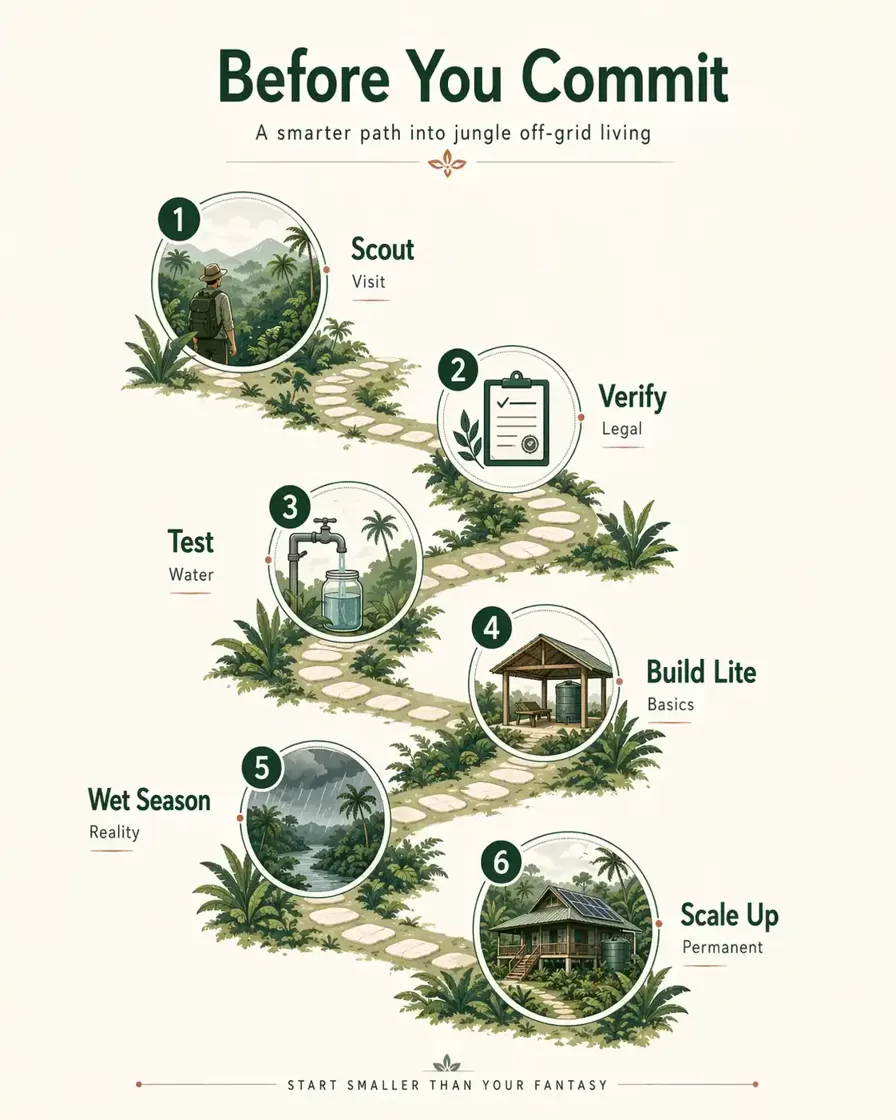
Step 5: Build in phases
A phased approach is often wiser:
- verify title and access
- test water and drainage
- create temporary dry storage and shelter
- install minimal but serious utilities
- live on the site long enough to learn it
- then build the permanent structure
That sequence is slower, but usually cheaper than redoing a beautiful mistake.
Jungle Off-Grid Living Works Only When Land, Infrastructure, Climate, Law, and Daily Life Work Together
Jungle off-grid living is not impossible, and it is not reserved for survivalists. But it only works when treated as a complete system of land, infrastructure, climate adaptation, law, money, health, and daily discipline.
The people who make it work are usually less romantic than outsiders expect. They choose buildable land over dramatic land, resilient systems over pretty shortcuts, and legal clarity over seductive low prices. That is the version of jungle living that holds up over time.
Jungle off-grid living only works within a larger relocation strategy, so this breakdown of the top South American expat destinations in 2026 is a helpful companion for weighing country-level tradeoffs before committing to a move.
FAQ
Can you really live in the jungle full time?
Yes. People can and do live full time on remote tropical properties, but it only works when the land is legally usable, the house is designed for hot-humid conditions, and water, sanitation, power, access, and emergency planning are reliable. It is much closer to system management than to wilderness fantasy.
Is jungle off-grid living legal?
Sometimes, yes. Sometimes, no. Legality depends on the exact country, region, municipality, land-use designation, environmental restrictions, sanitation rules, and access rights. Owning land does not automatically mean you can build or occupy it full time.
How much does it cost to live off-grid in the tropics?
There is no honest universal number. Costs vary by country, terrain, labor, access, climate burden, and system quality. The major categories are land, legal setup, house construction, drainage, water, solar and batteries, sanitation, transport, maintenance, repairs, and connectivity.
What kind of house works best in a tropical rainforest climate?
A good tropical off-grid house prioritizes drainage, elevation above wet ground, strong roofing, deep overhangs, cross-ventilation, passive airflow, shaded openings, and materials that tolerate moisture and can dry out. Climate-responsive design in tropical conditions emphasizes ventilation and protection from solar gain and moisture.
Is jungle living safe for families?
It can be, but only with much stronger infrastructure than many people expect. Families need reliable medical access, safer layouts, stronger water and sanitation systems, communication redundancy, and a realistic education and transport plan.
Can foreigners buy land and live there?
Sometimes, but rules vary widely by country and sometimes by restricted zones within a country. Foreign ownership, residency, inheritance, corporate ownership, and occupancy rights all need local legal verification before purchase.
What are the biggest hidden problems?
The most common hidden problems are poor access, weak drainage, mold, underbuilt power systems, water quality issues, bad sanitation fit, unclear permits, seasonal road failure, humidity damage to materials and electronics, and the ongoing labor of maintenance.
Is it possible to work remotely from a jungle property?
Yes, but only if connectivity and power redundancy are treated as essential. You need reliable internet, backup communication, and enough stored power to support work during bad weather or system interruptions.
How do people get water and electricity?
Water usually comes from rain capture, wells, springs, trucked water, or mixed systems; safe storage and ongoing management are still necessary. Electricity often comes from solar plus batteries, sometimes supported by backup generators, because solar output drops at night and can be limited on cloudy days.
What diseases or health risks matter most?
That depends on the location, but common tropical concerns include mosquito-borne disease, unsafe water, sanitation failure, mold exposure, heat stress, and delayed emergency care. WHO notes that dengue is more common in tropical and subtropical climates and malaria is mostly found in tropical countries.
What countries are most realistic for this lifestyle?
The most realistic countries are usually those with clear property law, workable permitting, manageable climate burden, reasonable access to healthcare and supplies, understandable residency rules, and enough infrastructure nearby to support full-time life. There is no single credible ranking without country-specific verification.
Is jungle off-grid living cheaper than normal life?
Not automatically. It can reduce some recurring costs, but setup, maintenance, transport, replacements, and mistakes can make it more expensive than ordinary living. People who do best usually pursue autonomy and location fit, not the cheapest possible lifestyle.
Official Health, Safety, Water, and Infrastructure Sources for Jungle Off-Grid Living
For the water side of jungle off-grid living, the practical issue is not just finding a source, but keeping it safe over time. The World Health Organization’s overview of drinking water safety is a strong reference for understanding why storage, contamination control, and treatment matter so much on remote tropical land.
Sanitation is just as important as water supply, especially on humid rural properties where poor waste management can damage both health and land usability. This official WHO fact sheet on sanitation is a useful external source for the section on septic systems, waste handling, and legal site planning.
Readers concerned about mosquitoes and tropical disease exposure should use public-health guidance rather than anecdotal travel advice. The WHO page on vector-borne diseases gives solid background for the health and safety section of the article.
Because heat and humidity can turn a poorly designed house into a mold-prone structure, it helps to anchor that discussion in official building-health guidance. The U.S. Environmental Protection Agency’s resource on mold, moisture, and indoor humidity control supports the parts of the article dealing with airflow, drying potential, and long-term tropical maintenance.
In steep, wet, or heavily forested terrain, rainfall is not only a comfort issue but also a land-stability issue. The U.S. Geological Survey’s overview of rainfall-induced landslides is a strong official source for explaining why slope, drainage, and site choice matter before buying remote tropical land.
For the energy section, it is useful to point readers toward a neutral technical baseline instead of oversimplified off-grid marketing. The U.S. Department of Energy’s Homeowner’s Guide to Solar works well as an external reference for understanding solar fundamentals before sizing a tropical off-grid system.
If you want one more official health source focused specifically on one of the most relevant tropical mosquito-borne illnesses, the CDC’s page on dengue is a strong addition for readers evaluating jungle living from a family, relocation, or long-term health perspective.