
Best Countries to Live in the Jungle (2025–2026): Peru, Colombia, Ecuador, Costa Rica, Panama, Bali & More — Honest Comparison
What This Guide Covers
The best countries to live in the jungle permanently — ranked honestly by land ownership rights, monthly costs, visa options, internet access, safety, and real livability for foreign expats. This guide covers 11 countries: Peru, Colombia, Ecuador, Costa Rica, Panama, Bali, Malaysia (Borneo), Brazil, Bolivia, Thailand, and French Guiana.
This is not a tourism article. It is a practical decision-making resource for people who are seriously considering making the jungle their permanent or semi-permanent home.
Quick answers this guide provides:
- Which countries allow foreigners to own jungle land outright (and which do not)
- Where you can live in the Amazon or tropical jungle for under $1,200/month
- Which country best fits your profile: retiree, remote worker, eco-lodge entrepreneur, or family relocator
- What the lifestyle content never tells you about heat, medical access, and isolation
It starts before dawn. Somewhere outside the mesh of your window, a howler monkey begins its morning performance — a sound less like an animal and more like a malfunctioning amplifier deep in the trees. The air is already warm, already wet. By the time you make coffee, a green-and-black frog has stationed itself on the kitchen wall, and a hummingbird is working the ginger plant two meters from your door.
This is not a resort. This is Tuesday.
For tens of thousands of expats now living across Peru, Colombia, Ecuador, Costa Rica, Bali, and the jungles of Borneo, this is daily life — chosen deliberately, built slowly, and lived without apology. Jungle living as a permanent lifestyle choice is no longer a fantasy reserved for retired adventurers or trust-fund seekers. Remote work, affordable land in Latin America and Southeast Asia, Starlink connectivity reaching deep forest areas, and a growing global community of off-grid jungle expats have made this more achievable than at any previous point.
But here is the part the lifestyle content never tells you: the country you choose changes everything. A $600-per-month life in the Colombian Amazon is a radically different proposition from a $2,500-per-month lease in Ubud. The question of whether a foreigner can actually own the jungle land they live on — not rent it, not lease it for 25 years and then negotiate again — varies dramatically by country and determines whether your investment is permanent or a legal gamble. Medical access, internet reliability, school quality if you have children, the specific jungle climate type, the visa pathway — all of it shifts depending on where you plant your flag.
This guide gives you an honest comparative view of the 11 most realistic jungle living countries in the world. It separates the destinations that are genuinely livable long-term from those that are primarily tourist experiences wearing jungle clothing. Every cost figure is a range, not a guess. Every land ownership rule is stated clearly. And it ends with a direct answer to the question most comparison guides avoid: which country is specifically right for you.
Building a home in the jungle without grid connection is a separate discipline entirely — water collection, solar sizing, waste management, and flood-proof foundations all require specific planning before you buy land. If you are moving toward full autonomy, read our complete off-grid jungle living guide before committing to any specific property or country.
Featured article
How much does it cost to live in the Amazon rainforest?
A practical cost breakdown for living in the Peruvian Amazon, including land prices, housing, monthly expenses, infrastructure, internet, and realistic startup costs.
Read the full Amazon cost of living guideWhy the Country You Choose Matters More Than Anything Else
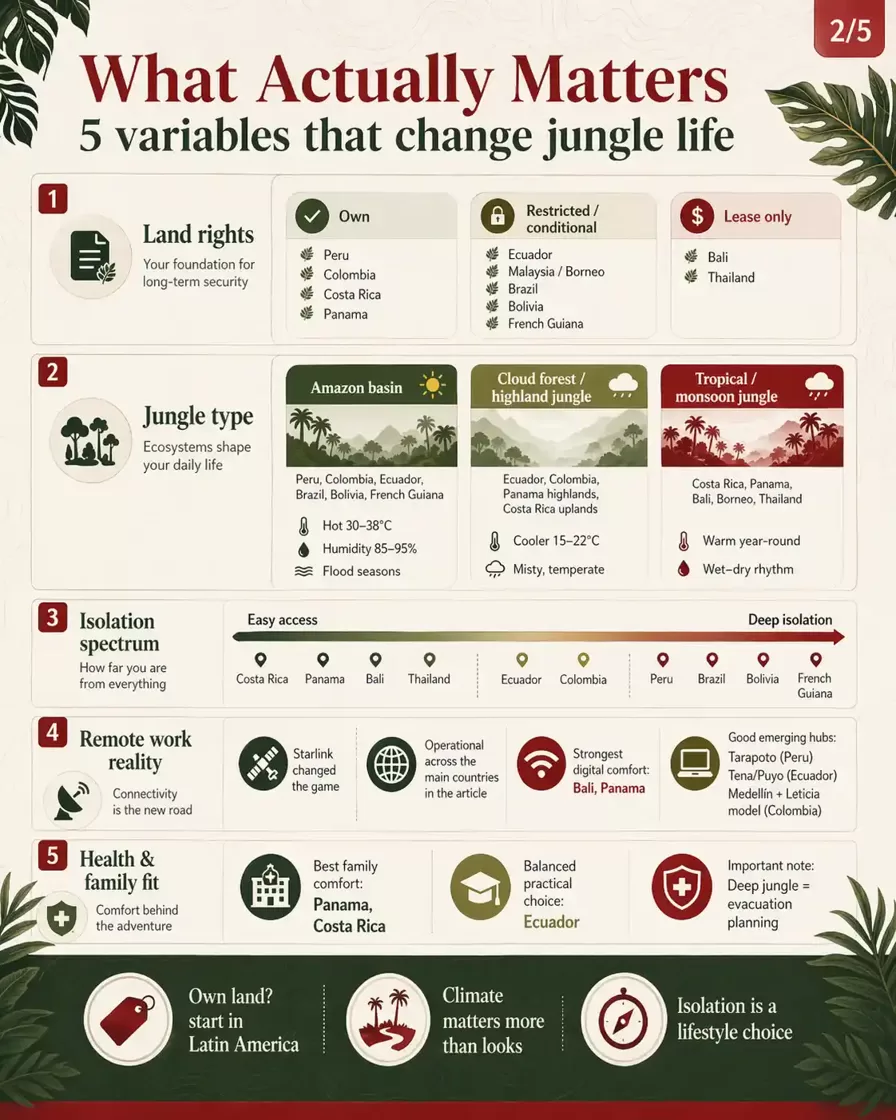
Before comparing destinations, it helps to understand what variables actually determine quality of life in a jungle setting — because they are different from the variables that matter in a conventional expat destination.
Land ownership is the first and most important variable. In Peru, Colombia, Ecuador, Costa Rica, and Panama, a foreign national can purchase freehold land with largely the same rights as a citizen. In Bali and Thailand, this is not possible — foreigners are limited to long-term leases, typically 25 to 30 years, which creates genuine long-term legal uncertainty. This is not a minor technicality. It determines whether you are building wealth or renting an experience.
The type of jungle is the second variable most people ignore. The Amazon basin in Peru, Colombia, and Ecuador is a specific ecosystem — extremely hot (30–38°C year-round), extremely humid (85–95% relative humidity), with defined wet seasons that bring flooding, and a daily rhythm dictated by rain patterns. The cloud forests of Ecuador and Colombia's Andean slopes are cooler (15–22°C), misty, and temperate — "jungle" in ecology but very different in feel. Southeast Asian jungle (Bali, Borneo, Thailand) has its own monsoon pattern, different species, different cultural context. These differences are not cosmetic. They determine whether you thrive or spend six months fighting mold.
Infrastructure and isolation exist on a spectrum. Panama City is 45 minutes from jungle. The depth of the Peruvian Amazon near Iquitos is accessible only by river or by small aircraft. Between those extremes lies every other option on this list, and your tolerance for isolation — physical, medical, and social — should drive your decision before any other consideration.
Two distinct profiles drive jungle living: the person seeking a retreat or eco-lodge business opportunity, and the person seeking a permanent or semi-permanent residence. The best countries for each profile overlap but are not identical. Costa Rica and Peru serve retreat entrepreneurs exceptionally well. Panama and Ecuador serve permanent relocators with families exceptionally well. This guide addresses both.
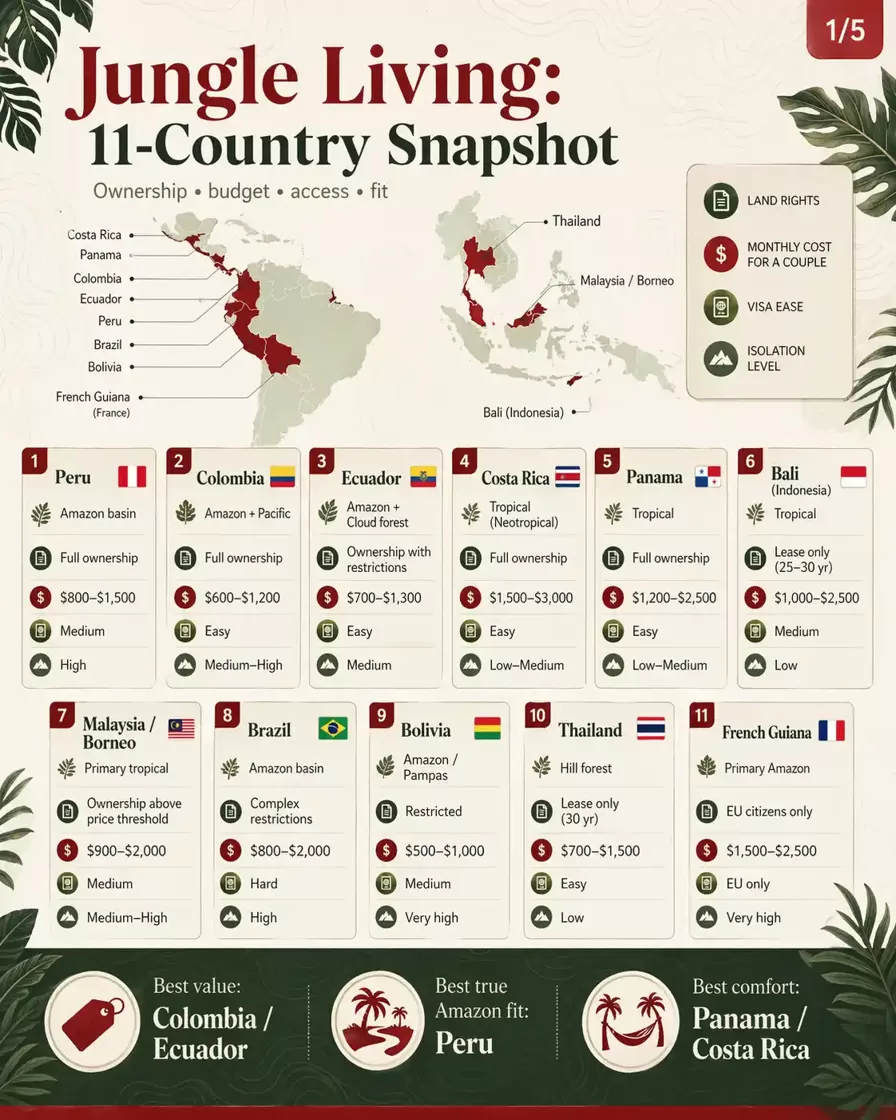
At a Glance: 11 Countries Compared
| Country | Jungle Type | Foreigners Can Own Land? | Est. Monthly Cost (couple) | Visa Ease | Isolation Level |
|---|---|---|---|---|---|
| Peru | Amazon basin | ✅ Full ownership | $800–$1,500 | Medium | High |
| Colombia | Amazon + Pacific | ✅ Full ownership | $600–$1,200 | Easy | Medium–High |
| Ecuador | Amazon + Cloud forest | ✅ With restrictions | $700–$1,300 | Easy | Medium |
| Costa Rica | Tropical (Neotropical) | ✅ Full ownership | $1,500–$3,000 | Easy | Low–Medium |
| Panama | Tropical | ✅ Full ownership | $1,200–$2,500 | Easy | Low–Medium |
| Bali (Indonesia) | Tropical | ❌ Lease only (25–30 yr) | $1,000–$2,500 | Medium | Low |
| Malaysia / Borneo | Primary tropical | ✅ Above price threshold | $900–$2,000 | Medium | Medium–High |
| Brazil | Amazon basin | ⚠️ Complex restrictions | $800–$2,000 | Hard | High |
| Bolivia | Amazon / Pampas | ⚠️ Restricted | $500–$1,000 | Medium | Very high |
| Thailand | Hill forest | ❌ Lease only (30 yr) | $700–$1,500 | Easy | Low |
| French Guiana | Primary Amazon | EU citizens only | $1,500–$2,500 | EU only | Very high |
Cost estimates based on expat community data and property market reports from 2024–2026. Verify locally before making financial decisions.
Peru — The Amazon's Best-Kept Secret for Serious Expats
Peru is one of the strongest options for jungle living because foreigners hold the same freehold land ownership rights as Peruvian citizens, combined with genuinely accessible Amazon regions and a cost of living that remains among the lowest on this list.
Between 10,000 and 15,000 Americans were living in Peru as of 2025 — a figure that has grown roughly 15–20% since 2020, according to U.S. Embassy Lima estimates, driven primarily by remote workers and retirees. The jungle regions, however, remain dramatically underrepresented in that community. That underrepresentation is both the challenge and the opportunity.
Why Peru Is Underrated
Most people associate Peru with Machu Picchu and Lima. The reality is that 60% of Peru's territory is covered by Amazon rainforest, and that rainforest contains some of the most accessible jungle living options in South America.
Iquitos is the starting point for any serious conversation about Peru jungle living. It is the world's largest city with no road connection to the outside — accessible only by river or small aircraft. A city of approximately 500,000 people, it has hospitals, supermarkets, restaurants, universities, and a long-established expat community drawn primarily by the ayahuasca retreat economy. Living in Iquitos does not mean living in isolation. It means living in a genuine Amazonian city.
Tarapoto is the most practical entry point for first-time jungle expats. It has a domestic airport with multiple daily flights to Lima, road connections to the coast, fiber-optic internet in the town center, and a surrounding jungle that feels genuinely wild while remaining logistically manageable. A couple can live comfortably in Tarapoto on $900–$1,400 per month.
Puerto Maldonado is the gateway to the Madre de Dios region — the most biodiverse area on Earth per unit area, bordering Bolivia and Brazil. The airport serves Lima directly. This is where Peru's most serious conservation-minded expats tend to settle.
Pucallpa sits on the Ucayali River and is among the most affordable options — rawer, less developed, with a lower cost of living but correspondingly less infrastructure.
Land and Property Rights
Foreign nationals in Peru can purchase freehold land and buildings with the same legal rights as Peruvian citizens. There is one significant restriction: property within 50 kilometers of an international border cannot be owned by foreigners. In practice, this affects areas near the Brazilian, Ecuadorian, and Bolivian borders — relevant if you are considering the most remote Amazonian regions. Tarapoto, Iquitos, Puerto Maldonado, and Pucallpa are generally outside this restriction zone, but verify the specific parcel with a local notary before any purchase.
Jungle land pricing varies enormously by remoteness and accessibility. Rural land near river systems can start from $2,000 per hectare. Parcels with road access near growing towns such as Tarapoto typically range from $8,000–$20,000 per hectare. Always conduct a full title search (saneamiento predial) through SUNARP (Peru's national property registry) before proceeding.
Cost of Living
A couple living in a jungle town such as Tarapoto or Pucallpa can sustain a comfortable lifestyle on $1,000–$1,600 per month. This covers rent or mortgage servicing, food (fresh produce and fish are extremely affordable from local markets), utilities, and occasional travel back to Lima. Iquitos costs are similar despite the isolation — but imported goods (construction materials, electronics, vehicles) cost substantially more because everything must arrive by river or air.
Internet connectivity has changed significantly since Starlink became operational in Peru in 2022–2023. In Tarapoto and Puerto Maldonado, fiber-optic service is available in town centers. In rural areas and Iquitos, Starlink provides reliable connectivity that enables remote work — a development that has fundamentally altered the remote-jungle-living calculus.
Private healthcare in Tarapoto and Iquitos is affordable and adequate for routine care. Serious medical situations — surgery, cardiac events, complex diagnosis — typically require evacuation to Lima. This is a non-negotiable risk factor for anyone considering deep Amazon living and must be planned for explicitly.
Unique Draws
Peru's Amazon holds specific attractions that no other country on this list can match. The ayahuasca retreat economy centered on Iquitos has created an entire infrastructure of ceremonial centers, guesthouses, and plant medicine practitioners. For those interested in this ecosystem as a business opportunity or personal practice, Iquitos is the global center of gravity. The Madre de Dios region (Puerto Maldonado) offers genuine wildlife encounters — jaguars, giant river otters, macaw clay licks — that most nature documentaries have to travel to Peru to film.
The language requirement is significant and should not be minimized: English proficiency outside tourist areas is very limited. Spanish fluency is effectively mandatory for jungle living in Peru.
Best for: Serious off-gridders, nature researchers, retreat entrepreneurs, Spanish-speaking adventurous retirees, remote workers willing to accept logistical complexity in exchange for the most authentic Amazon experience on this list.
Colombia — The Rising Star of Jungle Living
Colombia ranked second globally for expat happiness in 2025 (Internations annual survey of more than 10,000 expats across 172 nationalities), and its jungle regions represent some of the most compelling and underpriced real estate on this list for foreigners who can purchase with full ownership rights.
The country has changed dramatically over the past decade. The Colombia that many people's mental models are built on — the one defined by conflict and cartel violence — is not the Colombia that tens of thousands of expats are now choosing as a permanent home. Safety remains a nuanced topic that requires honest assessment by specific region, but the trajectory is one of steady improvement, and the jungle areas specifically are among the calmer parts of the country.
Colombia Has Two Completely Different Jungles
This distinction matters enormously and most guides fail to make it clearly.
The Colombian Amazon (Amazonas department, centered on Leticia) is a classic equatorial Amazon experience — flat, hot, waterway-dominated, with a biodiversity profile similar to the Peruvian and Brazilian Amazon. Leticia, a town of roughly 40,000 people on the southern tip of Colombia, is accessible only by air from Bogotá (approximately 2.5 hours) or by river from neighboring Peru and Brazil. It sits in the Trapecio Amazónico — the narrow corridor where Colombia meets the Amazon basin. The surrounding forest includes Amacayacu National Park, one of the most biodiverse protected areas in the country.
The Chocó biome is a Pacific coastal rainforest on Colombia's western edge and is, by several measures, the most biodiverse terrestrial ecosystem on Earth — with higher plant species density than the Amazon basin in many areas. Towns like Nuquí and Bahía Solano are accessible only by small aircraft or boat from Medellín or Quibdó. This is a wetter, steamier, more remote, and in many ways more spectacular jungle experience than the Amazon — and it is largely unknown to international expats. Land in the Chocó region is among the least expensive on this list, though due diligence on community land rights (many areas are legally designated as collective territories of Afro-Colombian communities) is essential.
The June 2025 Moment
In June 2025, a Danish national named Lennox-Hvenekild went viral after purchasing 7.5 acres of land in Colombia's Amazon region to build a cabin and restore native habitat for endangered primates, including spider monkeys. The story, which spread through social media, illustrated two things simultaneously: the genuine accessibility of jungle land purchase in Colombia for foreigners, and the conservation context within which such purchases now occur. According to Global Forest Watch, Colombia lost approximately 2.09 million hectares of humid primary forest between 2002 and 2024. The purchase, framed as sustainable homesteading with active reforestation, drew both praise and criticism — a preview of the ethical landscape any jungle landowner in Colombia will navigate.
Land Rights and Property Purchase
Foreigners can buy Colombian property under the same legal framework as Colombian citizens. There is no requirement for residency, no restriction on the amount of property that can be purchased, and no special permit process for foreign buyers beyond the standard notarial purchase and registration system.
Rural jungle land in the Amazonia region starts from approximately $2,000 per hectare for remote parcels with river access. Land with road access and infrastructure in developing areas ranges from $5,000–$15,000 per hectare. The critical due diligence step in Colombia's jungle regions is verifying that land is not designated as indigenous resguardo (reserve), collective Afro-Colombian territory, or protected national park buffer zone — all of which preclude private purchase.
Cost of Living
Living in Leticia (Colombian Amazon) costs a couple approximately $600–$1,000 per month. This is among the lowest costs on this list for a town with reasonable infrastructure. Medellín — which many Colombia-based jungle expats use as an urban base — costs $1,500–$2,000 per month for a comfortable lifestyle. The model of maintaining a Medellín apartment while developing jungle land (a 2.5-hour flight from Leticia) is increasingly common among Colombia-focused expats.
Colombia's private healthcare system is modern in urban areas. Private health insurance runs $40–$80 per month per person for comprehensive coverage in cities. In Leticia, medical infrastructure is limited — serious conditions require evacuation to Bogotá.
Best for: Adventure-minded expats, eco-investors and rewilding enthusiasts, digital nomads using Medellín as an urban anchor with jungle as a retreat destination, those seeking the cheapest combination of accessible jungle + full foreign ownership on this list.
Ecuador — Dollar Economy, Two Jungles, Underrated Value
Ecuador is the most practical option for American and Canadian expats who want Amazon access combined with a dollar-denominated economy, no currency exchange risk, affordable land, and accessible healthcare — without the logistical complexity of Peru's deep jungle.
Ecuador uses the US dollar as its official currency. This single fact eliminates the currency risk and exchange-rate volatility that affects expat finances in every other Latin American country on this list. For retirees on Social Security or pensions, or remote workers paid in dollars, it is a meaningful practical advantage.
Ecuador Has Two Distinct Jungle Zones
The Amazon (Oriente region) runs along Ecuador's eastern flank — Tena, Puyo, Baños, Lago Agrio, and Coca serve as gateways. The town of Tena, widely considered Ecuador's "adventure capital," sits at the confluence of two rivers in a region where primary forest begins within minutes of the town center. It has a domestic airport, reliable road connections to Quito (approximately four hours), a small but growing expat community, and fiber-optic internet available in the town itself with Starlink as a rural supplement.
Coca (officially known as Puerto Francisco de Orellana) is the primary gateway to Yasuní National Park — designated by UNESCO as a World Biosphere Reserve and estimated to hold the highest species density per hectare of any area on Earth. The oil extraction tensions in Yasuní (Ecuador held a historic referendum in 2023 that voted to halt oil drilling in Block 43 within the park) give the region a complex political and conservation context that ecologically minded expats will want to understand fully.
The Cloud Forest represents Ecuador's second, and often underappreciated, jungle option. The western Andean slopes are covered in temperate cloud forest — the Mindo valley, the Intag region, and the area around Baños offer a fundamentally different experience: temperatures of 15–22°C rather than 30–38°C, lower humidity, misty mornings, and an extraordinary biodiversity of birds (Ecuador has over 1,600 bird species, the highest density globally per unit area). For those who find the Amazon's heat and humidity genuinely challenging, cloud forest living is the answer — and Ecuador is the best country on this list for it.
Land Rights
Foreigners can generally purchase land in Ecuador, though several restrictions apply. Property within a 20-kilometer zone of international borders and coastal areas has specific restrictions. Indigenous community land (particularly in Amazon provinces like Pastaza and Morona Santiago) cannot be purchased privately. These restrictions are significant in the jungle context and require careful due diligence.
Outside restricted zones, rural land in the Oriente can range from $3,000–$12,000 per hectare depending on accessibility and existing improvements. Cloud forest land near Mindo or the Intag valley tends to be $8,000–$20,000 per hectare given higher demand from eco-tourism operators.
Cost of Living
A couple living in Tena or Puyo can sustain a comfortable lifestyle on $800–$1,300 per month. This includes rent ($300–$500 for a furnished house), food from local markets ($150–$250 per month), utilities, and transport. Ecuador's private healthcare is affordable and modern in larger cities — private insurance runs $40–$80 per person per month. In jungle towns specifically, routine care is available; complex cases require travel to Quito (accessible within 4–6 hours from most Oriente towns).
Ecuador's political situation is worth noting honestly: the country has experienced periods of instability and security challenges in recent years. The situation varies significantly by region. Jungle areas in the Oriente have generally remained calm relative to coastal and urban security concerns. Verify current conditions through current U.S. State Department or equivalent advisories before making decisions.
Best for: Budget-conscious American/Canadian expats who want real Amazon access without currency risk, cloud forest dwellers prioritizing biodiversity over heat, eco-homesteaders, couples looking for the best balance of affordability, ownership rights, and practical access to medical care.
Costa Rica — The Classic, the Most Comfortable, the Most Expensive
Costa Rica is the best-known and most infrastructure-rich jungle living destination in Latin America — and the most expensive by a significant margin.
The country welcomed 2.6 million international visitors in 2024, a 10% increase over 2023, according to tourism data. That number reflects a mature, proven desirability — but it also explains why Costa Rica's jungle real estate now costs three to five times more per hectare than comparable land in Ecuador or Colombia.
The Osa Peninsula and Southern Zone
The Osa Peninsula, home to Corcovado National Park, holds what National Geographic once called "the most biologically intense place on Earth." The Southern Zone — encompassing Dominical, Uvita, Ojochal, and the areas between — is where the most established jungle expat community in Latin America has formed. Here, jungle meets beach, howler monkeys are a daily reality, and you can drive to a fully stocked supermarket in 45 minutes.
Jungle lots in the Southern Zone start from approximately $159,000 for two acres (riverfront properties in less developed areas) and rise quickly into $300,000–$800,000+ for ocean-view parcels. This is categorically different pricing from what Peru or Colombia offer.
Foreign ownership is fully permitted in Costa Rica. Rule of law is strong — the country has no military and a stable democratic history. Building regulations are meaningful and enforced, particularly near rivers, wetlands, and protected zones. This is not a Wild West land market: permits are required, environmental impact assessments are required in many cases, and setbacks from water sources are strictly regulated.
Who Costa Rica Is Actually Right For
Costa Rica serves a specific profile extremely well: the first-time jungle expat who wants genuine nature immersion but cannot or will not sacrifice medical access, English availability, established schools, and food security. It serves families better than any other option on this list. It serves retirees who want the jungle aesthetic with the security of a country that has strong rule of law and a functioning private healthcare system.
It is not the right choice for someone whose primary motivation is cost of living, land ownership as an investment, or the most authentic Amazon experience. The jungle in the Southern Zone is beautiful and genuinely wild — but it is also increasingly managed, increasingly expensive, and increasingly surrounded by expat infrastructure that softens the isolation considerably.
Best for: First-time jungle expats, families with children, retirees prioritizing medical access and safety, those who want the jungle experience with first-world infrastructure and are willing to pay for it.
Panama — The #1 Expat Country, Underrated for Jungle Living
Panama ranked first globally for overall expat satisfaction in the 2025 Internations survey across 46 countries, placing in the top three across all five major categories including quality of life, ease of settling in, and personal finance. It is also the most overlooked jungle living destination on this list.
Panama's reputation is primarily built on Panama City — the gleaming financial hub with direct flights from Miami, a dollarized economy (yes, Panama also uses the US dollar), and a famously straightforward retirement visa program. The jungle dimension of Panama is genuinely underappreciated.
Panama's Jungle Regions
Bocas del Toro is a Caribbean archipelago surrounded by mainland jungle and one of the most biologically diverse regions in Central America. The combination of island living and immediate jungle access is unique on this list.
Boquete sits in the western highlands in a cloud forest setting — cooler than tropical lowlands, with a well-established retirement community and a reputation as one of the most comfortable small expat towns in Latin America.
The Darién is the infamous gap in the Pan-American Highway — primary jungle bordering Colombia. It is also an active migration corridor with documented criminal activity and is explicitly not recommended as a living destination for expats. It is mentioned here only to be clearly ruled out.
The Azuero Peninsula and surrounding areas offer more accessible jungle with a decidedly local, less-touristy character.
The Pensionado Visa
Panama's Pensionado (retiree) visa is widely considered one of the world's most generous: it requires a minimum monthly pension income of $1,000 (from any government or private source), provides permanent residency, and delivers a substantial package of discounts on hotels, restaurants, healthcare, utilities, and public transport — discounts of 10–50% depending on the category. There is no age restriction. For retirees, it changes the financial math of living here significantly.
Foreign property ownership is fully permitted, and the legal framework for property purchase is straightforward. Land near jungle areas (outside of indigenous Comarca territories, which cannot be purchased) ranges from $15,000–$60,000 per hectare in accessible locations — more expensive than South America but cheaper than Costa Rica.
A couple can live comfortably in Boquete or Bocas del Toro on $1,200–$2,000 per month. Panama City as an urban base adds cost but provides access to one of the best medical systems in Central America.
Best for: Retirees (particularly those with pensions who can leverage the Pensionado Visa), families prioritizing convenience and safety, those wanting US-dollar certainty and first-world financial infrastructure alongside jungle access.
Bali (Indonesia) — The Most Beautiful Jungle Trap on This List
Bali offers the most aesthetically compelling jungle living experience on this list. It also has the most significant legal limitation: foreigners cannot own freehold land in Indonesia. Every jungle villa you see on social media is built on a lease.
This is not a reason to dismiss Bali — but it is a reason to enter it with clear eyes.
The Ubud Reality
Ubud, Bali's cultural and creative center, is surrounded by rice terraces, jungle, and river canyons. A growing population of digital nomads, wellness practitioners, and lifestyle expats has built a genuine community here over the past decade. Infrastructure for remote workers is strong — the area has multiple co-working spaces, reliable fiber internet, good private hospitals (BIMC and Prima Medika serve the Ubud area), and an international school ecosystem.
The lifestyle is genuinely compelling. Mornings with jungle fog, evenings at warungs, creative communities, and year-round warmth without the extreme isolation of Amazon living.
The Land Lease Question
Under Indonesian law, foreigners cannot hold Hak Milik (freehold ownership) of land. What is available is Hak Sewa (right of lease) — typically 25 to 30 years, with the option to renew at the discretion of the landowner. A business-structured purchase (using a local nominee or PT PMA company structure) is technically possible but carries its own legal complexity and risk.
In practical terms: a couple paid approximately $17,000 to lease a jungle plot in Ubud for 20 years and built a modern jungle home there (documented case from Business Insider, 2021). The home has value and the lifestyle is real. But at the end of that lease, the land and any structure on it reverts to the Indonesian freeholder unless a renewal is negotiated and paid for.
For lifestyle-focused expats, short-to-medium-term residents, or retreat operators with a 10-to-20 year horizon, Bali's combination of beauty, community, and infrastructure can be excellent value. For those seeking permanent roots and long-term wealth building through land ownership, the legal structure creates genuine insecurity.
Bali received more than 7 million international visitors in 2025. The infrastructure is excellent. The jungle is real. The ownership is not.
Best for: Digital nomads, lifestyle seekers with a medium-term horizon (3–15 years), wellness retreat operators, creative professionals who prioritize community and environment over legal permanence.
Malaysia and Borneo — The Underrated Southeast Asian Jungle
Malaysia's portion of Borneo — the states of Sabah and Sarawak — contains some of the world's oldest primary rainforest (estimated at 130 million years old) and is arguably the most spectacular jungle environment on this list from a pure wildlife perspective.
Orangutans. Proboscis monkeys. Pygmy elephants. Clouded leopards. Sun bears. Hornbills of multiple species. Borneo's biodiversity is extraordinary, and much of it can be encountered within an hour of urban centers like Kota Kinabalu (Sabah's capital) or Kuching (Sarawak's capital).
The MM2H Visa
Malaysia's Malaysia My Second Home (MM2H) program is a long-term residency visa historically regarded as one of the world's most accessible. Requirements have been revised and tightened since 2021; as of the latest available information, the program requires proof of offshore income, a fixed deposit in a Malaysian bank, and health insurance. Verify current requirements directly with Malaysia's Ministry of Tourism before planning — these have changed multiple times since 2020 and continue to be subject to revision.
English is widely spoken throughout Malaysia, which is a significant practical advantage for English-speaking expats navigating bureaucracy, healthcare, and daily life.
Land Ownership
Foreigners can purchase property in Malaysia above certain minimum price thresholds, which vary by state. In Sabah and Sarawak, rural and jungle land is subject to additional restrictions — some areas are designated as Native Customary Rights (NCR) land and cannot be privately purchased. Urban and semi-urban property above the minimum threshold (typically RM 1 million, approximately $220,000) is accessible to foreigners.
Interior Borneo, where the most primary forest exists, is substantially less accessible for property purchase than Kota Kinabalu or Kuching. The model that works best is an urban base (Kota Kinabalu) with jungle access through land held through an appropriate legal structure — which requires local legal advice specific to the parcel and state.
Cost of living in Kota Kinabalu runs $900–$1,600 per month for a comfortable couple's lifestyle. Interior Borneo is cheaper but logistically more complex. Private healthcare in Kota Kinabalu is excellent and affordable — a major advantage over most of the Latin American options on this list.
Best for: Nature lovers who want Southeast Asia rather than Latin America, those who value English-speaking environment as a non-negotiable, retirees who find Borneo's wildlife a primary draw, expats comfortable with leasehold complexity in exchange for extraordinary biodiversity.
Brazil, Bolivia, Thailand, and French Guiana — Quick Assessments
Brazil 🇧🇷
Brazil contains approximately 60% of the Amazon basin — by far the largest share. The jungle is vast, spectacular, and in many areas extraordinarily remote. Manaus is a city of 2 million people in the middle of the Amazon with opera houses and river dolphins — a genuinely fascinating urban jungle proposition.
The challenge for foreign expats is Brazil's bureaucratic complexity. Property purchase involves multiple steps, a tax system that can be onerous for non-residents, and a legal framework that varies by state. Permanent residency requires navigating a process that is considered more complex than any other country on this list. Prices in Amazon towns like Manaus, Santarém, and Alta Floresta vary widely but can be accessible.
For those with Brazilian family connections, language fluency, or a strong specific reason to be in Brazil's Amazon rather than Peru's or Colombia's, it is worth serious consideration. For others, the administrative friction is difficult to justify when Peru and Colombia offer comparable jungle with simpler ownership paths.
Bolivia 🇧🇴
Bolivia is the cheapest jungle living option on this list. Rurrenabaque, a small town in the Beni department, serves as the gateway to both the Bolivian Amazon and the Pampas wetlands. Living costs can run $500–$900 per month. The jungle is genuine and largely untouched.
What Bolivia lacks is virtually any foreign expat infrastructure in its jungle areas. There is almost no community of international residents to connect with, medical access is extremely limited, and internet connectivity in jungle areas is poor even with Starlink available in the country. Foreign land purchase is subject to restrictions. Bolivia is for the truly adventurous, the deeply self-sufficient, or those with a specific conservation project that requires the most remote and affordable land available.
Thailand 🇹🇭
Thailand's northern regions — Chiang Rai, the area around Pai, and the Doi Inthanon highlands — offer a "jungle adjacent" lifestyle in hill forest terrain. This is categorically different from Amazon-scale rainforest: cooler temperatures, lower humidity, different wildlife, and a Southeast Asian cultural context.
Thailand prohibits foreign land ownership entirely. Leasehold (30 years, renewable) is the only option. The country is extraordinarily easy to live in from a lifestyle standpoint — excellent food, world-class healthcare in Chiang Mai, established expat communities, strong digital infrastructure. For those not drawn to Latin America and seeking jungle-adjacent living with maximum convenience, Thailand is compelling. For those seeking true rainforest immersion and land ownership, it is not the answer.
French Guiana 🇬🇫
The wildcard. French Guiana is an overseas department of France — meaning it operates under French and EU law, uses the Euro, and provides EU-standard public services. Approximately 90% of its territory is covered by primary Amazon rainforest. Its capital, Cayenne, has a population of roughly 60,000. The Guiana Space Centre (the EU's primary rocket launch facility) is located here.
French Guiana is the most pristine, most isolated, and most legally complex option on this list for non-EU citizens — because practically, it is only viable for EU nationals who can live and work there under EU freedom of movement. For EU citizens seeking the most untouched jungle on Earth combined with French administrative standards and Euro pricing (which makes it expensive relative to Latin American options), it is a genuine and extraordinary option. For everyone else, it is a fascinating footnote.
The Seven Questions That Determine Which Country Is Right for You
This section is designed to help you match your specific priorities to the right destination. Answer these questions honestly before reading the recommendations.
Which country is the cheapest for jungle living as a foreigner?
Bolivia is the cheapest overall, with couples living on $500–$900 per month in jungle areas. However, Bolivia has almost no expat infrastructure in jungle regions and significant land ownership restrictions. For the best combination of low cost and functional livability, Ecuador and Colombia offer jungle living from $600–$1,300 per month with full foreign ownership rights, improving infrastructure, and growing expat communities.
Where can foreigners actually OWN freehold land in the jungle — not lease it?
Peru, Colombia, Ecuador, Costa Rica, and Panama all permit full freehold land ownership for foreigners with minimal restrictions. Malaysia permits purchase above minimum price thresholds. Brazil permits purchase but with administrative complexity. Bali (Indonesia) and Thailand do not permit freehold ownership by foreigners — leasehold only. This is the single most important legal variable in this comparison.
Which jungle country is the safest for expats?
Costa Rica and Panama rank consistently as the safest on this list, with stable governments, low rates of violent crime targeting foreigners, and strong rule of law. Ecuador and Peru are generally safe in their jungle regions, though urban areas (Guayaquil in Ecuador, Lima in Peru) require attention. Colombia has improved substantially and specific regions like Medellín and the Leticia Amazon area are considered safe — but the country requires region-by-region research rather than a blanket safety assessment. Bolivia and Brazil require careful, specific research by area.
Where is internet access most reliable for remote workers living in the jungle?
Bali and Panama offer the most reliable digital infrastructure for remote workers. Among the Latin American Amazon options, Tarapoto (Peru), Tena (Ecuador), and Medellín plus Leticia (Colombia) all have improving connectivity. Starlink has been operational across Peru, Colombia, Ecuador, Costa Rica, and Panama since 2022–2024 and has fundamentally changed the remote-work calculation in rural areas. As of 2025–2026, reliable work-from-home connectivity is achievable in jungle areas close to small towns in all Tier 1 countries on this list.
Which country is best for retiring to the jungle?
Panama (Pensionado Visa, minimum $1,000/month pension income, permanent residency, wide discounts), Ecuador (Jubilado Visa, minimum $800/month pension income, fast processing, dollar economy), and Costa Rica (Pensionado program, minimum $1,000/month, stable healthcare) are the three strongest retirement visa programs on this list. For those prioritizing authentic Amazon immersion over convenience, Peru offers the same land rights with lower costs — but without a comparable retirement visa incentive program.
Which country has the most biodiverse jungle?
Ecuador's Yasuní National Park holds the highest species density per hectare of any measured area on Earth — more species of trees per hectare than in all of North America combined. Colombia's Chocó biome is considered the most biodiverse terrestrial ecosystem by total species count. Peru's Madre de Dios (Puerto Maldonado area) is the world's documented leader in bird species diversity per unit area. All three are extraordinary. If maximum biodiversity is your primary criterion, any of these three deliver an experience that Bali, Malaysia, or even Costa Rica cannot match.
Can I realistically build a sustainable eco-lodge or retreat in the jungle as a business?
Yes — and this is one of the strongest business cases for jungle living across several countries on this list. Peru's Iquitos is the global center of the ayahuasca retreat economy, with dozens of established centers and a well-worn visitor pipeline. Costa Rica's Osa Peninsula has an established eco-lodge circuit with infrastructure to support international guests. Panama's Bocas del Toro and Colombia's Leticia both have growing retreat economies. Ecuador near Tena serves an adventure tourism market. Each country has specific permit requirements for operating tourism businesses as a foreigner — legal advice from a local attorney specializing in tourism business setup is mandatory before investing.
Choosing a jungle region within a country is only half the decision. The other half is understanding which South American cities work best as urban anchors — for banking, medical care, flights, and the periods when you simply need civilization. Our breakdown of the best South American countries and cities for expats covers exactly that, with cost and infrastructure data by city.
The Honest Reality Check — What They Don't Tell You on Instagram
The gap between the jungle living fantasy and the jungle living reality is large. This section exists to close that gap.
The Climate Is Not Background Scenery — It Is Your Daily Working Condition
Amazon lowland climate means temperatures of 30–38°C and relative humidity of 85–95%, year-round. It means that mold grows on books, clothing, and walls faster than you expect. It means that electronics require dehumidification management. It means that the rainy season (which varies by country but typically runs 6–7 months of the year) brings flooding, mud, road closures, and levels of precipitation that make outdoor activity genuinely challenging for days at a time. Cloud forest is cooler but perpetually damp in a different way.
The people who thrive in jungle living are those who genuinely enjoy heat and humidity — not those who tolerate it. This is not a personality trait that can be trained; it is a physiological preference. If you are seriously heat-sensitive, the Amazon basin is not where you will find long-term happiness. Ecuador's cloud forest or Boquete, Panama, or highland Colombia may be a better fit.
Medical Access Is a Safety-Critical Variable
The single most important non-financial variable for jungle living is your distance from quality medical care. Tarapoto, Peru has a functional regional hospital. Iquitos has better care than you might expect for a road-inaccessible city. Tena, Ecuador has adequate facilities for routine emergencies. Rural land 30–90 minutes from any of these towns does not.
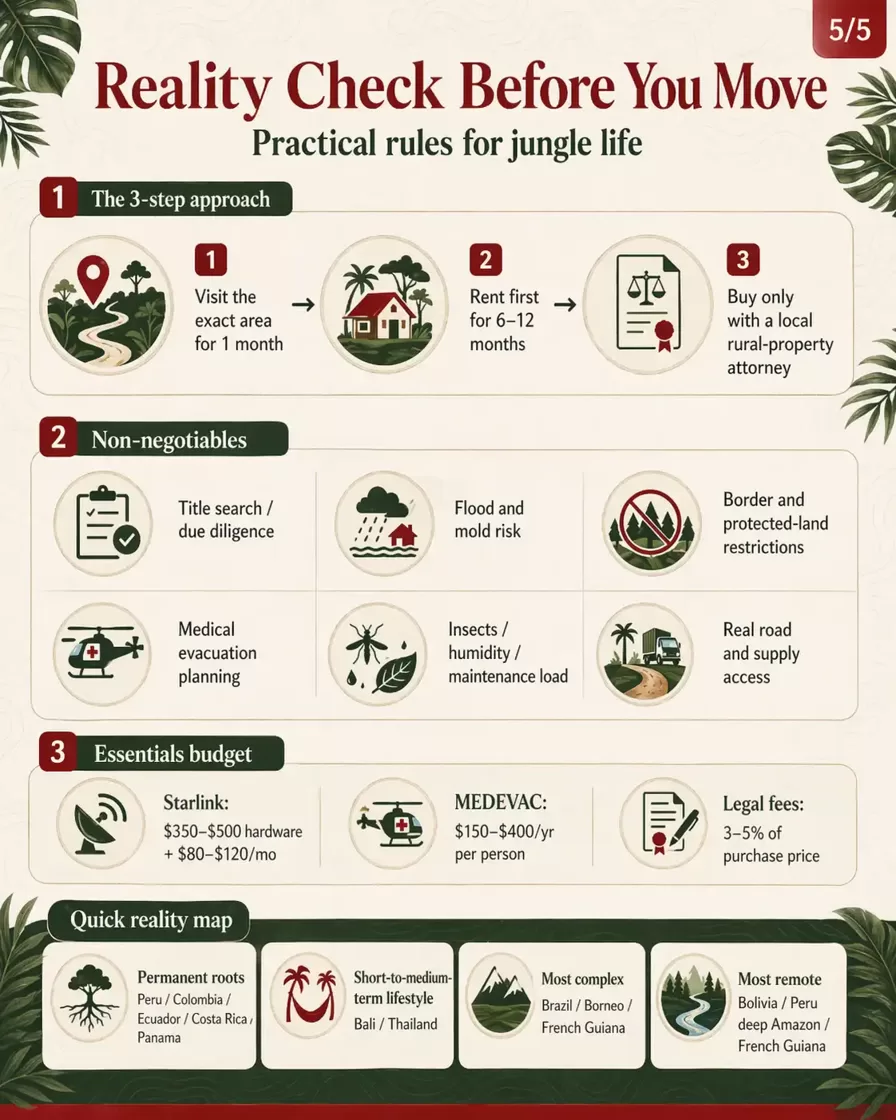
For serious cardiac events, strokes, complex surgical emergencies, or oncological care, the realistic answer in most jungle areas is medical evacuation to a major city. This takes hours at minimum, sometimes more than 24 hours. Private medical evacuation insurance (MEDEVAC coverage) is not optional for jungle living — it is as essential as the property itself. Factor this into your budget: $150–$400 per year per person is a reasonable range for comprehensive MEDEVAC coverage from Latin America to a country of your choice.
The Three-Step Approach
Anyone who has purchased jungle land without following this sequence has a story they would prefer not to tell:
Step 1: Visit the specific area for a minimum of one month — not the nearby town, the actual area. Experience a full cycle of weather. Understand the road conditions, the neighbor situation, the noise, the insects, and the isolation level when friends are not visiting.
Step 2: Rent before buying. Spend 6–12 months renting in or near the location. Relationships, logistics, and your own psychological response to isolation are not predictable from a two-week scouting trip.
Step 3: Buy with a local attorney who specializes in rural property transactions in that specific country and region. Title chains in jungle areas — particularly in Latin America — can be complex. Indigenous land conflicts, unregistered historical claims, and environmental protection overlaps are all real.
The Starlink Variable (A Genuine Game-Changer)
Starlink's expansion into Latin America and Southeast Asia since 2022 has materially changed what jungle living means for remote workers. As of 2025–2026, Starlink is operational in Peru, Colombia, Ecuador, Costa Rica, Panama, Brazil, Bolivia, Indonesia (including Bali), and Malaysia. Download speeds of 50–200 Mbps in rural areas — once unimaginable — are now routine. This has effectively removed the internet barrier that once made remote jungle living incompatible with professional remote work.
The equipment cost is approximately $350–$500 for the hardware plus $80–$120 per month for the service. In a context where you are spending $800–$1,500 per month on total living costs, this is a significant but manageable line item that makes the entire lifestyle viable in a way it was not five years ago.
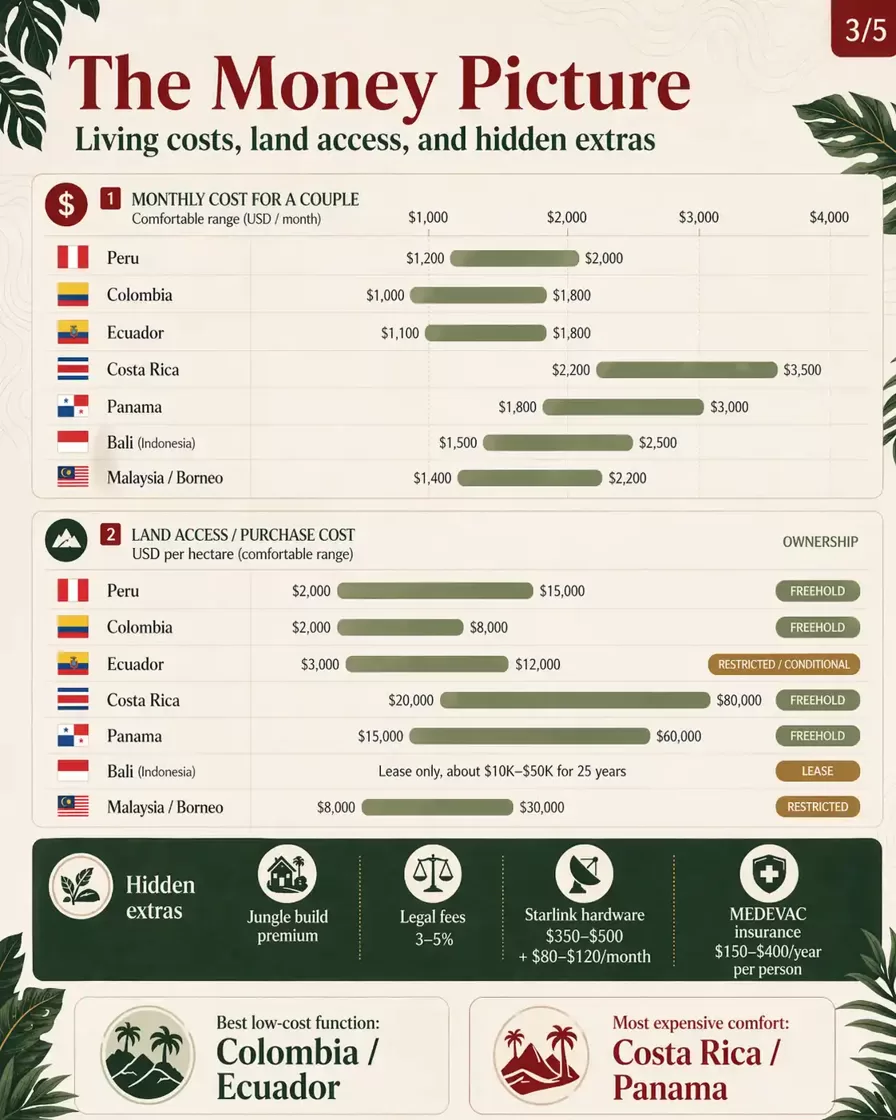
Real Cost Breakdown by Country
This table reflects 2024–2026 data from expat community reporting, property market analysis, and cost-of-living databases. All figures are estimates. Land prices vary enormously by specific location, road access, and available infrastructure.
| Country | Monthly Cost — Basic (couple) | Monthly Cost — Comfortable (couple) | Land Price (per hectare) | Construction Cost (per m²) |
|---|---|---|---|---|
| Peru (jungle towns) | $800–$1,200 | $1,200–$2,000 | $2,000–$15,000 | $200–$500 |
| Colombia (Amazon / Chocó) | $600–$1,000 | $1,000–$1,800 | $2,000–$8,000 | $150–$400 |
| Ecuador (Oriente / cloud forest) | $700–$1,100 | $1,100–$1,800 | $3,000–$12,000 | $180–$450 |
| Costa Rica (Southern Zone) | $1,500–$2,200 | $2,200–$3,500 | $20,000–$80,000 | $400–$900 |
| Panama (Bocas / Boquete) | $1,200–$1,800 | $1,800–$3,000 | $15,000–$60,000 | $350–$800 |
| Bali, Indonesia (Ubud area) | $1,000–$1,500 | $1,500–$2,500 | Lease: $10K–$50K / 25 yr | $300–$700 |
| Malaysia / Borneo (Kota Kinabalu) | $900–$1,400 | $1,400–$2,200 | $8,000–$30,000 | $250–$600 |
Notes:
- Construction costs for jungle-appropriate building (elevated foundations, hardwood or concrete, adequate ventilation, metal roofing) are significantly higher than for standard urban construction in the same country. Budget for jungle-specific construction costs.
- Land prices near urban centers are at the high end of the range. Remote parcels with river access only are at the low end.
- These figures do not include medical evacuation insurance, property legal fees (typically 3–5% of purchase price in Latin America), or connection of utilities.
For those approaching jungle land as an investment rather than — or alongside — a lifestyle decision, the calculus changes significantly. Land appreciation dynamics, title risk, and exit liquidity differ sharply between Peru, Brazil, and Ecuador. Our Amazon jungle land investment analysis for 2026 covers all three markets with current pricing benchmarks and risk assessment.
Verdict — Which Country Is Right for You?
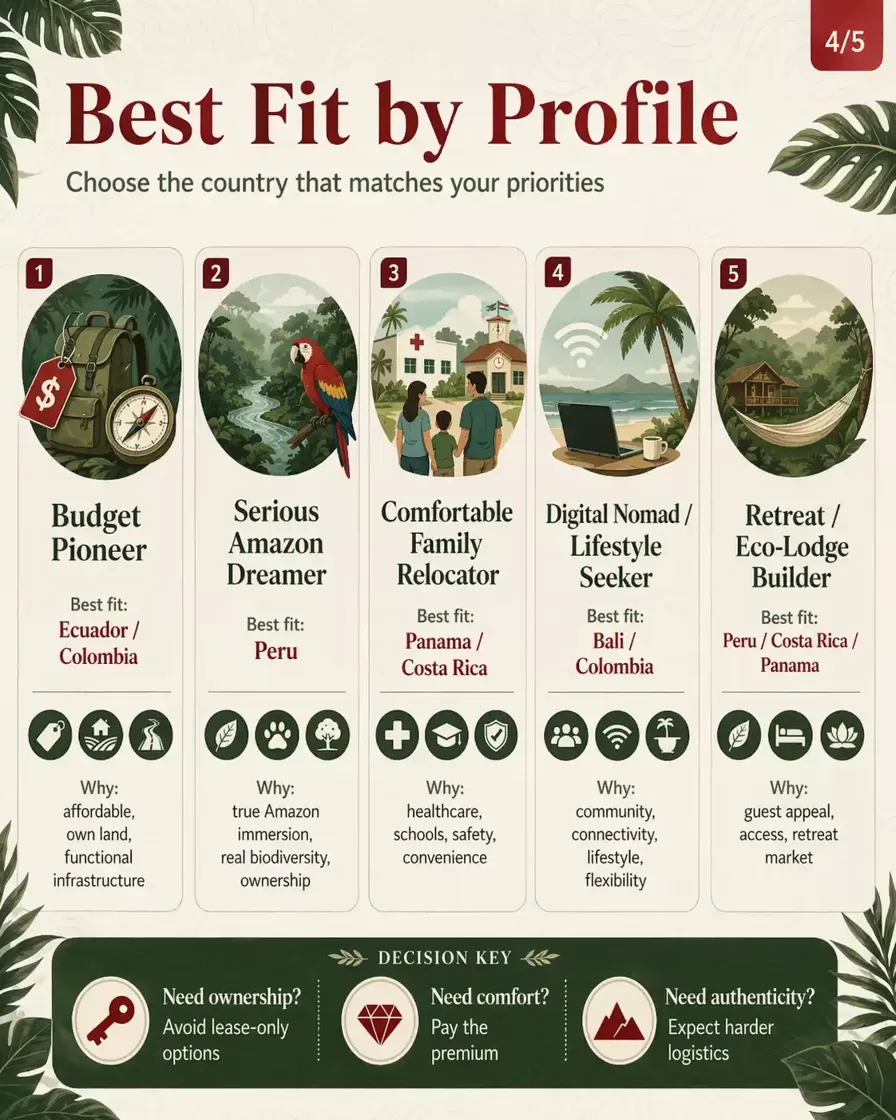
The "best" jungle country does not exist. What exists is the best match for a specific set of priorities. After this comparison, five profiles emerge clearly:
Profile 1: The Budget Pioneer
You want the deepest value: cheapest land, lowest monthly costs, and you are comfortable building infrastructure from scratch with limited nearby community support.
→ Best fit: Ecuador or Colombia
Ecuador's dollar economy eliminates currency risk and makes budget planning simpler. Colombia offers the cheapest combination of accessible jungle land and full foreign ownership rights. Both allow you to live well on $700–$1,200 per month in jungle areas.
Profile 2: The Serious Amazon Dreamer
Your primary motivation is authentic Amazon immersion — genuine wilderness, extraordinary biodiversity, a real rainforest experience rather than a curated eco-resort adjacent to one.
→ Best fit: Peru
Peru offers the clearest combination of full foreign land ownership, real Amazon access (Iquitos, Tarapoto, Puerto Maldonado), growing expat infrastructure, and authentic biodiversity that the more developed Costa Rica and Panama cannot match. The logistics are more demanding — but that is the price of the genuine article.
Profile 3: The Comfortable Family Relocator
You have children, or plan to. Medical access is a firm non-negotiable. You want jungle life but cannot accept significant infrastructure gaps.
→ Best fit: Panama or Costa Rica
Both offer the best infrastructure, most established English-speaking expat communities, strongest healthcare, and most reliable school systems of any country on this list. Panama's Pensionado Visa and dollar economy add specific advantages. The premium in cost (both are among the most expensive options here) reflects genuine advantages.
Profile 4: The Digital Nomad / Lifestyle Seeker
You work remotely, value community and aesthetics, and are planning a 3-to-10-year jungle chapter rather than a permanent root.
→ Best fit: Bali or Colombia (Medellín as base + Amazon as destination)
Bali's combination of infrastructure, community, visual beauty, and lifestyle ecosystem is unmatched for medium-term lifestyle living. The land lease limitation matters less if your horizon is 5–10 years. Colombia's model — Medellín as a world-class urban base and Leticia as a jungle destination — gives you both worlds, with full ownership rights if you commit to property in either location.
Profile 5: The Eco-Lodge or Retreat Entrepreneur
You are building a business, not just a lifestyle. You need a location where international guests can and will come, and where the retreat or eco-tourism market already has established demand.
→ Best fit: Peru (Iquitos), Costa Rica (Osa Peninsula), or Panama (Bocas del Toro)
Peru's Iquitos is the global center of the plant medicine retreat industry with an established visitor pipeline. Costa Rica's Osa Peninsula has the most developed eco-lodge infrastructure and the highest international visitor volume of any jungle area in the Western Hemisphere. Panama's Bocas del Toro combines accessibility from the US with an emerging retreat economy and strong foreign ownership rights.
One Decision That Changes Everything
The jungle is not a decoration. It is an ecosystem that will require something of you — in attention, in adaptation, and in honesty about what you genuinely want. The countries on this list give you access to some of the most extraordinary natural environments on Earth. They do it under very different terms.
The countries that give you the strongest legal foundation — Peru, Colombia, Ecuador, Costa Rica, Panama — are the ones where you can build something permanent. Bali offers beauty and community on borrowed time. Thailand offers convenience without roots. Borneo offers spectacle in exchange for complexity.
Define your non-negotiables first: Do you need to own the land? What is your monthly budget? Can you handle genuine medical isolation? Do you need your children in an international school? How important is speaking English in your daily life? How much heat and humidity can you realistically live in?
Answer those questions honestly, then match them to the comparison above. The right jungle country for you is the one where your non-negotiables are met — and where the compromises required are ones you would make willingly, not ones you are hoping to avoid.
That is where you build.
One option that bridges the gap between visiting and committing is spending an extended period at a functioning Amazonian retreat — long enough to understand the climate, the isolation, and the daily rhythm before signing anything. Our Amazonian solo retreat program is designed specifically for that purpose: immersive, unstructured time in the jungle with the infrastructure already in place.
Sources and references:
- Internations Expat Insider Annual Survey 2025 (10,000+ expats, 172 nationalities, 46 countries)
- Global Forest Watch — Colombia Deforestation Data 2002–2024
- GlobalPropertyGuide — Medellín Rental Yield Data Q1 2024
- U.S. Embassy Lima — American Expat Community Estimates 2025
- SkyQuestt — Global Off-Grid Housing Market Report 2025
- Dataintelo — Off-Grid Tiny House Market Research 2024
- Rumah123 / GlobalPropertyGuide — Bali Property Market Data 2024–2025
- ColombiaOne — Danish Amazon Land Purchase Report, June 2025
- Business Insider DE — Australian Couple Bali Jungle Home Case Study, 2021
- TheLatinvestor — Peru and Colombia Expat Data 2025–2026
- InternationalLiving — Costa Rica Real Estate Guide 2024–2025
Visa requirements, property laws, and cost-of-living figures change over time. Verify all legal and financial information with qualified local professionals before making decisions. This article does not constitute legal or financial advice.