
How Much Does It Cost to Live in the Amazon Rainforest
 Most articles about living in the Amazon are written by people who
spent two weeks in a jungle lodge. This one is not. We live and work in
the Loreto region of Peru, we own land here, and we know exactly what
things cost — not from Google, but from receipts, conversations with
neighbors, and years of dealing with local realities.
Most articles about living in the Amazon are written by people who
spent two weeks in a jungle lodge. This one is not. We live and work in
the Loreto region of Peru, we own land here, and we know exactly what
things cost — not from Google, but from receipts, conversations with
neighbors, and years of dealing with local realities.
If you are seriously considering a move to the rainforest, you need numbers. Not romantic stories. Not survival fantasies. Just honest, practical figures that help you make a real decision.
This is that breakdown.
Why the Peruvian Amazon Is the Most Affordable Rainforest Region in South America
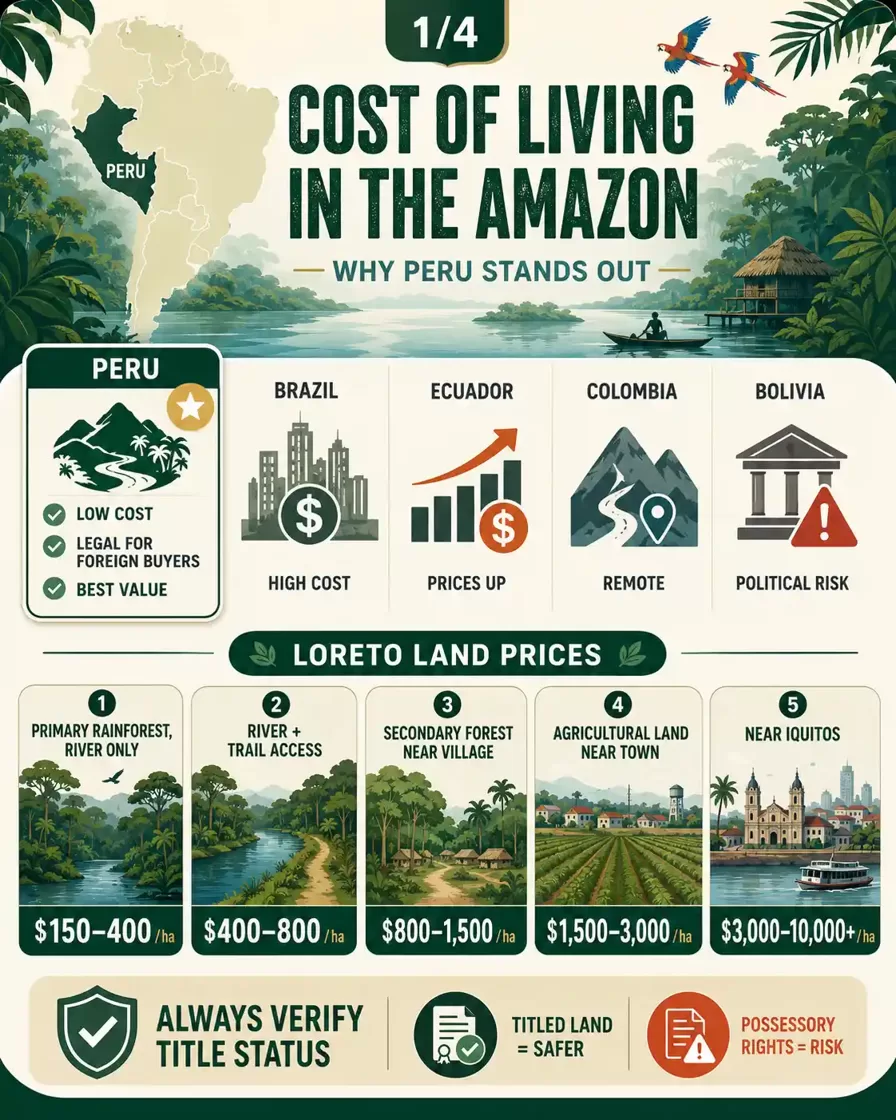
South America has plenty of jungle. Brazil, Ecuador, Colombia, Bolivia — they all have their share of the Amazon basin. But when you compare actual costs, legal accessibility for foreigners, and quality of life, Peru comes out ahead in almost every category.
Brazil is expensive and bureaucratically complex for foreign land buyers. Ecuador has driven prices up thanks to decades of expat migration. Colombia offers good infrastructure but jungle land near the Amazon is remote and poorly connected. Bolivia is cheap but politically unstable and offers limited legal protections for foreign property owners.
Peru sits in a sweet spot. Land prices in the Peruvian Amazon remain low. Foreigners can legally purchase property. The cost of daily life is a fraction of what you would spend in Central America or Southeast Asia. And the Loreto region — the largest department in Peru, almost entirely covered by primary rainforest — is where prices are lowest and nature is most intact.
If you have already been comparing countries, we wrote a detailed honest comparison of the best South American countries for expats. But if you have already decided on Peru, keep reading — here is where the real numbers start.
Legal due diligence
Before buying Amazon land, verify the legal title first
Price per hectare is only useful after the property title, access, boundaries, and transfer process are clear.
Land Prices in the Peruvian Amazon Per Hectare
Land is the foundation of everything. Without it, you are a tourist. With it, you are building something.
Here is what jungle land actually costs in the Loreto region as of mid-2026:
| Land Type | Price per Hectare (USD) | Notes |
|---|---|---|
| Primary rainforest, no road access | $150 – $400 | River access only, most remote |
| Primary rainforest, river + trail access | $400 – $800 | Suitable for projects, farming |
| Secondary forest near a village | $800 – $1,500 | Partially cleared, some infrastructure |
| Agricultural land near a town | $1,500 – $3,000 | Road access, power grid nearby |
| Land near Iquitos (periurban) | $3,000 – $10,000+ | Urbanizing, speculative prices |
Compare this to Costa Rica where jungle land starts at $5,000–$15,000 per hectare. Or Ecuador where anything near a town costs $8,000+. The Peruvian Amazon is not just cheaper — it is in a different price universe entirely.
Important detail: these prices are for land with clear title (título de propiedad). Land with only possessory rights (certificado de posesión) is cheaper but carries legal risk. Always verify the title status before purchasing anything.
We currently have land available in Loreto — 700 hectares of primary rainforest with river access. You can see the details on our land listing page.
How Much Does It Cost to Build a Home in the Jungle
You do not need a mansion. In fact, building heavy concrete structures in the Amazon is both expensive and impractical. Most people who live here long-term use a combination of local hardwood, raised platforms, and metal roofing — a design that has worked in this climate for centuries.
Here is a realistic breakdown:
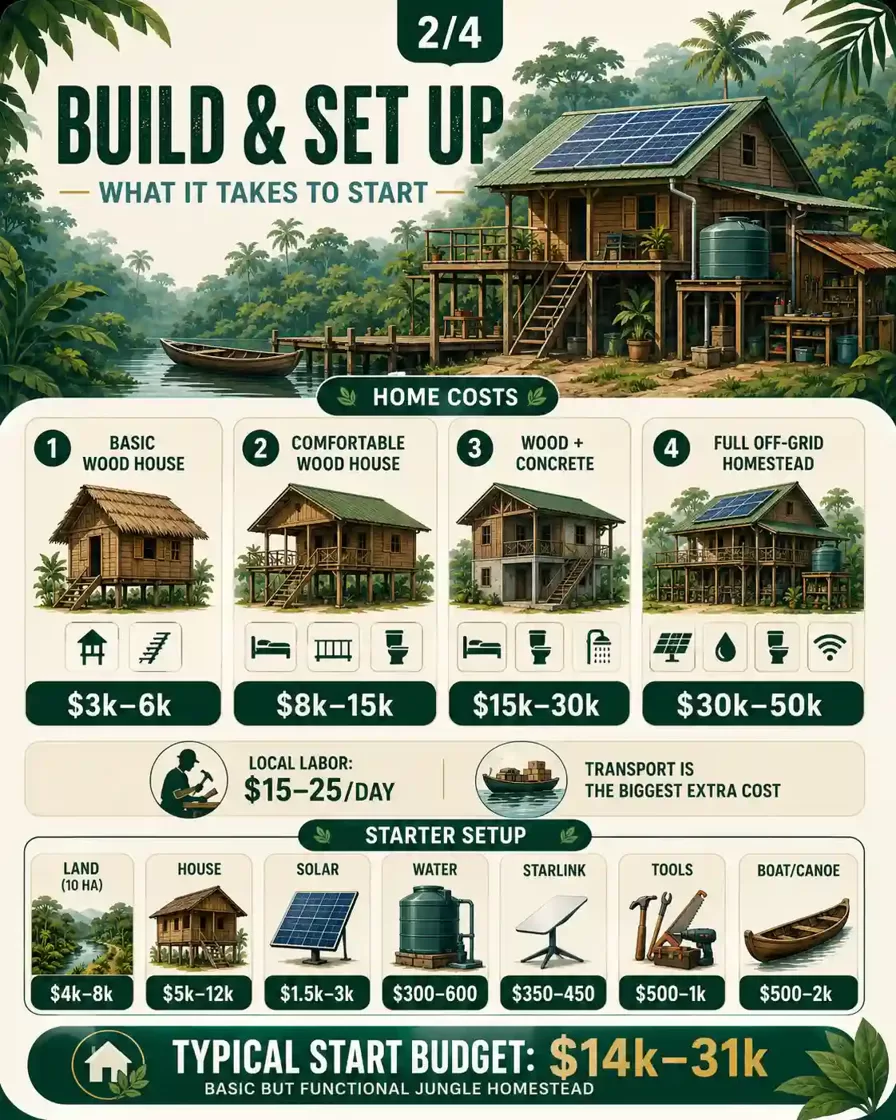
| Home Type | Approximate Cost (USD) | What You Get |
|---|---|---|
| Basic wooden house (40–60 m²) | $3,000 – $6,000 | Open layout, raised floor, tin roof, no plumbing |
| Comfortable wooden house (60–100 m²) | $8,000 – $15,000 | Separate rooms, basic plumbing, covered terrace |
| Mixed construction (wood + concrete) | $15,000 – $30,000 | Concrete foundation, wood upper, solar-ready, bathroom |
| Full off-grid homestead with systems | $30,000 – $50,000 | Solar panels, water filtration, satellite internet, workshop |
A few things to know. Hardwood is abundant and inexpensive locally — what would cost a fortune in Europe or North America is simply available here. Labor is affordable. A skilled carpenter charges $15–$25 per day. The biggest expense is usually transporting materials to remote locations, especially if your land has no road access.
Most people start with a basic structure and improve it over time. That is the smart approach. Live in it first, understand the climate and the land, then build what you actually need.
Monthly Living Costs in the Peruvian Amazon
This is the question everyone asks. Here is a straightforward answer based on real life in and around the Loreto region.
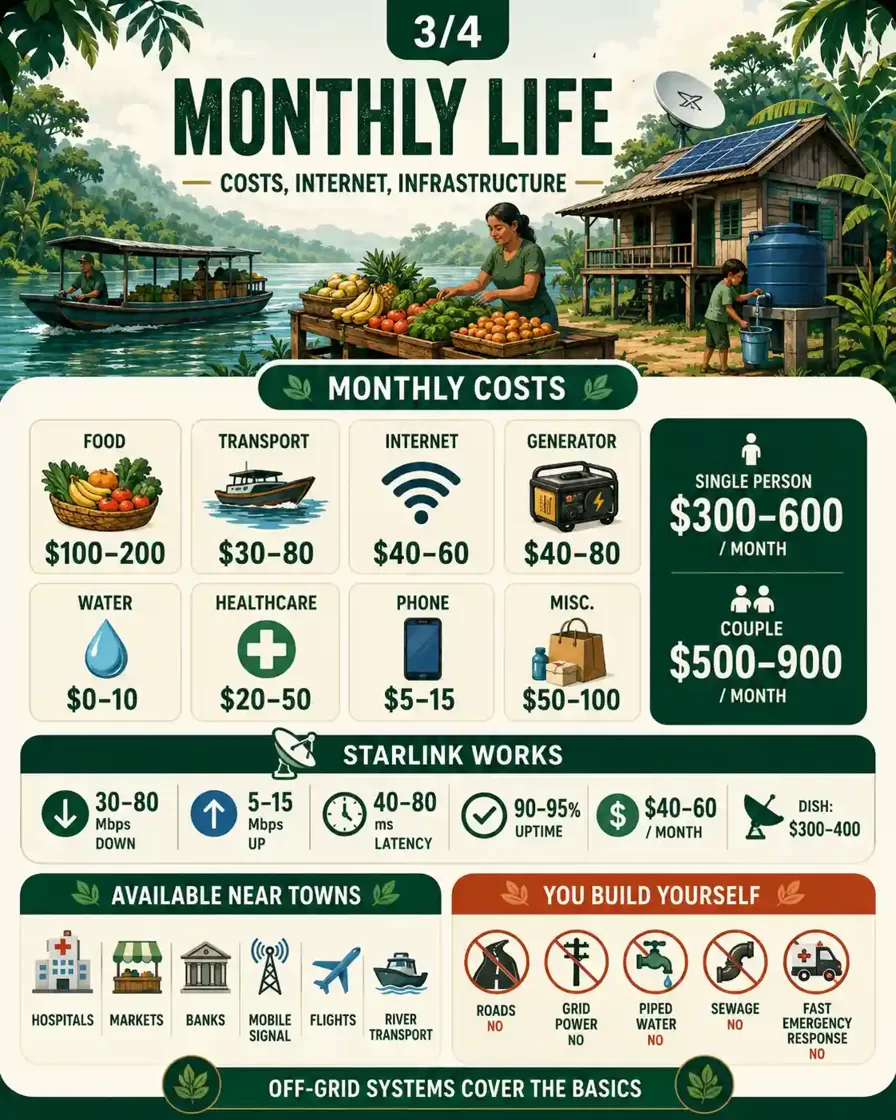
| Category | Monthly Cost (USD) | Notes |
|---|---|---|
| Food (local market + garden) | $100 – $200 | Rice, fish, fruit, vegetables. Meat and imported goods cost more |
| Transport (river + mototaxi) | $30 – $80 | Depends on distance from Iquitos |
| Internet (Starlink) | $40 – $60 | Works well in the jungle. Game-changer for remote workers |
| Electricity (solar system) | $0 (after initial investment) | 4-panel system costs $1,500–$3,000 upfront |
| Electricity (generator) | $40 – $80 | Fuel costs. Backup option |
| Water | $0 – $10 | Rainwater collection, river, or well |
| Healthcare | $20 – $50 | Basic care. Iquitos has hospitals for anything serious |
| Phone (mobile plan) | $5 – $15 | Coverage exists near towns, spotty in deep jungle |
| Miscellaneous | $50 – $100 | Tools, repairs, household supplies |
Total realistic monthly cost: $300 – $600 for a single person. $500 – $900 for a couple.
This is not a misprint. You can live a simple but comfortable life in the Peruvian Amazon for under $600 a month. This does not mean poverty — it means most of what you need comes from the land and the river, not from a supermarket.
For comparison, the average digital nomad in Medellín spends $1,500–$2,500 monthly. In Lisbon, $2,000–$3,000. In Bali, $1,000–$1,800. The Amazon is not competing with these places on lifestyle — it is offering something fundamentally different. But on pure cost, nothing comes close.
Is Peru really the best-value jungle destination?
The Peruvian Amazon makes more sense when compared against other rainforest regions by land access, costs, legal clarity, and quality of life.
What Can You Grow and Earn on Amazon Land
Living in the jungle is not just about spending less. The land produces.
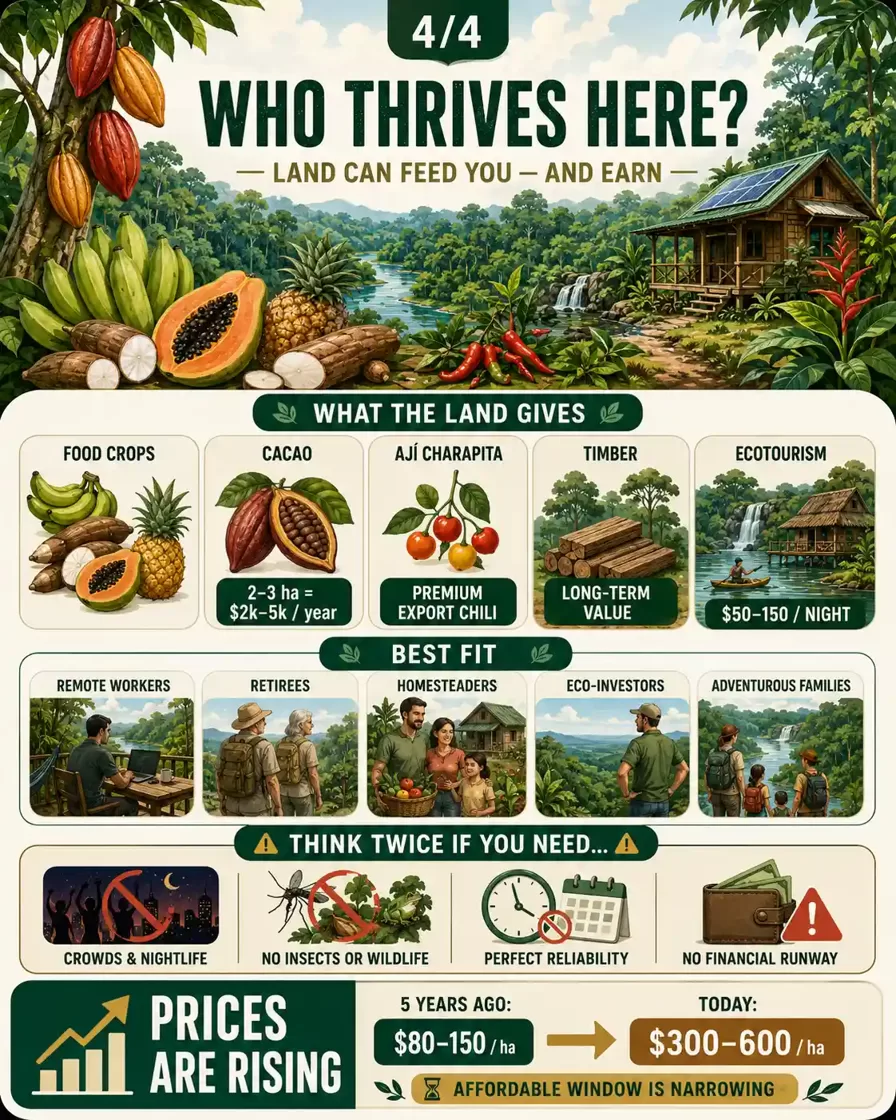
Within 6–12 months of basic cultivation, you can grow enough food to significantly reduce your grocery expenses. Bananas, plantains, yuca (cassava), papaya, pineapple, cacao, and dozens of other tropical crops grow here with minimal effort. The soil and climate do most of the work.
But there is also income potential.
Cacao is in strong demand globally. Peruvian cacao, especially from the Amazon basin, commands premium prices. A small plantation of 2–3 hectares can generate $2,000–$5,000 per year once mature.
Coffee grows well at slightly higher elevations within the jungle region. Specialty Peruvian coffee sells for $4–$8 per pound at export level.
Ají charapita — a tiny wild chili pepper native to the Loreto region — is one of the most expensive peppers in the world. Dried ají charapita sells for $25,000 or more per kilogram in international markets. It grows naturally on Amazon land and requires almost no cultivation. We wrote a detailed piece about this remarkable pepper and its commercial value.
Timber from sustainably managed forest plots has long-term value. Hardwood species like tornillo, cedro, and ishpingo take decades to mature but are worth significant money.
Ecotourism is another option. Travelers pay $50–$150 per night for authentic jungle experiences. If your land has wildlife, a river, and basic accommodation, you have a tourism business.
The point is this — Amazon land is not dead capital. It produces, it feeds you, and if managed well, it generates income.
Does Starlink Actually Work in the Amazon Rainforest
Yes. This is probably the single biggest change in jungle living over the past three years.
Before Starlink, internet in the deep Amazon was either nonexistent or painfully slow. You relied on mobile data near towns, or you simply went offline. For anyone running a remote business, freelancing, or just wanting to stay connected, this was a dealbreaker.
Starlink changed everything. We have tested it extensively in the Loreto region. Here is what we can confirm as of 2026:
- Download speeds: 30–80 Mbps (varies by weather and canopy cover)
- Upload speeds: 5–15 Mbps
- Latency: 40–80 ms
- Reliability: 90–95% uptime. Heavy rainstorms cause brief interruptions
- Monthly cost: approximately $40–$60 USD in Peru
- Equipment cost: $300–$400 one-time purchase (sometimes available used)
You need a clear view of the sky, which means either placing the dish above the tree canopy on a tall pole or positioning it in a clearing. Most people install it on a 10–15 meter pole attached to their house or a nearby tree. Works fine.
This means you can live in the middle of the Amazon rainforest and have a Zoom call with a client in New York. That was impossible five years ago. It is routine now.
Living systems
Jungle living works only when the basic systems are planned
Water, solar power, access, internet, tools, and emergency planning matter more than luxury design.
What Infrastructure Exists and What You Need to Build Yourself
Let's be direct about what the jungle provides and what it does not.
What exists near towns like Iquitos, Nauta, or Yurimaguas:
- Hospitals and basic medical clinics
- Markets with fresh food daily
- Banks and ATMs
- Mobile phone coverage
- Domestic flights to Lima (Iquitos has a commercial airport)
- River transport to surrounding villages and land
What does NOT exist on remote jungle land:
- Paved roads (most access is by river or dirt track)
- Grid electricity
- Piped water
- Sewage systems
- Emergency services with fast response times
This is not a disadvantage — it is the nature of the territory. If you want paved roads and municipal water, the Amazon is not for you. If you want clean air, pristine rivers, abundant wildlife, and silence, then building your own systems is simply part of the deal.
The good news: off-grid technology in 2026 is excellent and affordable. Solar panels, water filtration, composting toilets, and satellite internet cover all basic needs for a reasonable upfront investment. Most people set up a fully functional off-grid homestead for $5,000–$15,000 in infrastructure costs, on top of the house itself.
Who Should Not Move to the Amazon
Honesty matters more than sales.
This life is not for everyone, and pretending otherwise would waste your time and ours. Here are the types of people who tend to struggle:
People who need constant social stimulation. Jungle communities are small. Your nearest neighbor might be a 20-minute boat ride away. If you need cafés, nightlife, and crowds, this will feel isolating within weeks.
People who are uncomfortable with insects and wildlife. There is no way around this. The jungle has mosquitoes, ants, spiders, snakes, and dozens of creatures you have never seen before. You learn to coexist. But if the idea of a tarantula in your bathroom makes you unable to function, reconsider.
People who expect everything to work perfectly. Things break. Deliveries are late. The river floods. The solar panel gets covered in leaves. Jungle living requires patience, adaptability, and basic problem-solving skills. If you need predictability, this is the wrong environment.
People without any financial runway. You need savings or remote income. The local economy does not offer high-paying jobs for foreigners. Plan for at least 12–18 months of living expenses before your land starts producing anything meaningful.
Who Thrives in the Amazon
On the other hand, certain people find exactly what they were looking for.
Remote workers and digital entrepreneurs. With Starlink, you can run a business from the jungle. Your costs are minimal, your environment is peaceful, and your quality of life is high. Several people in the Loreto region are already doing this successfully.
Retirees seeking peace and low costs. If your pension or savings give you $800–$1,500 per month, you can live very comfortably in the Amazon. Better than most retirement destinations in Latin America.
Homesteaders and self-sufficiency seekers. If you have dreamed of growing your own food, building with your hands, and living close to nature, the Amazon offers that at a fraction of the cost of doing it in North America or Europe.
Conservationists and eco-investors. Owning Amazon rainforest is not just a lifestyle choice. It is an ecological asset. Primary forest generates carbon credits, supports biodiversity, and holds increasing value as the world recognizes the importance of standing forest. This is investment with purpose.
Adventurous couples and families. It sounds unlikely, but several families with children live in the region. The kids grow up bilingual, resilient, and deeply connected to nature. It is not mainstream — but it is real.
Amazon land is not only a place to live
Productive land can reduce food costs and open realistic paths through specialty crops, eco-tourism, conservation, or long-term forest value.
A Simple Budget to Get Started
If you are serious, here is what a realistic startup budget looks like:
| Item | Cost (USD) | Notes |
|---|---|---|
| Land (10 hectares, titled) | $4,000 – $8,000 | River access, primary or secondary forest |
| Basic house construction | $5,000 – $12,000 | Wooden, raised, 60–80 m² |
| Solar power system | $1,500 – $3,000 | 4 panels, battery, inverter |
| Water system (rain + filter) | $300 – $600 | Tank, gutters, ceramic or UV filter |
| Starlink setup | $350 – $450 | Dish + first month |
| Tools and initial supplies | $500 – $1,000 | Machete, chainsaw, cooking gear, seeds |
| Transport (boat or canoe) | $500 – $2,000 | Essential if river access |
| Buffer fund (6 months living) | $2,000 – $4,000 | Food, fuel, emergencies |
Total to get started: approximately $14,000 – $31,000
This is not a fantasy number. This is what it actually costs to establish a basic but functional jungle homestead in the Peruvian Amazon. For the price of a used car in the US, you can own land, have a home, and live off-grid in one of the most biodiverse places on Earth.
Obviously, you can spend more. A larger property, a more comfortable house, better solar systems, a proper workshop — these push the budget higher. But the entry point is genuinely accessible.
The Peruvian Amazon Is Not Getting Cheaper
One final point worth considering.
Land prices in the Loreto region have been rising steadily. Five years ago, you could buy primary forest for $80–$150 per hectare. Today, the same land sells for $300–$600. The trend is clear and driven by several factors: growing international interest, infrastructure improvements, Starlink availability, and increasing awareness of the Amazon's ecological and economic value.
This does not mean you should rush into anything. But it does mean that the window of genuinely affordable Amazon land is narrowing. Every year, more people discover this region. Every year, prices adjust.
If you have been thinking about this for a while, the cost of waiting is real.
Can foreigners legally buy titled land in the Peruvian Amazon?
Yes. Foreigners have the exact same constitutional property rights as Peruvian citizens, provided the land is located more than 50 kilometers away from an international border. You can purchase titled land (título de propiedad) directly in your own name, hold the deed, and register it with the national government database (SUNARP) without needing a local partner or permanent residency.
What is the difference between titled land and possessory rights in Peru?
A property title (título de propiedad) represents absolute, legally recognized ownership backed by the Peruvian state. Possessory rights (certificado de posesión) only grant permission to use the land, usually issued by a local village authority, but do not prove legal ownership. Foreign buyers should strictly purchase titled land to ensure their investment is secure and to avoid future boundary or ownership disputes.
Can buying property in Peru grant me residency as an expat?
Yes, purchasing real estate in Peru can qualify you for an Investor Visa. As of 2026, the required minimum investment threshold is 500,000 PEN (approximately $130,000 USD). Because Amazon land is highly affordable, the raw land purchase alone rarely reaches this threshold. However, expats commonly combine the land cost with documented home construction expenses, establish a local agricultural business, or opt for the separate Rentista visa based on independent monthly income.
Is it safe to live off-grid in the Peruvian rainforest?
From a crime perspective, rural areas in the Loreto region are exceptionally safe compared to major Latin American cities, and violent crime against foreign homesteaders is rare. The primary safety considerations are environmental. Living safely requires maintaining a reliable boat, understanding river navigation, keeping a well-stocked first aid kit for cuts or tropical infections, and respecting local wildlife. Preparation and common sense replace the need for heavy security.
Are solar panels reliable during the Amazon rainy season?
Yes, modern solar power systems perform highly effectively in the Amazon, even during the rainy months. Tropical regions receive intense UV radiation year-round. While heavy cloud cover reduces daily energy generation, a properly sized solar array paired with a modern lithium battery bank easily powers a standard household, refrigerator, and Starlink terminal through several days of rain. Having a small backup gasoline generator is a standard, inexpensive precaution.
How do off-grid homes handle water and sewage in the jungle?
Most homesteaders utilize a dual water system. Rainwater collection is highly efficient due to frequent, heavy downpours; the water is stored in large tanks and passed through ceramic or UV filters for safe drinking. For sewage, composting toilets are the most ecological and practical solution for the jungle environment, though some properties install professionally sealed septic tanks located safely away from groundwater sources.
Are property taxes expensive on rural land in Peru?
Property taxes (impuesto predial) on rural Amazon land are incredibly low. For a standard 10-hectare plot of rainforest, annual property taxes typically range between $20 and $50 USD per year, depending on the exact municipality and registered assessed value. Furthermore, Peruvian law provides substantial tax incentives and exemptions for registered agricultural and sustainable forestry projects.
Is Starlink fast enough for remote work and video calls in the jungle?
Absolutely. Starlink delivers highly stable download speeds between 30 and 80 Mbps with low latency across the Loreto region, making it perfectly capable of handling HD video conferences, large file transfers, and daily remote work. While intense tropical downpours can cause brief signal drops lasting a few minutes, overall reliability remains above 90%, transforming the reality of running an international business from the rainforest.
Weles Group operates in the Loreto region of the Peruvian Amazon. We own and manage rainforest land, and we help people navigate the process of purchasing property in this region. If you want to talk specifics — land availability, legal process, or logistics — contact us directly. No pressure, just real answers.
References & Official Sources
For legal verification, forest data, and regional context, always check official Peruvian institutions before making land or relocation decisions.