
Rainforest Land Valuation in Peru Why Price per Hectare Is Not Enough
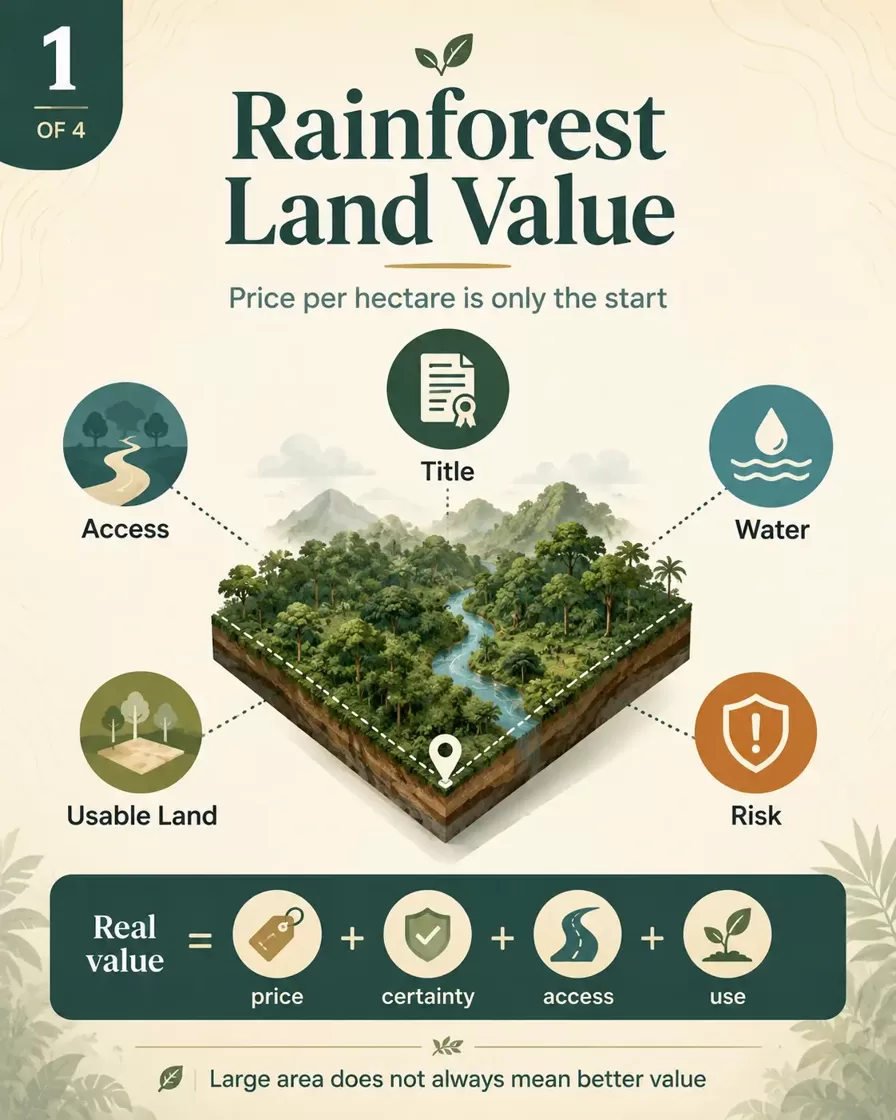 Rainforest land in Peru cannot be valued by price per hectare alone. The real value of jungle land depends on legal title, registered boundaries, access, water, terrain, forest condition, usable zones, local management costs and the buyer’s long-term plan.
A low price can look attractive at first. But in the Amazon, cheap land can become expensive if it has no reliable access, unclear ownership, seasonal flooding, boundary disputes or no practical way to manage the property. A higher price can be more rational when the land has clear documentation, year-round access, water sources, usable areas and realistic development potential.
For buyers looking at rainforest land for conservation, eco-tourism, agroforestry, retreat development or long-term private ownership, the right question is not only “How much does the land cost?” The better question is “What exactly gives this land value, and what risks are included in the price?”
Legal Checks Before Comparing Land Prices
Price per hectare only matters after the buyer understands title, boundaries and the legal route to ownership in Peru.
There Is No Universal Price for Rainforest Land in Peru
There is no single market price for rainforest land in Peru. Two properties can have the same number of hectares and very different real value.
One parcel may be remote, difficult to reach, poorly documented and expensive to maintain. Another may have a clean title, clear boundaries, river or road access, water, higher ground, natural beauty and practical zones for conservation or low-impact development.
That is why the advertised price per hectare is only the first number. It is not the full valuation.
A serious buyer should evaluate rainforest land through several layers:
- legal certainty;
- access and logistics;
- usable land area;
- water and flood risk;
- forest condition;
- infrastructure burden;
- possible use cases;
- long-term management costs;
- local risks;
- exit strategy.
The more uncertain these factors are, the more careful the buyer should be.
Why Can Price per Hectare Mislead Buyers
Price per hectare is useful for comparison, but it can also create false confidence.
A large property with a low hectare price may look like a bargain. But if the land is difficult to reach, has no registered boundaries or requires major investment before it can be used, the true cost may be much higher than expected.
A smaller or more expensive property may offer better value if it already has access, verified ownership, natural water, usable terrain and a realistic path toward the buyer’s goal.
In rainforest land valuation, the cheapest land is not always the best deal. The best deal is usually the property where price, risk, access and use potential are in balance.
The Real Valuation Formula for Rainforest Land in Peru
A practical way to evaluate rainforest land is this:
Real land value equals purchase price plus legal certainty plus physical access plus usable land plus infrastructure burden plus long-term management risk.
This formula is not a mathematical appraisal. It is a decision framework.
A buyer should not ask only:
“How many hectares do I get for this price?”
A better set of questions is:
- Can I prove what I am buying?
- Can I reach the land reliably?
- Can the boundaries be verified?
- Is there water?
- How much of the land is actually usable?
- What part should remain untouched forest?
- What will it cost to protect and manage the property?
- Can my intended use legally and practically work here?
- What risks are not visible in the listing?
This is where rainforest land becomes different from ordinary real estate. The value is not only in the land area. The value is in the certainty, access and realistic future use of the land.
Due Diligence and SUNARP Risk
A low land price can hide registration problems, possessory claims or unclear boundaries. These risks should be priced before any offer.
Legal Title Is the First Value Multiplier
Legal title is one of the most important factors in rainforest land valuation.
A property with clear ownership documentation is usually more valuable than land where rights are informal, unclear or difficult to verify. Buyers should understand the difference between registered ownership, possession claims, informal agreements and seller promises.
Before buying rainforest land in Peru, a buyer should verify:
- who legally owns the property;
- whether the title is registered;
- whether there are liens, disputes or restrictions;
- whether the boundaries match the documents;
- whether the seller has the right to sell;
- whether the property overlaps with protected, community or restricted areas.
This article is not legal advice. Foreign buyers should work with a qualified local lawyer and verify property records before making any payment or commitment.
For a deeper legal process, the article should internally link to your guide about legal steps before buying land in Peru.
What Should Buyers Check Before Trusting a Land Listing
A rainforest land listing can look attractive, but the documents matter more than the description.
Before treating a property as serious, buyers should ask for:
- ownership documents;
- registry information;
- cadastral or boundary maps;
- georeferenced coordinates if available;
- access description;
- photos and videos from different parts of the land;
- information about water sources;
- known restrictions;
- proof that the seller can legally transfer the property.
If a seller avoids documentation or gives vague answers, the risk should be reflected in the valuation. In some cases, it should stop the deal completely.
A beautiful piece of forest is not enough. A buyer needs legal clarity.
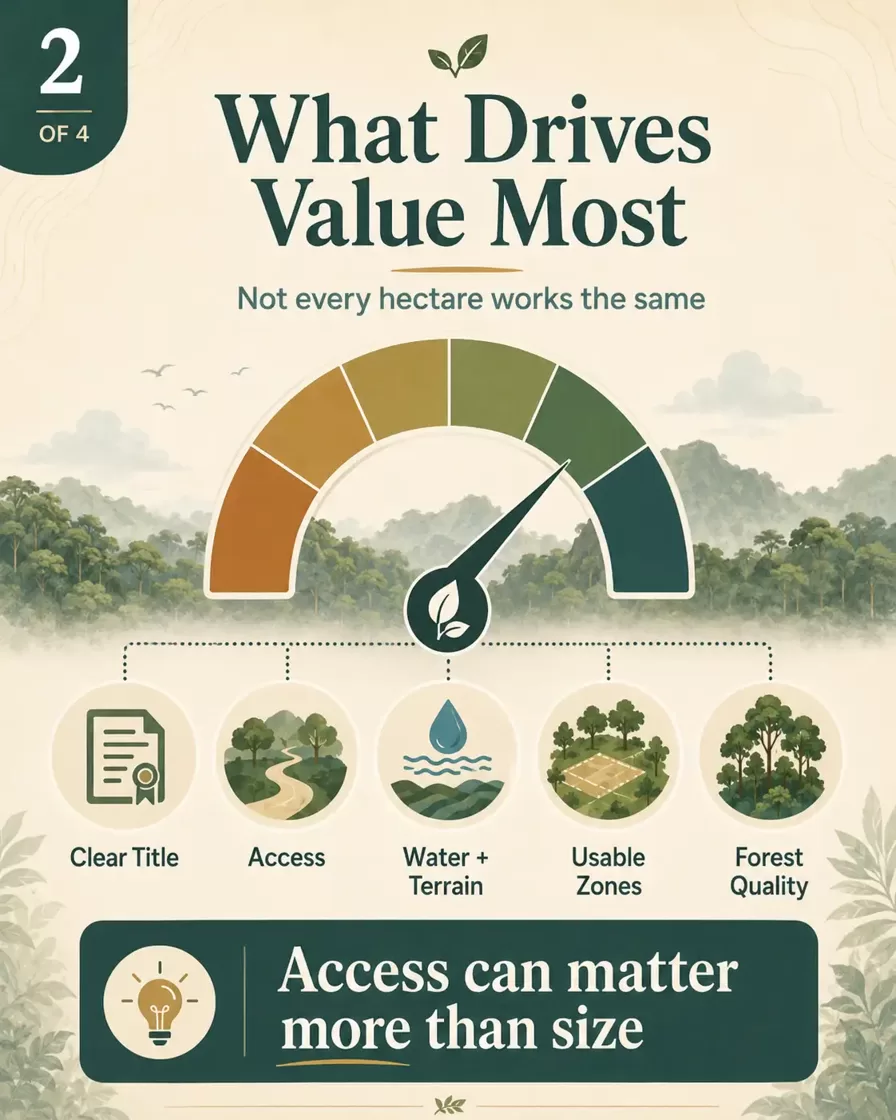
Access Can Matter More Than Land Size
Access is often one of the strongest value drivers for rainforest land in Peru.
A large property with weak access may be less useful than a smaller property that can be reached reliably. Access affects almost everything: inspection, construction, maintenance, tourism, emergency response, security, supplies and long-term management.
Buyers should evaluate:
- road access;
- river access;
- seasonal access;
- distance from the nearest city or town;
- distance from an airport or port;
- travel time during the dry season;
- travel time during the rainy season;
- emergency access;
- cost of transporting materials;
- cost of bringing workers or visitors.
A property that looks close on a map can still be difficult to reach in practice. In the Amazon, distance is not only measured in kilometers. It is measured in time, seasonality, transport options and reliability.
Real Listings and Eco Lodge Valuation
Raw rainforest land and a turnkey eco-lodge are valued differently. Compare land size, access, infrastructure and operational readiness.
How Does Water Affect Rainforest Land Value
Water can increase or reduce the value of rainforest land depending on the situation.
A clean stream, spring, river access or practical water source can support off-grid living, eco-lodge planning, agroforestry or basic infrastructure. But water also creates questions about flooding, erosion, wetland zones, mosquitoes, access interruptions and construction limits.
Buyers should check:
- whether water is available year-round;
- whether the land floods during the rainy season;
- where the higher and lower zones are;
- whether building areas remain dry;
- whether drainage is natural or problematic;
- whether river levels affect access;
- whether water can be used safely after treatment.
Water is not only a feature. It is part of the land’s risk profile.
Usable Land Is Different From Total Land Area
Total hectares do not tell the full story.
A rainforest property may include several types of land:
- intact forest for conservation;
- higher ground suitable for simple structures;
- lowland or flood-prone areas;
- riverbanks;
- trails or access corridors;
- agroforestry zones;
- steep or difficult terrain;
- sensitive habitat;
- areas that should not be disturbed.
A buyer should avoid thinking that every hectare has the same function or value.
For example, a 700-hectare property should not be valued only by multiplying the price per hectare by 700. The buyer should ask how much of that land is accessible, how much is buildable, how much is better preserved and what parts require long-term protection.
Large rainforest properties are often best understood as a mixed landscape, not as one uniform block.
Forest Condition Influences Conservation and Long-Term Value
Forest condition matters.
Intact forest, mature trees, biodiversity, wildlife corridors, water systems and natural beauty can increase the long-term value of rainforest land, especially for conservation, research, eco-tourism and nature-based projects.
But forest value is not always the same as fast resale value. A property may be ecologically important but still difficult to monetize. Buyers should separate ecological value from commercial liquidity.
Important questions include:
- Is the forest primary, secondary or degraded?
- Are there signs of illegal logging?
- Are there wildlife habitats?
- Are there streams, wetlands or special ecosystems?
- Is the land suitable for conservation?
- Is there potential for biodiversity monitoring?
- Would development damage the main value of the property?
For conservation buyers, forest condition can be the main asset. For development-focused buyers, forest condition defines limits and responsibilities.
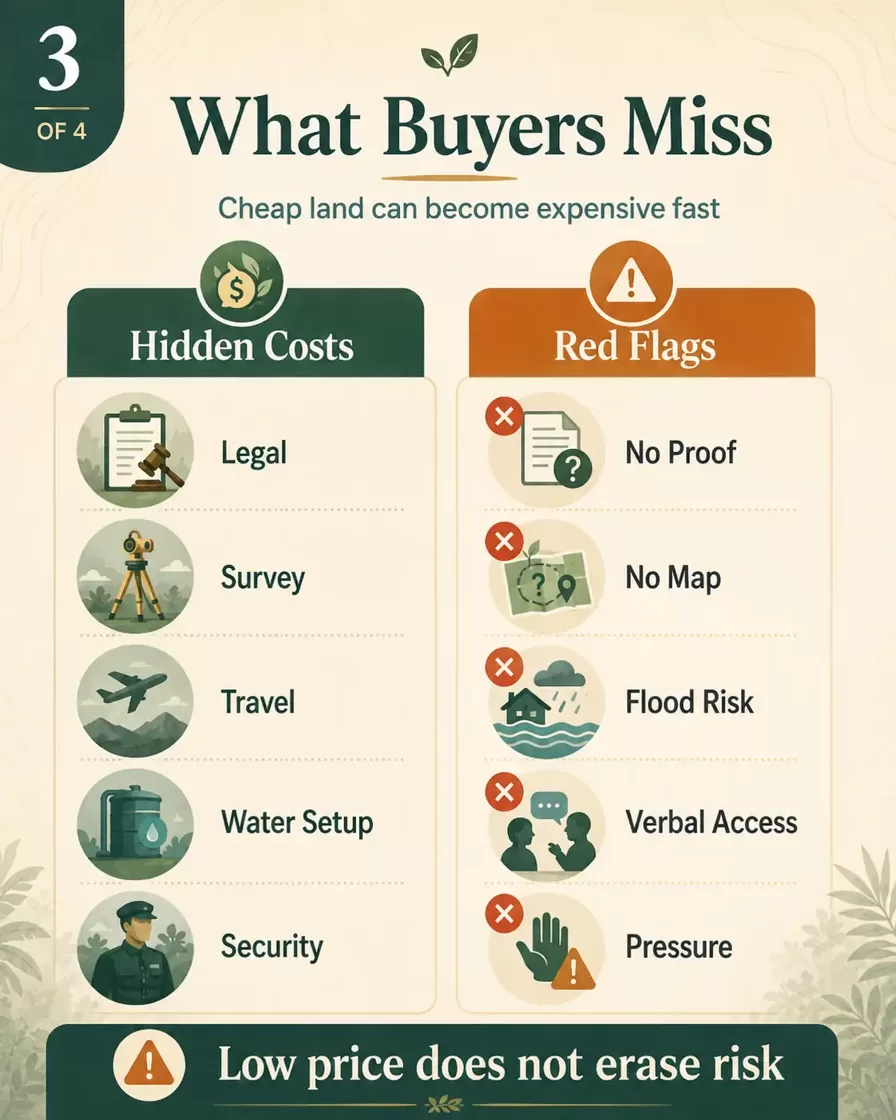
Hidden Costs Buyers Often Miss
The purchase price is not the only cost of rainforest land.
Buyers often underestimate the expenses that come before, during and after the transaction.
Common hidden costs include:
- legal review;
- notary costs;
- property registry verification;
- boundary survey;
- georeferenced mapping;
- travel for inspection;
- local transport;
- translation if needed;
- due diligence support;
- basic access improvements;
- water system setup;
- solar or off-grid energy;
- storage and security;
- caretaker or local manager;
- trail maintenance;
- taxes and transfer-related costs;
- ongoing visits;
- emergency repairs.
These costs can change the real value of a property.
A low purchase price can lose its advantage if the buyer must spend heavily on access, legal clarification, infrastructure and local management.
Calculators for Project Planning
Valuation should also include future use. These tools help estimate conservation, carbon and nature-based tourism scenarios before building a plan.
Raw Rainforest Land and Turnkey Eco-Lodge Properties Have Different Valuation Logic
Raw rainforest land and a turnkey eco-lodge are not valued the same way.
Raw land usually has a lower entry price, but the buyer takes on more work and risk. The buyer must think about access, water, trails, permits, buildings, staff, security, guest experience and long-term management.
A turnkey eco-lodge or retreat property may cost more, but part of the value comes from existing infrastructure. This can include cabins, paths, water systems, common areas, river access, operating history, staff knowledge or tourism positioning.
Raw land may be better for buyers who want to design everything slowly from the beginning. A turnkey property may be better for buyers who want a faster operational base.
The better option depends on the buyer’s goal, budget, patience and local experience.
How Should Buyers Evaluate a 700-Hectare Rainforest Property
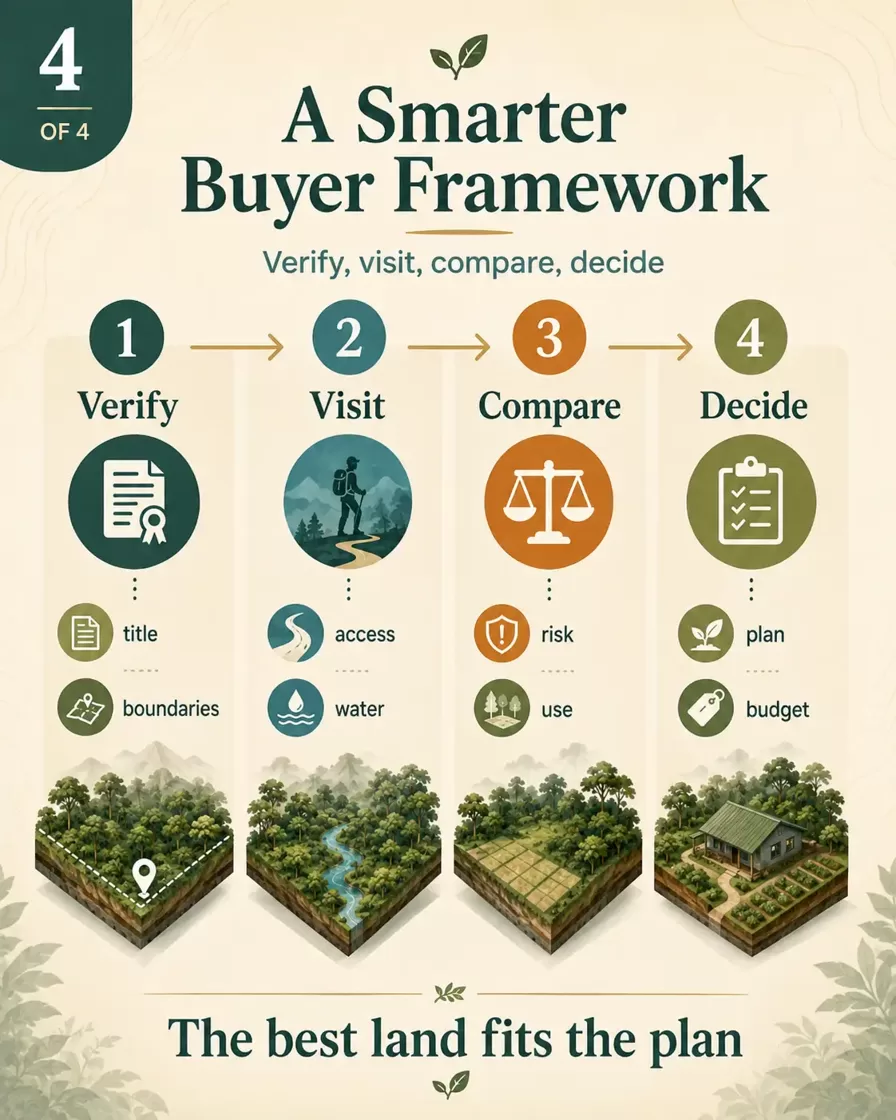
A 700-hectare rainforest property should be evaluated through a full buyer framework, not only by size.
A serious review should include:
- legal title;
- ownership chain;
- registered boundaries;
- access routes;
- dry season and rainy season logistics;
- water availability;
- forest condition;
- usable zones;
- conservation value;
- development limits;
- local management needs;
- security;
- realistic use cases;
- long-term budget.
A large property can be valuable because it allows a mixed-use model: conservation, limited eco-tourism, research, agroforestry and private long-term ownership. But the larger the land, the more important management becomes.
Size is an advantage only when the land can be understood, protected and managed.
This section should internally link to your page about 700-hectare rainforest land for sale in Peru.
When a Higher Land Price Can Be More Rational
A higher price can be justified when the property reduces buyer risk.
Rainforest land may deserve a stronger valuation when it has:
- clear legal title;
- registered boundaries;
- reliable access;
- water sources;
- usable high ground;
- existing trails or infrastructure;
- lower conflict risk;
- strong conservation value;
- practical eco-tourism potential;
- proximity to transport routes;
- a realistic local management setup.
In other words, the buyer is not only paying for hectares. The buyer is paying for certainty, usability and reduced friction.
For serious buyers, certainty has value.
When Cheap Rainforest Land Can Become Expensive
Cheap rainforest land can become expensive when the buyer discovers problems after the purchase.
Common reasons include:
- access is harder than promised;
- boundaries are unclear;
- title verification is incomplete;
- the land floods more than expected;
- there is no practical water solution;
- local conflicts exist;
- maintenance costs are high;
- basic infrastructure costs more than planned;
- the land is too remote for the intended use;
- the property cannot support the buyer’s business model.
Cheap land is not automatically bad. But cheap land needs stronger due diligence.
The lower the price, the more carefully a buyer should ask why the price is low.
Can Rainforest Land in Peru Generate Carbon Credits
Rainforest land may have carbon or nature-based project potential, but carbon credits are not automatic.
A buyer should not value land based only on promises of future carbon income. Carbon projects require eligibility, baseline analysis, monitoring, verification, documentation, long-term commitments and often specialist support.
A property may have conservation value without being suitable for a profitable carbon credit project.
Better questions include:
- Is the forest eligible for a carbon project?
- What baseline can be proven?
- Who would validate and monitor the project?
- What are the costs?
- What is the timeline?
- What risks could reduce the value?
- Is the seller making realistic claims?
Carbon potential can be part of valuation, but it should not replace legal, physical and financial due diligence.
This section should internally link to your Amazon rainforest carbon credits calculator.
What Red Flags Should Lower the Price or Stop the Deal
Some red flags should immediately reduce the valuation. Others should stop the deal completely.
Warning signs include:
- unclear ownership;
- no registry proof;
- no boundary map;
- seller avoids documents;
- price is justified only by future carbon credit promises;
- access exists only verbally;
- the property cannot be inspected;
- community conflicts are mentioned but not explained;
- protected area overlap is unclear;
- the seller pressures the buyer to pay quickly;
- no local professional is allowed to review the documents.
In rainforest land deals, uncertainty is not a small detail. Uncertainty is part of the price.
If a major risk cannot be clarified, the buyer should be ready to walk away.
A Practical Buyer Checklist for Rainforest Land in Peru
Before comparing two rainforest land offers, buyers should use a simple checklist.
Legal certainty
- Is the title registered?
- Can the seller legally transfer the land?
- Are there disputes, liens or restrictions?
- Do the documents match the actual land?
Boundaries and mapping
- Are the boundaries clear?
- Is there a map?
- Are coordinates available?
- Can a surveyor verify the property?
Access and logistics
- How do you reach the land?
- Is access possible year-round?
- What changes during the rainy season?
- How much does transport cost?
Water and terrain
- Is there reliable water?
- Does the land flood?
- Is there high ground?
- Are there suitable areas for low-impact structures?
Use potential
- Is the land suitable for conservation?
- Could it support eco-tourism?
- Is agroforestry realistic?
- Is private off-grid use practical?
- Are there restrictions?
Long-term management
- Who will manage the land locally?
- What will maintenance cost?
- How often must the owner visit?
- Is security needed?
- What is the 5-year or 10-year plan?
This checklist helps buyers compare real value, not just advertised price.
The Best Rainforest Land Valuation Looks Beyond the Sale Price
The real cost of rainforest land in Peru is not only the number in the listing.
A good valuation looks at purchase price, legal certainty, access, water, usable zones, forest condition, hidden costs, management needs and long-term strategy.
For buyers interested in conservation, eco-tourism, agroforestry, retreat development or private ownership, the strongest rainforest land is not always the cheapest or the largest. It is the land where the legal, ecological and practical conditions support the intended use.
Price per hectare is only the starting point. Real value begins when the buyer understands what the land can safely, legally and realistically become.
FAQ
How much does rainforest land cost in Peru?
There is no universal price for rainforest land in Peru. The value depends on legal title, access, boundaries, water, terrain, forest condition, usable areas, infrastructure needs and buyer risk. Price per hectare is only one part of the valuation.
Why is price per hectare not enough?
Price per hectare can hide important risks. A low price may reflect poor access, unclear title, flooding, boundary problems or high management costs. Buyers should evaluate the full property, not only the hectare price.
What makes rainforest land in Peru more valuable?
Rainforest land becomes more valuable when it has clear legal title, verified boundaries, reliable access, water, usable high ground, strong forest condition, low conflict risk and realistic potential for conservation, eco-tourism or agroforestry.
Is titled rainforest land worth more than untitled land?
In most buyer evaluations, clear registered title increases value because it reduces legal uncertainty. Untitled, informal or poorly documented land carries more risk and should be treated with much greater caution.
Is access more important than land size?
For many buyers, yes. Reliable access can be more important than total hectares. A smaller property with practical access may be more useful than a large property that is difficult or expensive to reach.
What hidden costs should buyers expect?
Buyers should plan for legal review, registry checks, notary costs, boundary surveys, mapping, travel, local transport, basic infrastructure, water systems, security, local management, maintenance and taxes or transfer-related costs.
Can foreigners buy rainforest land in Peru?
Foreign buyers may be able to buy property in Peru, but each transaction requires proper legal review. Buyers should verify ownership, restrictions, registration status and local rules with a qualified Peruvian lawyer before making any commitment.
Is raw rainforest land cheaper than a turnkey eco-lodge?
Raw rainforest land usually has a lower entry price, but it requires more planning, infrastructure and management. A turnkey eco-lodge may cost more because it already includes buildings, systems, access, trails or operating infrastructure.
Can rainforest land generate carbon credits?
Some rainforest properties may have carbon or nature-based project potential, but carbon credits are not automatic. Eligibility, validation, monitoring, documentation, costs and long-term commitments must be assessed by specialists.
How should buyers compare two jungle land offers?
Buyers should compare legal title, boundaries, access, water, usable zones, forest condition, hidden costs, local risks, management needs and intended use. The better property is not always the cheaper one.
Official References and Primary Sources
For land valuation in Peru, official checks should start with public registry, forest, protected area, environmental and water authorities.