
The Peru Investor Visa is a residence category based on a qualifying business investment. It is not a citizenship-by-investment programme, an unrestricted property-purchase visa or an automatic consequence of registering a Peruvian company.
Under the published investment rules, the investor must document a qualifying capital investment of at least S/ 500,000 and meet the applicable corporate, banking, immigration and background-check requirements.
The application route depends on whether the foreign national is outside Peru or is lawfully present and eligible to change immigration status within the country.
Once granted, investor residency generally lasts 365 days and can be renewed. Permanent residence is a separate application with additional conditions, not an automatic upgrade after the first year.
Thresholds, fees, documentation and administrative procedures must be checked against the applicable MIGRACIONES rules when applying. Published requirements may change.
What is the Peru Investor Visa?
The Inversionista Residente category allows a qualifying foreign national to reside in Peru for the purpose of establishing, developing or administering one or more lawful investments within the Peruvian legal framework.
It is administered by the Superintendencia Nacional de Migraciones, usually referred to as MIGRACIONES.
Although the expression Investor Visa is widely used in English, the legally relevant terminology is the immigration category calidad migratoria inversionista residente.
The distinction matters because immigration rights are determined by the approved category and its conditions, not by the marketing name used by an adviser or property seller.
What does investor residency allow?
The category provides a lawful basis for residence in Peru while the holder carries out activities permitted under that classification.
Under the applicable framework, investors may establish, develop or administer qualifying investments. Work performed through the company must respect the limitations of the immigration category and relevant labour and tax rules.
Official guidance identifies the investor's role in a company as that of manager or director, subject to the corresponding requirements.
An investor's residence status should not therefore be interpreted as unrestricted authorisation to undertake any form of employment for any business.
Is Peru's Investor Visa a golden visa?
Not in the sense commonly associated with programmes that grant residence in return for the purchase of qualifying real estate or other passive assets.
Peru's published Inversionista requirements focus on a particular form of business investment, supported by company documents and banking evidence.
Simply transferring money into the country, purchasing a house or acquiring an investment portfolio does not automatically establish eligibility.
The applicant must satisfy the specific requirements of the immigration category.
Does approval guarantee permanent residence or citizenship?
No. Initial investor residence, its renewal, permanent residence and naturalisation are separate procedures.
Each has its own legal basis, requirements and administrative decision.
Obtaining the initial Investor Visa does not guarantee later approval of a permanent-resident application or Peruvian citizenship.
Who is eligible for Peru's Investor Visa?
The central issue is whether the applicant can demonstrate a qualifying investment through the documentation required by MIGRACIONES.
Financial capacity alone does not establish eligibility.
Someone may have considerable assets and still be unable to qualify if the money has not been invested in the required manner.
Core eligibility conditions
The published procedures identify requirements involving the applicant, the investment and the receiving company.
- A valid passport or other accepted travel document.
- Compliance with the relevant immigration and background-check requirements.
- Evidence of a qualifying investment meeting the applicable minimum amount.
- Documentation showing the required international banking transfer.
- Corporate documents appropriate to a newly established company or a registered capital increase.
- Registration of the company and relevant capital changes with SUNARP.
- Compliance with the requirements governing the applicant's role and activities in the company.
Additional documents depend on the route chosen and the company's situation.
Is prior business experience required?
The official published investor procedures focus on the documented investment, legal eligibility and corporate records.
They do not establish a universal requirement for a particular university degree or a fixed number of years of entrepreneurship.
However, an applicant must still understand and comply with the business and immigration obligations arising from the investment.
Can the applicant work in the company?
The investor category is associated with establishing, developing or administering the investment and with management or directorial activities permitted under the relevant rules.
Whether a specific role, salary or other arrangement is allowed should be checked against immigration, labour and tax requirements.
A shareholder, employee, director and independent contractor have different legal positions. They should not be treated as interchangeable merely because the same person is involved in the business.
The S/ 500,000 minimum investment requirement
The published framework for Peru's investor residence category sets a minimum qualifying investment of 500,000 Peruvian soles.
Its approximate value in another currency changes with exchange rates. For immigration purposes, the applicable amount and proof of investment must be evaluated under the Peruvian rules rather than an informal conversion into US dollars or euros.
Is S/ 500,000 a fee paid to the government?
No. The investment threshold is not an immigration application fee.
The money must be invested in the legally recognised manner. It is separate from application charges, notarial expenses, company-registration costs and professional fees.
It would be misleading to describe the residence process as simply paying S/ 500,000 to receive a visa.
Can you invest less than S/ 500,000?
A smaller investment may be commercially possible, and foreign nationals can participate in Peruvian businesses under the relevant legal rules.
But a transaction below the published minimum should not be presented as satisfying the ordinary Inversionista threshold.
People who do not meet the conditions may need to assess other immigration categories rather than assume that a small business investment will be sufficient.
Can several smaller transfers be added together?
This is a particularly important planning issue.
The published investor application rules refer to an international transfer made in a single disbursement through a banking or financial institution supervised within Peru's SBS framework.
A sequence of smaller transfers should not be presumed equivalent to the required transaction.
Before moving money, obtain advice on the required transfer structure, the identity of the sender and recipient, the currency conversion and the evidence MIGRACIONES will accept.
Do several investors qualify through one large company investment?
Not automatically.
If several foreign shareholders invest through the same company, each prospective immigration applicant must establish whether their individual documented investment satisfies the requirements.
A company's total capital cannot simply be treated as a qualifying personal investment for every shareholder.
Investment amounts, ownership rights and corporate documents need to be examined separately for each applicant.
Investing in a new company versus increasing capital in an existing company
MIGRACIONES distinguishes between investment made through a newly established business and investment made through a capital increase in an already constituted company.
The distinction affects the required documentary evidence and the timing of corporate formalities.
Option A — Investment in a newly formed Peruvian company
A foreign entrepreneur may consider establishing a company in Peru and providing qualifying capital to support its activities.
The official investor procedure calls for a copy of the company's public deed of incorporation when the investment is associated with a newly formed entity.
The published procedure also includes a freshness requirement for the relevant incorporation document.
This creates an important sequencing question: the banking transfer, incorporation, registration and immigration filing must be coordinated so that the documents satisfy the applicable requirements at the time of submission.
Registering a company without documenting the qualifying capital investment is not sufficient.
Company formation does not equal immigration approval
SUNARP registration establishes the legal existence of the relevant entity. A RUC from SUNAT establishes tax registration.
Neither document automatically gives the shareholder residence rights.
The immigration application must independently demonstrate that the investor satisfies the requirements of the Inversionista category.
Option B — Increasing capital in an existing company
Another potential route involves a qualifying new capital contribution to a company that is already registered.
For this situation, MIGRACIONES identifies additional documentation, including the public deed recording the capital increase and evidence concerning the company's previous tax declaration and operations.
The published requirements also request information concerning the applicable municipal operating licence.
This is different from purchasing shares directly from an existing shareholder.
Why an existing company requires additional examination
A company that has been operating for several years may have liabilities, employment obligations, contracts, tax exposure or unresolved legal matters.
A prospective investor must therefore examine the business independently of the immigration application.
A company can satisfy the formal requirements for registration while still being a poor commercial investment.
Relevant due diligence may involve SUNARP records, SUNAT status, financial statements, contracts, licences, ownership structure and pending disputes.
Is an SAC the best business structure?
A Sociedad Anónima Cerrada, or SAC, is a common Peruvian corporate structure for privately held businesses.
However, it is not automatically the most suitable form for every investor.
The correct structure depends on the number of participants, corporate governance, tax considerations, intended activities and the investor's position.
Company law and immigration law should be considered together before incorporation.
SUNARP provides an official overview of the steps for forming a company in Peru.
Does buying property in Peru qualify for the Investor Visa?
Buying real estate in Peru does not automatically qualify a foreign national for investor residency.
This is one of the most consequential misunderstandings in discussions of Peru's investment immigration framework.
Foreigners may generally purchase qualifying private property under Peruvian law, subject to restrictions including Article 71 of the Constitution.
But the ability to own property and the right to obtain residence as an investor are separate legal questions.
Buying a home or apartment
Purchasing a residential property in Lima, Cusco, Arequipa or another city does not by itself establish the required corporate capital investment.
The purchase may serve a personal housing purpose or form part of a broader financial plan, but that does not make the buyer automatically eligible for the Inversionista category.
Buying rainforest land
A private rainforest parcel in Loreto is also a real-estate asset rather than, by itself, proof of a qualifying corporate investment.
Even a substantial land purchase needs to be examined separately from the immigration rules.
Land classification, the seller's title, foreign ownership restrictions and permitted activities must also be reviewed.
For property-specific legal information, see How to Buy Land in Peru as a Foreigner.
Buying an existing eco-lodge or tourism business
This situation is more complex because a business acquisition may involve property, buildings, equipment, commercial contracts and shares in a Peruvian company.
Purchasing a company's existing shares is not necessarily the same as providing a newly documented capital contribution to that company.
If the buyer's objective includes investor residency, the transaction should be structured only after a qualified immigration lawyer and corporate adviser have examined whether it can satisfy the applicable investment requirements.
The purchase price of a business should never be represented as proof of Investor Visa eligibility without this assessment.
WELES Group presents an established Amazon eco-lodge and rainforest property near Iquitos. Its acquisition terms, company structure and potential immigration consequences are separate matters requiring independent verification.
What about passive real estate investments?
Owning rental apartments, receiving rental income or purchasing land for future resale does not automatically fulfil the published Inversionista requirements.
Where a person's principal financial situation involves stable permanent income rather than active corporate investment, the Rentista category may deserve separate examination.
The two categories should not be confused.
International bank transfers and proof of investment
For the Investor Visa, the evidence of how the investment entered Peru can be as important as the amount itself.
MIGRACIONES requires documentation of a qualifying international transfer through the relevant supervised banking or financial system.
This is not a minor technicality that can safely be resolved after the money has been moved.
Why the payment route matters
An investor may have sufficient funds but choose a transaction method that does not produce the evidence required for the immigration application.
Examples include undocumented cash movements, poorly structured third-party payments or multiple transfers that do not match the published single-disbursement requirement.
A valid commercial transaction is not automatically a qualifying immigration transaction.
Which documents may be useful?
The required evidence should be established before payment. Depending on the circumstances, the documentary file may involve:
- Bank confirmation of the international transfer.
- Documents identifying the remitter and beneficiary.
- Evidence of the amount, date, currency and transaction reference.
- Corporate records reflecting the intended capital contribution.
- The public deed of incorporation or registered capital increase, as applicable.
- Relevant compliance and source-of-funds documentation.
The precise documents accepted by MIGRACIONES and the receiving bank must be confirmed for the transaction.
Currency conversion and the required amount
Because the published investment threshold is denominated in soles, exchange-rate movements and banking charges can affect the recorded amount.
Investors should not send the exact equivalent of the minimum based on an informal exchange rate without first confirming how the receiving institution and immigration authorities will document the transaction.
The financial arrangements should be determined before the transfer, not reconstructed after it.
Source-of-funds verification
Banking institutions may request information concerning the origin of funds, the parties involved and the commercial purpose of a transfer.
The documents depend on the source of wealth and the bank's compliance procedures.
For example, personal savings, proceeds from a business sale and funds held through a company may require different supporting records.
Documentation should be accurate and consistent across banking, corporate and immigration filings.
Peru Investor Visa document checklist
The exact checklist depends on whether the applicant is requesting the residence category from outside Peru or applying for a change of immigration status inside the country.
The following items summarise the main categories of evidence without treating every document as universally required in every situation.
Applicant documents
- Completed application form for the relevant procedure.
- Valid passport or other accepted travel document.
- Required evidence of criminal, police and judicial history.
- Documents requested for any applicable immigration status change.
- Proof of payment of the correct administrative fee.
Investment and company documents
- Evidence of the required investment amount.
- Documentation of the qualifying international banking transfer.
- Company incorporation deed for a new business, where applicable.
- Public deed of capital increase for an existing company, where applicable.
- Relevant SUNARP corporate registration information.
- Company tax and operating-licence documents when required by the chosen route.
Apostilles and legalisation
Foreign public documents may need apostille or consular legalisation, depending on where they were issued and the applicable recognition rules.
Where translation is required, the accepted form of translation should be confirmed with the relevant authority.
Applicants should also check document validity periods. A document that was acceptable several months earlier may no longer satisfy the procedural requirement on the day of filing.
Is an Interpol certificate necessary?
The official published procedure for changing to the Inversionista category inside Peru includes a reference to the Ficha de Canje Internacional.
However, Peru has also seen administrative and legal decisions affecting the enforceability of particular document requirements in migration procedures.
The correct obligation must therefore be checked against the current TUPA, applicable rules and the actual requirements shown by MIGRACIONES for the application.
Do not assume that an older checklist is conclusive merely because it remains accessible online.
How to apply for a Peru Investor Visa from outside the country
MIGRACIONES publishes a specific procedure for foreign nationals requesting investor residence while outside Peru.
It is an online immigration procedure, but the requirements and applicant's location remain legally significant.
The official service is called Solicitar calidad migratoria de residente para inversionista.
Official MIGRACIONES Investor Visa application from abroad.
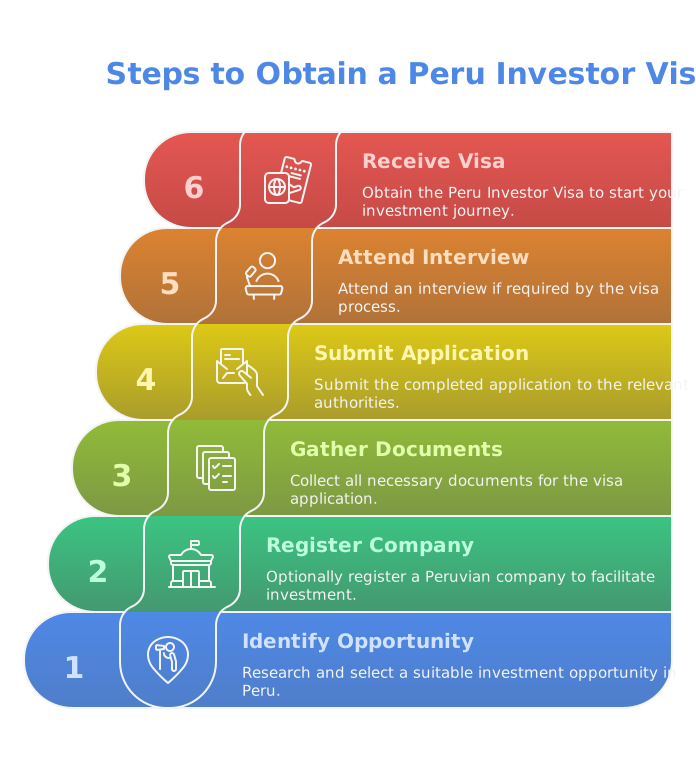
Confirm the correct immigration category
Before forming a company or moving funds, establish that the planned investment satisfies the Inversionista conditions and that no other residence category is more appropriate.
Prepare the corporate investment
Coordinate the relevant company documentation, investment structure and international transfer with qualified Peruvian corporate and immigration professionals.
Obtain the required applicant documents
Prepare the passport, relevant background certificates and other required records. Check legalisation, translation and validity requirements.
Use the appropriate MIGRACIONES procedure
Complete the application through the official digital agency, selecting the investor residence service intended for applicants outside Peru.
Pay the administrative fee
Use the payment instructions associated with that specific procedure. Confirm the current amount, payment code and accepted method before paying.
Upload the documentary file
Submit the required evidence in the formats accepted by the system. Confirm that names, dates, investment figures and corporate information are consistent.
Monitor the official electronic mailbox
Keep the application number and access credentials. MIGRACIONES communicates observations, notifications and decisions through its official channels.
Complete the post-approval entry and identification steps
Follow the instructions applicable to the approval, visa issuance or entry arrangements and subsequent foreign-resident identification. Do not assume that online approval alone completes every stage.
How long does the application take?
The current official procedure publishes an administrative response period of 30 working days.
This should not be interpreted as a guaranteed total duration from the decision to invest to arrival in Peru.
Company establishment, banking compliance, document legalisation, appointments and additional administrative observations may require separate time.
Can a representative submit the application?
The official rules address representation in certain circumstances and set requirements for representatives.
Whether representation is accepted for the particular application must be checked under the procedure being used.
Professional assistance does not remove the applicant's obligation to provide correct information or comply with the legal requirements.
How to change immigration status to Investor while in Peru
A foreign national who is already lawfully present in Peru may be eligible to request a change of immigration status to the investor category.
This is not the same procedure as applying from outside the country.
The official service is called Cambiar a calidad migratoria inversionista.
Official MIGRACIONES change to investor residence.
Who can use this route?
The applicant must satisfy the applicable requirements for changing immigration status within Peru.
They should confirm that their current immigration status remains valid and permits the relevant application and preparatory activities.
Merely being physically present in Peru does not establish eligibility for every immigration procedure.
What differs from applying abroad?
The in-country route has its own application form, payment instructions and published requirements.
Its current official checklist refers to the qualifying investment, the international transfer, corporate documentation and the relevant background records.
For an existing company, it also requests information concerning the company's income-tax filing and municipal operating licence.
Applicants should not combine documents from different procedures without verifying which items actually apply.
What if the person entered Peru as a tourist?
A foreign national who is lawfully present as a tourist should not assume that tourist status authorises them to carry out all business activities in Peru.
The ability to sign contracts, establish a company, perform paid work or undertake a particular immigration procedure can depend on the person's existing status and any required permissions.
A lawyer should examine the proposed sequence before the person begins activities that may be incompatible with tourist status.
Does the applicant have to appear personally?
The published in-country Investor Visa procedure describes the application as personal and generally not open to filing through a representative.
Because rules concerning representation may be affected by later legal or administrative developments, the current treatment should be verified before preparing the application.
Assistance with documentation and company matters does not necessarily mean a third party can replace the applicant in every immigration step.
Processing time and notifications
The published procedure identifies an administrative response period of 30 working days.
The applicant receives relevant information through MIGRACIONES' digital channels and must respond to any official observations within the applicable deadlines.
The existence of a published response period does not guarantee approval.
How much does a Peru Investor Visa cost?
The overall cost has several components. The qualifying investment is only one of them.
It is important to distinguish money invested in the company from fees paid to government bodies and the costs of obtaining professional assistance.
| Cost category | What it covers |
|---|---|
| Investment capital | Minimum qualifying capital under the applicable investor rules, currently published as S/ 500,000 |
| Immigration application | Official administrative fee for the specific application route |
| Company formation or capital increase | Corporate documentation, notarial services and relevant registration expenses |
| Banking | International transfer charges, compliance and possible currency-conversion expenses |
| Foreign documents | Background certificates, apostilles, legalisation and accepted translations |
| Professional services | Independent immigration, corporate, tax and accounting advice as needed |
| Post-approval expenses | Applicable resident identification, ongoing corporate administration and later renewal procedures |
Why official fees differ between application routes
MIGRACIONES publishes different administrative procedures for applying from abroad and changing status inside Peru.
These procedures have different fee schedules and payment codes.
Use the amount and code displayed for the actual route being filed. Do not rely on an estimate stated in US dollars or a fee copied from an unrelated migration procedure.
Administrative charges can change independently of the qualifying investment threshold.
How much should you budget for professional services?
The appropriate professional scope depends on how complex the investment and application are.
A straightforward capital contribution to a correctly registered company may involve fewer questions than a transaction combining foreign shareholders, an existing operating business, real estate and several family members.
Before engaging advisers, request a clear description of services, deliverables, third-party fees and tasks that remain the applicant's responsibility.
Can a consultant guarantee approval or speed up the process?
No private adviser can guarantee a favourable immigration decision.
Qualified assistance may help identify missing documents, prepare a consistent application and coordinate legitimate procedures.
It cannot remove statutory conditions, guarantee processing times or ensure that MIGRACIONES exercises its decision-making authority in a particular way.
What happens after Investor Visa approval?
Receiving approval of the relevant residence category is an important step, but a new resident should also understand the practical and administrative responsibilities that follow.
Carné de Extranjería and resident identification
The Carné de Extranjería is the identification document issued to qualifying foreign residents.
The card identifies the holder and contains information associated with their immigration status.
MIGRACIONES distinguishes between the validity of the identity card and the validity of the underlying residence permission.
For example, a resident may have an identification card that remains physically valid after an annual residence period needs renewal.
These are separate obligations.
Corporate responsibilities continue
Investor status does not remove obligations involving tax declarations, corporate records, employment, municipal licensing or other business requirements.
The company must continue to operate within the relevant legal framework.
A residence application should therefore not be viewed as the final objective of the investment structure.
Keep records from the beginning
Investors should preserve a clear record of important documents, including company registration, bank transfers, tax declarations, immigration decisions and residence extensions.
These records may become relevant during renewal or a later permanent-resident application.
How to renew Peru Investor Visa residency
Investor residence is not generally granted indefinitely at the initial stage.
The ordinary residence period is 365 days, with the possibility of extension where the relevant conditions remain satisfied.
The renewal procedure is called Prórroga de la calidad migratoria inversionista residente.
Official MIGRACIONES Investor Residence Renewal.
When should renewal be requested?
MIGRACIONES instructs investor residents to request renewal 30 days before the existing residence expires.
The application must be made through the appropriate procedure while the applicant satisfies the current conditions.
It is sensible to monitor the expiry date well in advance because business records and supporting documents may take time to obtain.
What evidence is requested for renewal?
The published investor renewal procedure includes documents concerning the applicant's background declaration and the continued functioning of the company.
The documentation includes the latest annual corporate income-tax declaration and relevant corporate documents where the investment involved a capital increase.
The company must remain properly registered, and the applicant must comply with the legal requirements associated with the investor category.
Does the company need to remain active?
Continued lawful business activity matters because the residence category is tied to the qualifying investment and applicable conditions.
An investor should not assume that the original capital transfer is sufficient to support indefinite renewals regardless of what happens to the company.
Changes in ownership, business operations or corporate status should be reviewed for their potential immigration consequences.
Is renewing the Carné de Extranjería the same thing?
No. MIGRACIONES distinguishes renewal of the resident identification card from extension of the residence category.
One procedure does not automatically replace the other.
Residents should track both the identity document and the validity of their immigration permission.
Can an investor obtain permanent residency in Peru?
Yes, qualifying investor residents may apply to change to permanent-resident status after meeting the applicable legal conditions.
Under the published MIGRACIONES procedure, the general residence requirement is three consecutive years.
This does not mean that permanent residency is granted automatically when the third anniversary arrives.
Three years of residence is only one condition
The permanent-resident application involves its own eligibility review, supporting documents and administrative decision.
The applicant must also respect the applicable conditions concerning lawful residence and time spent outside Peru.
Relevant compliance records should therefore be maintained from the beginning of investor residence.
Additional requirements for investors
The published permanent-residence procedure contains additional documentary requirements for applicants relying on previous investor status.
Among other items, MIGRACIONES identifies:
- Evidence concerning the company's annual income-tax declaration and financial solvency.
- Documents showing relevant tax and social-security compliance.
- Personnel payroll records for the preceding three months.
- Evidence relating to ten jobs for Peruvian nationals.
- Applicable tax documentation concerning the investor's income or role.
The same procedure identifies a minimum annual gross-income measure of S/ 55,000 in the relevant investor requirements.
These conditions are important for planning, particularly where a business is small or has few employees.
They must be examined under the version of the rules in force when the permanent-resident application is submitted.
Critical distinction: the published ten-job and income requirements arise in the additional documentation for an investor seeking the change to permanent residence. They must not be confused with the ordinary document list for the initial Inversionista application.
Why long-term planning matters
An investor may qualify initially through an appropriate capital contribution but later discover that the business does not meet the conditions necessary for the intended permanent-residence route.
Someone whose long-term objective is permanent residence should therefore examine the requirements for both stages before committing to the investment.
This is especially relevant for small companies, holding companies and businesses with limited staffing.
Official procedure — Change to Permanent Resident Status.
Is permanent residence the same as citizenship?
No. Permanent immigration status and Peruvian nationality are legally different.
Naturalisation has separate eligibility, residence and procedural requirements that may change under nationality legislation and implementing rules.
Anyone considering citizenship should check the current official nationality procedure rather than assume that permanent residence automatically leads to a passport.
Can an investor bring a spouse and children to Peru?
Peru provides a separate Familiar Residente immigration category for qualifying family members of Peruvian nationals and foreign residents.
Family residence is based on a documented family relationship and the applicable conditions.
It should not be presented as an automatic addition to an investor's own approval.
Spouse or recognised partner
A spouse may be eligible for the appropriate family-resident procedure when the relevant relationship and sponsor conditions are satisfied.
Documentation may involve a marriage certificate that meets the applicable validity, apostille or legalisation requirements.
Registered partnerships may involve different evidence under Peruvian rules.
Minor children
Children may be eligible under the family-resident framework, subject to the relevant relationship, parental-authority and documentation requirements.
Applications for minors follow procedures different from those applicable to adults.
The family should establish whether the child must apply from abroad or through an available in-country procedure.
Adult children and other relatives
Some family-resident rules cover additional relationships under specific conditions, such as qualifying adult children continuing their studies or eligible parents.
These rules should be checked individually.
Not every adult relative qualifies merely because the principal applicant has investor residence.
Can family residents work?
Peru's published Familiar Residente procedure permits certain qualifying holders to undertake dependent or independent remunerated activities.
However, the specific rights and conditions applicable to a family member should be checked under their approved status.
The investor's own work limitations and the family member's employment rights are not necessarily identical.
Official procedures — Family Residence for Adults and Family Residence for Minor Children.
How long can Investor Visa holders stay outside Peru?
Investor residency should not be confused with permission to remain outside Peru indefinitely.
Peru's immigration legislation includes restrictions on prolonged absence for residents who do not hold permanent status.
Under the published framework, an absence exceeding 183 consecutive days may lead to loss of non-permanent residence status, unless an applicable exception or authorisation is obtained.
Does investor residency allow frequent international travel?
The category can support international travel and re-entry under the applicable rules.
However, frequent travel should be planned with attention to the validity of residence and the legal consequences of extended absence.
Someone who expects to spend most of the year abroad should examine whether the category is compatible with that pattern of living.
What if a resident must remain abroad for an emergency?
MIGRACIONES publishes a procedure for requesting authorisation for a prolonged absence in certain circumstances involving emergency or force majeure.
The applicant must provide the required justification and supporting documents.
Approval is not automatic.
Official procedure — Authorisation to Remain Outside Peru for More Than 183 Days.
Immigration residence and tax residence use different rules
These two concepts must not be confused.
Immigration residence determines the person's legal permission to remain in Peru.
Tax residence determines how income is treated under tax law.
The fact that both systems refer to periods of approximately 183 days does not make them legally equivalent.
Taxes for foreign investors and residents in Peru
Immigration approval does not settle an investor's tax obligations.
The taxation of a Peruvian company and the taxation of its foreign shareholder or director are separate questions.
Tax treatment depends on the legal entity, the nature of income, the individual's tax-residence status and other relevant circumstances.
When does a foreign investor become a Peruvian tax resident?
Under SUNAT's published rules, a foreign individual may acquire Peruvian tax-domiciled status after residing or remaining in Peru for more than 183 calendar days during a twelve-month period.
The timing of the resulting tax classification, including the relevant tax-year rules, must be analysed individually.
A residence card does not by itself determine the complete personal tax position.
Peruvian-source and foreign-source income
Peru generally distinguishes between the taxation of non-domiciled individuals on relevant Peruvian-source income and the broader income-tax treatment that can apply to domiciled individuals.
For internationally mobile investors, questions may arise concerning overseas business profits, dividends, salaries, pensions and other income.
Double-taxation agreements and domestic rules may also be relevant.
Investors should obtain tax advice before changing their residence pattern, especially if they retain assets or business interests abroad.
Official reference — SUNAT — Tax-Domiciled and Non-Domiciled Individuals.
Corporate income tax and business operations
A company operating in Peru must comply with the tax regime applicable to its activities and circumstances.
Relevant obligations can include income-tax filings, IGV where applicable, electronic invoicing and record-keeping.
The General Income Tax Regime has its own rules, but not every company belongs to that regime.
Applicable rates, exemptions, payment schedules and reporting requirements must be checked for the actual taxpayer.
Official information — SUNAT — General Income Tax Regime.
Dividends, management remuneration and employment
Money received as a dividend is not legally identical to salary or remuneration for management duties.
Corporate profits, shareholder distributions and payments made to a director or manager can have different tax and legal treatment.
The immigration category also limits which activities may be undertaken.
The corporate structure should therefore be designed with both immigration and taxation in mind.
Why tax compliance matters for immigration
MIGRACIONES requests company tax documentation in various investor-related procedures, including renewal and the later change to permanent residence.
Tax and corporate compliance are therefore not merely accounting matters outside the immigration process.
Failure to maintain appropriate records may create problems when the foreign investor later needs to demonstrate continued eligibility.
Investor Visa vs Rentista Visa vs Worker Visa in Peru
These residence categories respond to different financial and professional circumstances.
Choosing the wrong category can lead to unnecessary company formation, avoidable expense or an application that does not match the applicant's actual situation.
| Category | Principal basis | Best suited to |
|---|---|---|
| Inversionista | Qualifying documented business investment meeting the applicable immigration threshold | Foreign entrepreneurs and investors establishing or administering eligible business investments |
| Rentista | Qualifying permanent pension or other qualifying permanent income | Individuals who meet the permanent-income requirements and do not need to rely on active business investment |
| Trabajador | Qualifying employment or independent professional services under the applicable rules | People whose main activity is lawful employment or qualifying contracted work in Peru |
| Familiar Residente | Qualifying documented family relationship | Eligible spouses, children and certain other relatives of Peruvians or residents |
What is the Peru Rentista Visa?
The Rentista category is separate from investor residency.
It applies to qualifying individuals who receive permanent pension or other qualifying permanent income from Peruvian or foreign sources.
The published procedure for certain foreign-source income identifies a minimum permanent net monthly amount of US$ 1,000, together with documentary and banking-related requirements.
This is not the same as investing S/ 500,000 in a company.
Receiving irregular capital gains or holding investments does not automatically establish the required permanent-income characteristics.
Official procedure — MIGRACIONES — Rentista Residence.
When is Worker residency more appropriate?
Someone whose principal purpose is working for a company or providing services may need to examine the Worker category.
That category has its own requirements concerning employment relationships, contracts and the relevant legal conditions.
It should not be replaced with an investor application simply because the person also owns shares in a business.
Official information — MIGRACIONES — Worker Residence.
Can one person hold multiple residence categories?
Peru's immigration framework generally provides for one immigration category at a time.
A person who later qualifies under different circumstances may be able to request an appropriate change, subject to the legal requirements.
Such a change is not automatic and should be planned before the existing residence expires.
Six investor scenarios and how the immigration rules apply
Examples help clarify the difference between an ordinary commercial investment and an investment that may support the Inversionista category.
The following situations are illustrative. They are not immigration approvals or recommendations to complete any particular transaction.
Scenario 1 — A foreigner opens a company with S/ 50,000
An entrepreneur establishes a small Peruvian business and contributes S/ 50,000 in startup capital.
The company may be legally established and able to conduct permitted activities, but the capital is below the published S/ 500,000 threshold for the ordinary investor residence category.
What this means: company ownership alone does not establish Inversionista eligibility. Another immigration route may need to be considered.
Scenario 2 — An entrepreneur invests S/ 500,000 in a new company
A foreign entrepreneur plans a qualifying capital investment in a newly incorporated Peruvian company, with the required banking and corporate documents.
This is closer to the transaction structure contemplated by the published investor procedures.
However, the amount alone does not guarantee approval. The transfer, timing of incorporation, applicant's background and other conditions must all be satisfied.
What this means: the transaction may be capable of supporting an application if its structure and documentation comply with the rules.
Scenario 3 — An investor buys S/ 600,000 worth of property
A foreign national purchases a home or other real estate in their own name.
Even though the purchase price exceeds the published investment threshold, the transaction is not automatically a qualifying corporate capital investment.
What this means: the investor should not assume that purchasing real estate creates residence rights.
Scenario 4 — A foreigner buys shares in an existing company
An investor pays an existing shareholder to acquire their shares.
The seller receives the purchase price, but the company may not receive a new capital contribution.
That distinction is important because the published investor requirements identify corporate investment documentation and, for an existing company, the public deed of an appropriate capital increase.
What this means: a share purchase should not be presumed equivalent to a qualifying injection of new capital.
Scenario 5 — An investor funds an existing eco-lodge company
An investor considers contributing qualifying capital to an existing Peruvian company operating a rainforest hospitality business.
The commercial transaction may involve land, buildings, employees, tax records, local licences and ongoing contractual obligations.
The company and the investment must be examined independently of the immigration question.
What this means: such a transaction requires coordinated corporate, financial and immigration due diligence before funds are transferred.
Scenario 6 — A foreign resident wants permanent status after three years
An investor has maintained lawful residence and business operations for three years and wishes to obtain permanent status.
The applicant must review the separate permanent-resident procedure, including its investor-specific income, tax and employment documentation requirements.
A small company that supported an initial investor application may not automatically satisfy those later requirements.
What this means: the permanent-residence objective should be considered when planning the investment, not only at the end of the third year.
Common Peru Investor Visa mistakes
Many avoidable problems arise because the investor commits funds before establishing which legal and immigration requirements apply.
Assuming every investment qualifies
Real estate, passive securities, company shares and registered capital contributions have different legal characteristics.
The type of investment matters, not only its value.
Sending funds before planning the documentation
A transfer may be commercially valid yet fail to create the evidence required for the investor procedure.
Banking and corporate documentation should be coordinated before payment.
Confusing Inversionista with Rentista
Permanent income and qualifying corporate investment are separate grounds for residence.
The applicant should choose the category that corresponds to their actual financial circumstances and intended activities.
Ignoring the company's operating obligations
The company needs ongoing legal, accounting and administrative compliance.
Residence renewal may require proof that the business continues to function.
Failing to plan for permanent residency
The requirements for changing to permanent status can be more demanding than those for obtaining initial investor residence.
Investors should identify this difference before establishing a company designed solely around a short-term residence objective.
Assuming long absences have no consequences
Prolonged absence can affect non-permanent residence.
Travel plans should reflect the applicable immigration rules and any necessary advance authorisation.
Relying on guarantees from intermediaries
No private adviser can promise that an application will be approved or that a government procedure will be completed in a guaranteed timeframe.
A responsible professional should explain the legal requirements, documentary risks, administrative procedure and limits of the services provided.
Before making the investment: obtain a legal assessment of the planned transaction against the specific MIGRACIONES application route. The cost of resolving a problem before transferring funds can be considerably lower than trying to restructure an unsuitable investment afterwards.
Preparing an Investor Visa application that can withstand scrutiny
A strong application is not necessarily the one with the longest business plan or the largest collection of documents.
It is the one in which the investment, identity of the applicant, company records, banking evidence and requested immigration category are consistent.
Use one coherent transaction record
The corporate documents should describe the investment in a manner that corresponds to the banking records and the applicant's actual participation.
Differences involving names, transaction dates, investment amounts or company details should be resolved before filing.
Separate legal eligibility from commercial attractiveness
A promising business opportunity is not automatically a qualifying immigration investment.
Equally, a transaction that can satisfy immigration documentation requirements is not automatically a profitable or prudent business decision.
Corporate due diligence and immigration assessment should be conducted as connected but distinct exercises.
Preserve documents for future renewals
The initial application is the beginning of a continuing administrative relationship.
Company registration, tax compliance, investment records and residence documents should be organised so that they can be produced when relevant.
Maintain an official-information checklist
Before each application stage, verify the current procedure through MIGRACIONES rather than relying solely on a previously saved guide.
Particular attention should be paid to investment thresholds, required forms, fees, deadlines and legal changes affecting documentary obligations.
Business establishment and investment projects with WELES Group
WELES Group S.A.C. operates from Iquitos, Loreto, and works with international clients interested in business, property and nature-based projects in Peru.
The company's areas of activity include business establishment, relocation-related information and projects connected with the Peruvian Amazon.
These services should be distinguished from the formal decisions made by MIGRACIONES, SUNARP, SUNAT and other competent authorities.
Company formation and business planning
Entrepreneurs considering Peru may need help understanding company structures, registration procedures, documentation and practical operating requirements.
The correct legal structure should be selected according to the intended business and independently assessed for immigration and tax purposes.
For broader information, see Visas and Company Registration in Peru and the WELES Peru Relocation section.
Investing in nature-based activities
Peru offers opportunities to examine lawful business ventures involving accommodation, agriculture, environmental services and other commercial activities.
However, the location or environmental description of a project does not determine whether it qualifies for investor residence.
Each project requires commercial and legal evaluation, including the way capital is invested and documented.
Available areas of work can be explored through WELES Group Projects.
When specialist advisers are necessary
A transaction intended to support investor residency may require coordinated work by corporate lawyers, immigration lawyers, accountants, notaries and banking professionals.
The role of each professional should be identified before the applicant commits funds.
Independent due diligence remains appropriate even where a company or intermediary assists with project information or administration.
Frequently asked questions about the Peru Investor Visa
How much money do you need for an Investor Visa in Peru?
The published ordinary qualifying investment threshold is S/ 500,000. Applicants must also meet requirements concerning the investment structure, international bank transfer, corporate documentation and personal eligibility. The investment is separate from immigration fees.
Can you get Peru residency by buying property?
Buying a house, apartment or land does not automatically qualify the buyer for investor residence. The Inversionista procedure is based on qualifying business investment documentation. Property ownership and immigration eligibility are separate legal matters.
Can I obtain the Investor Visa by opening a company?
Company formation alone is insufficient. The applicant must demonstrate a qualifying investment meeting the published threshold and documentary conditions. Corporate registration and immigration approval are separate procedures.
Can I apply for investor residence while outside Peru?
Yes. MIGRACIONES publishes a specific investor residence application for foreign nationals outside Peru. The applicant must satisfy the relevant investment, background-check and documentation requirements.
Can I change to Investor Visa status while already in Peru?
Potentially, yes. MIGRACIONES publishes a separate in-country procedure for changing to the investor category. Applicants must satisfy the relevant conditions, including lawful status and the required investment evidence.
How long is Peru investor residency valid?
The ordinary investor residence period is 365 days. An extension may be requested under the applicable conditions, with MIGRACIONES instructing residents to apply before the existing period expires.
How long does the Investor Visa application take?
The official investor procedures publish an administrative response period of 30 working days. Preparing the company, transfer and foreign documents may take additional time. An individual application's overall duration is not guaranteed.
Do I need to employ ten Peruvian workers for the initial Investor Visa?
The published initial investor application checklist does not present the ten-job requirement as a universal initial condition. The current permanent-resident change procedure includes investor-specific payroll evidence relating to ten jobs for Peruvian nationals. The two stages should not be confused.
Can an Investor Visa lead to permanent residency?
Qualifying investors may apply for permanent residence after three consecutive years under the published framework. Approval requires satisfying the separate permanent-resident conditions, including additional investor-specific documents.
Can I bring my spouse and children?
Eligible relatives may apply under the Familiar Residente category, subject to documented family relationships and the applicable requirements. Family members do not automatically receive investor residence merely because the principal applicant has been approved.
Can I live outside Peru while keeping my Investor Visa?
Investor residence is subject to absence restrictions. Extended absence can lead to loss of non-permanent residence status, and special authorisation may be available in qualifying circumstances. Residence should not be treated as permission to live abroad indefinitely.
Is the Rentista Visa the same as the Investor Visa?
No. Rentista residence is based on qualifying permanent income or pension arrangements, while Inversionista residence is based on a qualifying business investment. The documentation and permitted activities are different.
Can I invest in an existing business instead of opening a new one?
A qualifying capital increase in an existing company may be relevant under the published investor rules. The required documents differ from those for a new company and include records concerning the company's operations and tax filings. A simple purchase of existing shares should not be presumed sufficient.
Does the Investor Visa make me a Peruvian tax resident?
Immigration and tax residence are different legal concepts. SUNAT applies tax-domicile rules that consider physical presence and other relevant conditions. The personal tax consequences must be assessed separately from immigration approval.
Is the investment amount refundable if the visa is refused?
The qualifying capital contribution is a commercial investment, not a deposit held by MIGRACIONES. Its recoverability depends on the company, transaction documents and applicable law. Visa refusal does not automatically create a right to recover invested capital.
Plan the investment and residence application as one legal process
For a foreign entrepreneur, the most important decision comes before filing the immigration form.
It concerns the relationship between the intended business investment, the required banking transaction, the corporate structure and the immigration category.
If those elements are not coordinated correctly, an otherwise legitimate business investment may fail to provide the documentation needed for the Investor Visa.
The long-term decision is equally important. Renewal and permanent residence may require evidence of continuing corporate operations, income, tax compliance and other conditions that cannot be satisfied merely by pointing to the original investment.
The purpose is not simply to qualify for residence today. It is to establish an investment and legal status that can remain coherent over time.
Before committing capital, identify the applicable application route, review current MIGRACIONES requirements and obtain independent professional advice on the corporate, banking, immigration and tax consequences.
That preparation provides a much stronger foundation than treating residence approval as an automatic benefit attached to an investment purchase.
Considering an investment or business project in Peru?
WELES Group S.A.C. works with international clients exploring business and property opportunities in Peru, with particular experience in the Iquitos and Loreto region.
If your plans involve company establishment, a business acquisition or a nature-based project, the first step is to clarify the proposed transaction, investment structure and practical objectives.
Immigration eligibility must be verified separately by qualified advisers under the current MIGRACIONES framework. No investment or consulting service guarantees residence approval.
Contact WELES Group →Official sources and legal references
Peru's immigration procedures are subject to legal and administrative changes. The official information below should be consulted before making an investment or filing an application.
- MIGRACIONES — Investor Residence Application from Abroad. Requirements, corporate documents, banking evidence and the official application procedure. Official Investor Visa procedure.
- MIGRACIONES — Change to Investor Immigration Status in Peru. Requirements for eligible foreign nationals applying within the country. Official change-of-status procedure.
- MIGRACIONES — Renewal of Investor Residence. Residence extensions, timing and the required corporate documentation. Official investor renewal procedure.
- MIGRACIONES — Change to Permanent Residence. Three-year residence pathway and additional conditions for qualifying applicants, including investors. Permanent residence procedure.
- MIGRACIONES — Rentista Residence. Requirements for foreign nationals receiving qualifying permanent income or pensions. Official Rentista procedure.
- MIGRACIONES — Family Residence for Adults. Applications based on qualifying family relationships. Family residence procedure.
- MIGRACIONES — Family Residence for Minor Children. Requirements for qualifying children of residents or Peruvian nationals. Residence procedure for minors.
- MIGRACIONES — Extended Absence Authorisation. Procedure addressing residence holders who need to remain abroad beyond the permitted period in qualifying circumstances. Official absence authorisation.
- SUNARP — Company Formation. Corporate incorporation steps and the registration of a Peruvian business. Official incorporation guidance.
- SUNAT — Tax-Domiciled Status. Tax-residence rules affecting foreign individuals and non-domiciled taxpayers. Official tax-residence guidance.
- SUNAT — General Income Tax Regime. Company income-tax administration and applicable tax obligations. Official corporate tax information.
- MIGRACIONES — General Immigration Services. Current procedures, residence categories and administrative information. Official immigration procedures directory.
This guide provides general educational information about Peru's Investor Visa and related immigration, investment and tax matters. It does not constitute legal, immigration, investment or tax advice. Amounts, procedures, fees and eligibility conditions must be verified under the official rules applicable to the individual application. Neither a qualifying investment nor professional assistance guarantees immigration approval.