
The Ayahuasca Industry Under Siege
Who gets to decide what makes an ayahuasca retreat safe?
Government warnings, Indigenous traditions, commercial interests and personal freedom are now part of the same debate.
The ayahuasca industry is facing a question it can no longer answer with testimonials or tradition alone: who is responsible when something goes wrong? On January 23, 2025, the U.S. Embassy in Peru issued a warning against ayahuasca and kambo consumption. Four days later, Costa Rica's Ministry of Health published its own warning concerning ayahuasca and ibogaine. Neither announcement settled the legal or cultural debate, but both placed renewed attention on the risks surrounding a growing market for psychoactive retreats.
The controversy is more complicated than a confrontation between government authorities and traditional Amazonian medicine. Peru officially recognizes the traditional knowledge and uses of ayahuasca practiced by Indigenous Amazonian communities as part of its cultural heritage. Commercial retreats, meanwhile, operate across a spectrum of business models, from locally directed initiatives to internationally marketed facilities. Traditional practice, legal authorization, medical oversight and business accountability overlap, but they are not interchangeable.
The safety evidence also requires precision. A widely repeated figure of 58 ayahuasca-associated deaths comes from an investigation of media reports covering 1994 to 2022. It does not represent 58 medically confirmed deaths from acute intoxication by traditional ayahuasca. Yet serious incidents involving medical complications, accidents, violence or other substances cannot be dismissed simply because direct toxicity was not established. The distinction matters both for honest risk communication and for fair treatment of Indigenous traditions.
A study published in JAMA Network Open in January 2026 provides another part of the picture. Researchers interviewed representatives of 49 publicly advertised psychedelic retreat organizations and found wide differences in medical screening, medication policies, trained personnel and aftercare. These were self-reported practices from a limited sample, not an independent inspection of the industry. Nevertheless, the findings raise practical questions about how prospective participants can distinguish substantial safeguards from convincing promotional language.
There is a financial dimension as well. ICEERS estimated that tourist retreat centers in the Amazon and Costa Rica received approximately 62,000 visitors in 2019, generating an estimated $62 million in retreat revenue. That historical calculation is frequently overshadowed by unsupported claims about a billion-dollar ayahuasca market. It also says little about how profits are distributed, whether traditional knowledge holders influence business decisions or whether commercial demand is placing additional pressure on the plants used to prepare ayahuasca.
This investigation examines the ayahuasca industry crisis in 2025–2026 through official government warnings, Costa Rica's regulatory decisions, the evidence concerning reported fatalities, published retreat-safety research, the economics of ayahuasca tourism and the relationship between commercialization, Indigenous authority and Amazonian conservation. It separates confirmed findings from unresolved questions and considers what responsible operations would require without pretending that any checklist can eliminate the risks of psychoactive substances.
The central issue is not whether governments, Indigenous practitioners, scientists or commercial operators should have the final word on every aspect of ayahuasca. It is how their different responsibilities can be recognized while protecting people from preventable harm. Who should set the standards, who should enforce them, and who should have a meaningful voice in those decisions? That debate deserves better evidence than the industry has often provided.
Ayahuasca Research in 2026 on Depression, Cognition and Safety
What did scientists actually discover about ayahuasca in 2026? Several publications have made the evidence easier to examine. Researchers followed depressive symptoms in 280 adults over six months, reviewed eighteen prospective studies of longer-term health outcomes, evaluated sixteen studies of cognition and social functioning, and used brain imaging to investigate changes in neural networks associated with social perception.
One of the most significant developments came from a different but related intervention. In February 2026, Nature Medicine published a randomized trial involving thirty-four adults with major depressive disorder. Intravenous DMT, administered with psychological support, produced a greater reduction in depressive symptoms than placebo after two weeks. DMT is one of ayahuasca's principal psychoactive compounds, but the clinical formulation and administration method were different from drinking a traditional botanical preparation.
Research on ayahuasca itself also produced notable findings. A Brazilian longitudinal study reported a reduction in average Montgomery–Åsberg Depression Rating Scale (MADRS) scores from 43.04 at baseline to 24.56 after 180 days. However, every participant received the intervention, and there was no untreated or placebo comparison group. The observations are relevant, but they cannot establish how much improvement was caused by ayahuasca rather than other aspects of care or changes over time.
Other publications examined cognitive flexibility, working memory, empathy, emotion recognition and broader health behaviors. A Portuguese survey involving 203 ceremony participants found favorable self-reported health and lifestyle indicators compared with population references. Because the research was cross-sectional and participants were self-selected, it cannot demonstrate that ayahuasca caused those differences.
Safety research added an equally important dimension. A February 2026 pharmacokinetic study predicted interactions between ayahuasca alkaloids and selective serotonin reuptake inhibitors, particularly fluoxetine and paroxetine. The findings support serious attention to medication histories, while the modeling itself cannot determine the frequency of adverse events in actual patients.
This report examines ayahuasca research published through November 1, 2026, separating observational findings from randomized evidence, whole-brew studies from purified DMT research, and promising biological mechanisms from clinically established treatment effects. It also considers psychiatric vulnerability, medication interactions and the role of preparation, setting and follow-up support.
What emerges is a body of research that is increasingly specific about what researchers can measure, while remaining limited in what can be concluded about long-term clinical effectiveness and individual safety.
Can Ayahuasca Treat Depression? What Clinical Trials Actually Show

Can ayahuasca relieve depression when conventional antidepressants have failed? A small randomized clinical trial published in Psychological Medicine found that patients receiving ayahuasca experienced greater reductions in depressive symptoms than those receiving placebo during the first week. The findings attracted scientific interest because the participants had treatment-resistant depression, a condition in which previous treatments had not provided adequate relief.
At seven days, 57% of the ayahuasca group responded on the Hamilton Depression Rating Scale (HAM-D), compared with 20% of the placebo group. On another established measure, the Montgomery–Åsberg Depression Rating Scale (MADRS), the corresponding response rates were 64% and 27%. These were encouraging differences, but the trial included only 29 analyzed participants, and its primary follow-up extended just seven days.
The distinction between improvement and recovery matters. Although more patients in the ayahuasca group met remission criteria, the reported between-group remission comparisons did not reach conventional statistical significance. The findings therefore support further research into a possible rapid antidepressant effect, not a claim that a single ceremony reliably cures depression.
Research published during 2026 has expanded the discussion. A systematic review examined 18 prospective studies of longer-term outcomes. A separate review mapped registered clinical trials of ayahuasca and DMT. In September, a feasibility study involving six women with cancer-related depressive and anxiety symptoms reported improvements over several weeks, but its small sample and lack of a conventional control group severely limit what can be concluded.
Researchers are also investigating how ayahuasca compares with esketamine, an established prescription treatment for certain forms of depression. A small direct-comparison study has been registered as completed, although publicly verified comparative results have not yet established whether ayahuasca performs better, worse or similarly. A related PTSD study remains at an earlier stage.
This review examines ayahuasca clinical trials for depression through November 1, 2026, including the original Brazilian studies, response and remission data, the roles of DMT and MAO-A inhibition, research into brain-derived neurotrophic factor, the evidence for PTSD, comparison with esketamine and the medical risks that distinguish controlled clinical research from commercial retreats.
The central question is no longer whether researchers have observed an antidepressant signal. They have. The unresolved questions concern how reliable it is, how long it lasts, who might benefit, who could be harmed and whether larger controlled trials can reproduce the findings.
Ayahuasca Around the World in 2025–2026
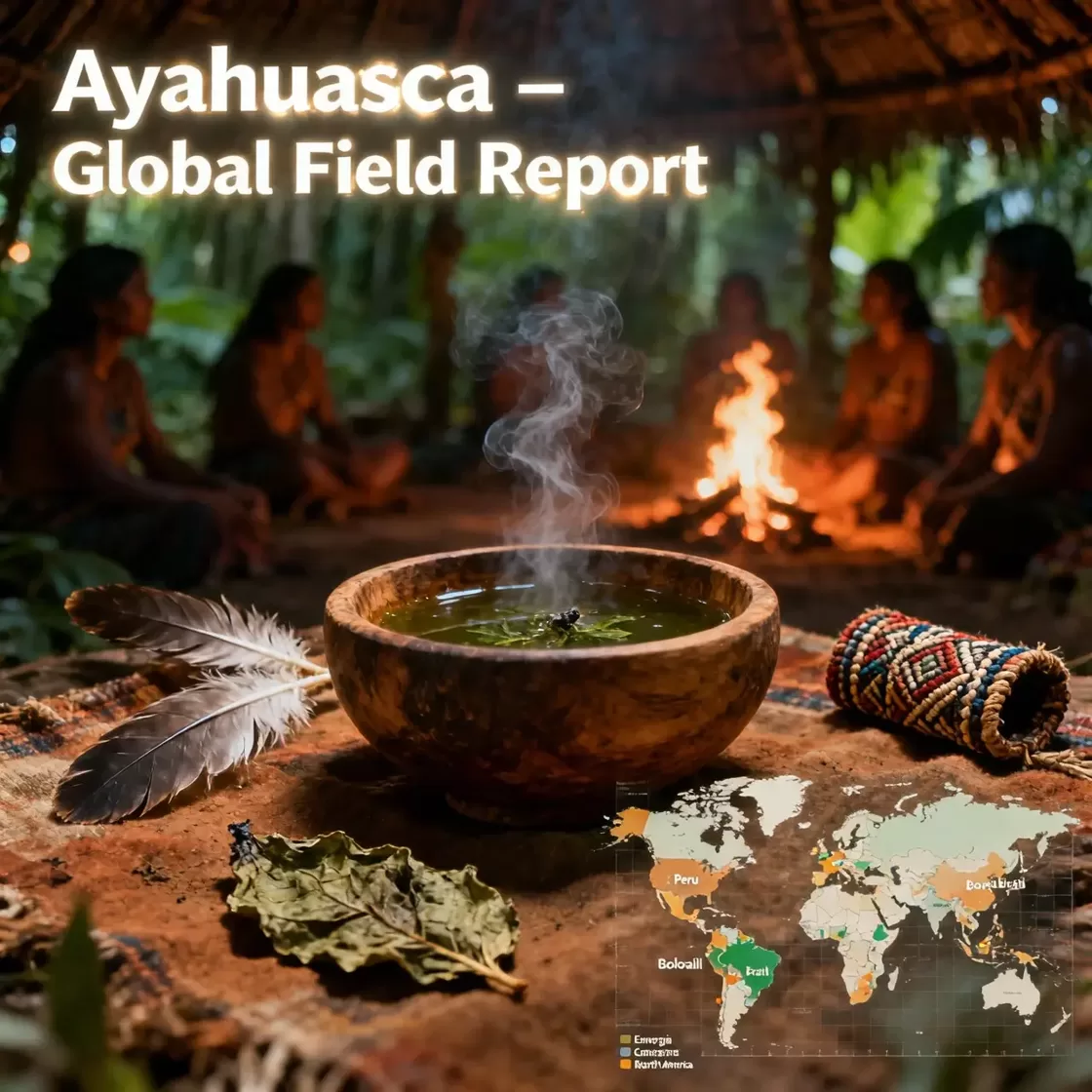
Ayahuasca entered 2026 with a growing international retreat market, renewed scientific attention and increasingly visible questions about safety, law and accountability. The most consequential developments did not follow a single global trend. Researchers published new evidence about psychological experiences and retreat practices. Governments issued travel warnings, enforced controlled-substance laws and introduced rules governing traditional plant use. Meanwhile, commercial retreats continued operating across borders under very different legal and cultural conditions.
One of the clearest measurements of this international market came from a May 2025 study in PLOS ONE. Researchers identified 298 publicly advertised psychedelic retreat organizations operating across 440 locations. Of those organizations, 220 advertised ayahuasca. The findings established a documented picture of commercial availability, although they did not measure the total number of ceremonies, participants or actual industry revenue.
Safety research became more specific in January 2026, when JAMA Network Open published interviews with representatives of 49 retreat organizations. Most reported screening participants and offering some form of preparation or follow-up support, but procedures varied considerably. Particularly concerning were recommendations or requirements to discontinue prescription medications, sometimes without clearly established medical supervision.
Legal developments were equally uneven. Brazil's Acre state introduced new provisions governing the collection and transport of plants used in religious ayahuasca practices. France maintained explicit narcotics controls on relevant plants, Germany continued listing DMT as a controlled substance, and the United States reinforced warnings for travelers considering ceremonies in Peru. In Spain, commercial retreats attracted both media attention and police scrutiny.
Scientific progress has also demanded greater precision. Research on Banisteriopsis caapi, self-reported psychological outcomes and prospective observational studies offers important information, but it does not establish ayahuasca as a universally safe or clinically proven treatment. Individual vulnerability, medication interactions, setting and emergency preparedness remain central considerations.
This global ayahuasca report covering January 2025 through November 1, 2026 examines the strongest available evidence on research, health risks, international regulations, retreat-market development, Indigenous cultural rights, plant conservation and restrictions imposed by advertising and payment platforms. It distinguishes published research from commercial claims, legal rules from journalistic descriptions and documented events from uncertain market forecasts.