
Cost of Living in Peru and the Economy Behind the Prices
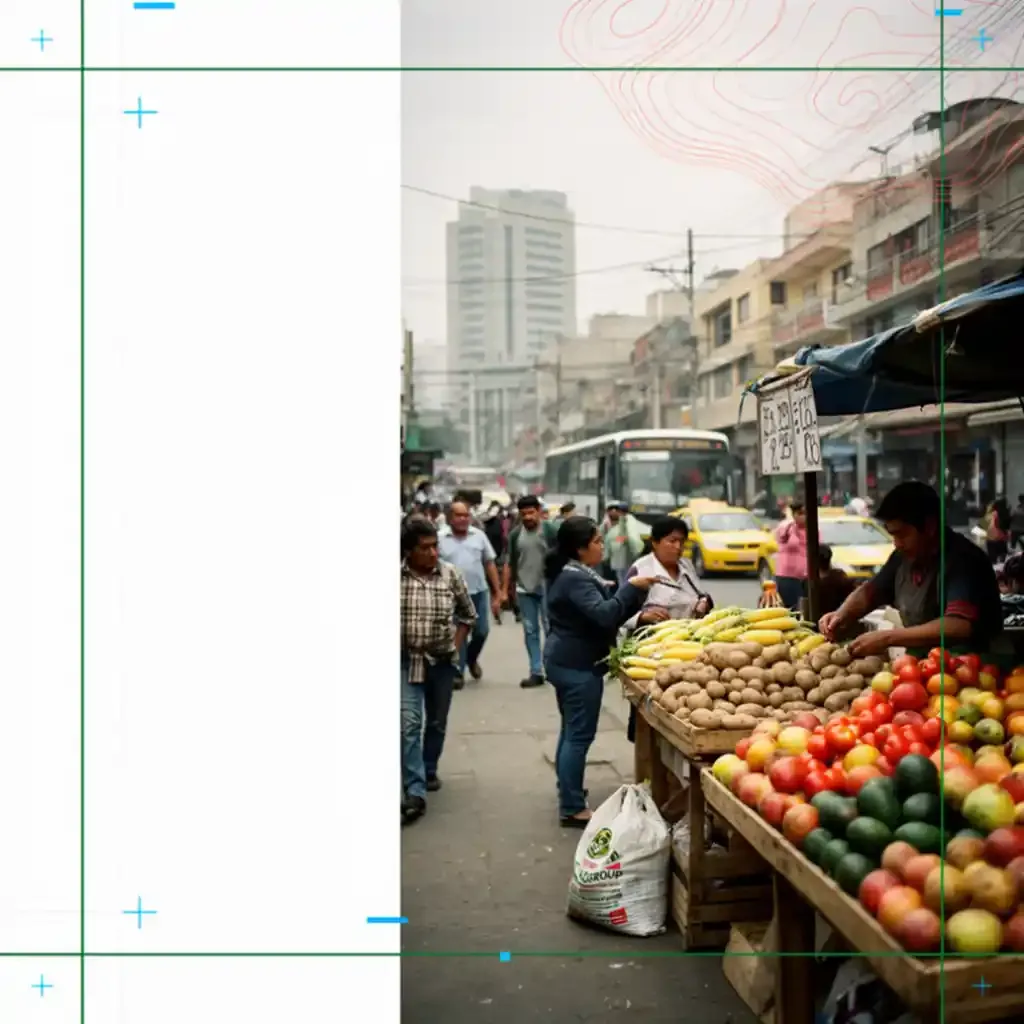
A single person in Lima covers rent, food and transport on roughly $900 to $1,500 a month in a central district, and on less in provincial cities. That budget has held its shape because the sol has traded in a narrow band for years and the central bank has kept prices anchored, even through a recent fuel-driven inflation pickup above its target. The stability comes from the central bank and the export sector, and it has outlasted every change of president.
A single person typically needs $900 to $1,500 a month in a central Lima district, and less elsewhere. Prices are set in soles, so your dollar cost moves with the exchange rate. The sol has been stable, but Lima inflation recently rose above the 1% to 3% target, so budget in soles and test your plan at a sol 10% to 15% stronger.
General information, not financial, tax or legal advice. Confirm figures with official sources and, for residency or leases, with a notary or lawyer.
Break this article down with AI
A ready-made prompt. Copy it in one click.
Show prompt text
From this article to your Peru budget
Planning a long stay in Peru or in the Amazon? The WELES Group team can help you test your numbers against flights, permits and paperwork before you commit.
In this issue
- What the cost of living in Peru looks like in dollars
- Why the Peruvian sol holds its value
- Is Peru cheap if you earn in dollars?
- Peru’s economy next to Chile’s, in size and in income
- Does political turnover undo Peru’s macro stability?
- Copper, agro-exports and the Pacific route to Asia
- What do Peru’s GDP averages hide?
- How to budget in soles on a dollar income
- Does a stronger sol make Peru more expensive?
- What to verify before a long stay in Peru
- A dollar earner’s plan for Peru — budget in soles, stress-test the rate and verify the numbers
- Frequently asked questions about the cost of living in Peru
What the cost of living in Peru looks like in dollars
A single person in a central Lima district typically spends roughly $900 to $1,500 a month on rent, food and transport, and provincial cities cost less. Local prices are quoted in soles, and the sol is what your landlord and your grocer think in.
A menú del día lunch in a Lima office district runs S/10 to S/20. A one-bedroom apartment in Miraflores, Barranco or San Isidro is usually offered between $500 and $800 a month, while the same size several districts inland drops to $300 to $450. Groceries for one person who cooks most days land around $200 to $300. These are asking-price ranges from recent listings rather than official statistics, so treat them as a starting point and check current listings for the district you actually want.
A workable monthly baseline for one person in Lima, converted at an assumed 3.5 soles per dollar that you should replace with the rate of the day:
| Expense | Monthly range in USD | In soles at the assumed 3.5 |
|---|---|---|
| Rent for a one-bedroom in a central district | $500 to $800 | S/1,750 to S/2,800 |
| Groceries | $200 to $300 | S/700 to S/1,050 |
| Utilities and home internet for a small apartment | $60 to $110 combined | S/210 to S/385 |
| Local transport with occasional ride-hailing | $40 to $80 | S/140 to S/280 |
For scale, the legal minimum wage in the private sector is S/1,230 a month, about $350 at that assumed rate, after the first step of a two-stage increase. A further step to S/1,300 is scheduled by decree. A remote salary of $2,000 sits far above the local wage structure, which explains why “Peru is cheap” circulates as advice and why it describes your purchasing power rather than Peruvian living standards. To test your own salary against these numbers, run it through the WELES Group expat cost of living calculator.
Food and transport have risen faster than the headline rate. INEI data reported in the press show fish and seafood up about 30% and vegetables and tubers up about 24% in Lima between January and October, and transport up close to 16% over twelve months. Leave extra headroom in the groceries and local transport lines.
Why the Peruvian sol holds its value
The sol holds its value because an independent central bank, low public debt and a large reserve buffer limit sharp currency swings. Price inflation is a separate story, and it has recently moved above the official target.
The Banco Central de Reserva del Perú has been constitutionally independent for more than three decades and has run an explicit inflation target for over two, currently 1% to 3%. Annual inflation peaked at 8.46% at the height of the post-pandemic price spike, fell to 3.24% a year later and to 1.97% the year after, according to INEI, which is a faster return to target than most of the region managed. Public debt is among the lowest in Latin America, and international reserves are large relative to the economy. The sol has traded mostly between roughly 3.3 and 4.1 per dollar over the past several years, a range that looks boring next to what neighbouring currencies went through. In early November the official rate was around S/3.4 per dollar, a little stronger than the S/3.5 used in the baseline above.
Inflation, however, has recently moved the other way. Annual inflation in Lima reached 5.25% at the latest INEI reading, above the target band for eight consecutive months, and the central bank raised its policy rate to 4.50% in November. The bank attributes much of the overshoot to fuel and transport costs and expects prices to return gradually to the band.
Inflation targeting and the reserve buffer behind the sol
The mechanism matters more than the label. A large reserve position lets the central bank smooth exchange-rate swings through swaps and intervention without turning every external shock into an interest-rate shock. Low sovereign debt keeps the country risk premium from feeding straight into local borrowing costs and prices. For someone signing a lease in soles, the practical result is that the dollar cost of that lease stays roughly comparable across the year, unless the sol itself moves. Peru has absorbed real food and fuel price spikes more than once, so this is a strong tendency rather than a guarantee.
Is Peru cheap if you earn in dollars?
Yes for locally produced food, domestic services, transport and rent outside the premium districts. No for imported electronics, cars, international schooling and care in Lima’s top private clinics, where prices approach what you would pay in North America or Western Europe. Rent, food and domestic services follow local wages, while electronics, cars and international schooling follow world prices.
Split every budget line into what Peru makes itself and what arrives in a container. Anything in the second category carries freight, duties and a thin retail margin, and the discount you were promised evaporates at the checkout.
Lima, Cusco and Iquitos price differently
Lima has the deepest supply of apartments and services, and the widest spread between districts, so your choice of neighbourhood moves the budget more than any national average. Cusco prices around the historic centre track the tourist calendar, with high-season premiums and much cheaper options a few blocks out. Iquitos has no road connection to the rest of the country, so everything arrives by air or by river. Imported goods cost more there while local food and river transport cost less, and flight and boat schedules shape daily life in a way that no cost-of-living index captures. For a closer look, see what life in the Peruvian Amazon costs.
The costs, advantages and challenges of everyday life in Peru in one expat guide.
Read the guide →Six countries and twelve cities compared for people planning a move.
Read the comparison →Peru’s economy next to Chile’s, in size and in income
Chile’s economy is still slightly larger than Peru’s in nominal terms, but the latest IMF projection has Peru edging ahead in the next full forecast year. Chile stays far ahead in income per person, at close to twice Peru’s level.
The October IMF World Economic Outlook puts Peru’s nominal GDP at about $414 billion and Chile’s at about $413 billion in that year, a gap of roughly $150 million. That would make Peru the fourth-largest economy in South America, behind Brazil, Argentina and Colombia. The convergence is a projection, revised every April and October, and the margin is small enough that currency moves alone can shift the date.
| Indicator | Peru | Chile |
|---|---|---|
| Nominal GDP this year, rounded IMF estimates | ~$400 bn | ~$402 bn |
| Nominal GDP in the projected crossover year | ~$414 bn | ~$413 bn |
| Nominal GDP per capita in the crossover year | ~$11,800 | ~$20,400 |
| South American rank by nominal GDP today | 5th | 4th |
| Purchasing-power GDP at the end of the IMF horizon | ~$907 bn | ~$933 bn |
Figures are rounded and move with each revision. In purchasing-power terms the IMF still has Chile’s total economy slightly ahead of Peru’s through the end of its forecast horizon, and income per person in Chile stays close to twice as high.
What the projected GDP crossover measures
It measures total output converted at market exchange rates, which makes it sensitive to population size, copper prices and the sol-peso relationship. A 10% appreciation of the sol adds roughly 10% to Peru’s dollar GDP without a single extra tonne of ore leaving the country. That is the honest reason the crossover year slides between vintages. Wages, hospital quality, school outcomes and contract enforcement sit outside this metric entirely, and Chile’s OECD membership and higher human development score reflect those differences. If you want the current number, pull NGDPD for Peru and Chile from the latest WEO database rather than from a screenshot in a news article.
Does political turnover undo Peru’s macro stability?
So far it has not. Peru has had nine or ten presidents in a decade, depending on how interim office-holders are counted, and several were removed by Congress. Former presidents have been convicted or held in pretrial detention on corruption charges years after leaving office.
The latest general election was the first under the restored bicameral congress. Through all of it the central bank kept its inflation target and the export sector kept shipping. What political instability does change is permitting timelines, infrastructure delivery, conflict around mining projects and the reliability of public services you might otherwise use. Your budget risk in Peru sits in logistics, paperwork and the exchange rate far more than in the currency’s basic stability.
Copper, agro-exports and the Pacific route to Asia
Peru’s macro picture runs on metals, farm exports and the route to Asia. More than half of Peru’s export value comes from mining, and the country ranks among the world’s largest producers of copper, silver and zinc. China takes roughly a third of everything Peru sells abroad.
Beyond minerals, Peru is the world’s largest blueberry exporter and a major supplier of grapes, avocados and asparagus, plus the leading fishmeal exporter. Two variables therefore move the whole macro picture — the copper price and El Niño. Quellaveco, which started production in recent years, added meaningful copper volume, and the sol tends to firm up when metal prices and terms of trade improve. El Niño is already a live risk for prices, and the central bank named it among the reasons for its latest rate rise.
Chancay and the shorter sailing to Shanghai
The Cosco-built port of Chancay opened its first phase, about $1.3 billion, with a direct Asia service that cuts transit to Shanghai to roughly 23 days on selected direct sailings, from the 35 to 40 days typical of earlier routings. For a resident the effect arrives slowly, through freight costs and import availability over years rather than through next month’s grocery bill. It also concentrates a strategic asset in one operator, which is why the project keeps generating legal and political argument.
What do Peru’s GDP averages hide?
They hide a large informal economy and wide gaps between regions. Roughly seven in ten Peruvian workers are in informal employment, and close to three in ten Peruvians lived below the monetary poverty line in INEI’s latest annual readings.
Aggregate growth coexists with uneven hospitals, schools, roads and water systems, and the gap between coastal Lima and Amazon regions such as Loreto is wide. For a foreign resident this shows up as private health cover and private schooling paid out of pocket, water tanks and generators in some jungle towns, and dependence on couriers and flights for anything specialised. Anyone planning to live beyond the grid should read how off-grid living in the jungle works. Cash still matters outside Lima, and card acceptance is patchy once you leave the main streets.
How to budget in soles on a dollar income
Start with the lease currency. Corporate landlords in Lima sometimes quote dollars, which quietly transfers exchange-rate risk to you, while a lease in soles keeps your cost anchored to local inflation.
Ask whether maintenance, water and building services are included, since a S/1,500 rent with S/300 of extras is a different offer from a S/1,700 all-in. Expect a deposit of one or two months plus the first month upfront, and confirm what document the landlord accepts as a guarantee if you have no Peruvian credit history. Convert through bank or transfer services rather than airport counters, keep a 10% to 15% buffer for currency and seasonal swings, and get health insurance quoted for your actual age and coverage rather than assuming a number from a forum. Our work at WELES Group is long-stay planning in Loreto, where flight schedules, permits and the paperwork behind them usually decide the real budget more than the price list does.
Compare net salary, rent and living costs across cities under your own assumptions.
Open the calculator →An overview of the immigration pathways and services for moving to Peru.
See the overview →Does a stronger sol make Peru more expensive?
Yes, in dollar terms, even when local prices barely move. A stronger sol raises a dollar earner’s rent and groceries without any Peruvian price tag changing.
The reverse happens when the sol weakens. It has slid towards 4.1 before, and dollar holders gained purchasing power overnight. Since sol strength is partly driven by copper and terms of trade, it can persist for years rather than reverting on schedule. Local inflation works the same way: when prices in soles rise faster than the exchange rate moves, the dollar cost of living goes up even if the sol stays flat. The sensible budgeting rule is to model your plan at today’s rate and at a rate 10% to 15% stronger, then check whether it still works.
What to verify before a long stay in Peru
Five checks replace most of the guesswork, because the numbers that matter to you will have moved by the time you read this. Each one points to an official source rather than a forum.
- Check the latest IMF World Economic Outlook for the Peru and Chile GDP projections, noting the vintage.
- Check BCRP for the daily sol rate, inflation readings and reserve position.
- Check INEI for poverty, informality and regional price data.
- Compare current rental listings in your specific district, not citywide averages.
- Confirm visa and residency requirements with Migraciones and the Peruvian consulate, not with expat groups. Our overview of Peru visas and residency is a starting point.
A dollar earner’s plan for Peru — budget in soles, stress-test the rate and verify the numbers
Peru is a good place to stretch a dollar income, provided you budget in soles, lease in soles and test the plan against a stronger exchange rate. Peru’s prices are set in soles and vary in dollars, and that distinction survives any reshuffle of the GDP ranking, including a forecast of Peru overtaking Chile. Read the lease currency, the day’s exchange rate and the latest inflation reading before you read any GDP forecast. For a framework on spotting hidden costs, read about information asymmetry in international relocation.
Frequently asked questions about the cost of living in Peru
How much does it cost to live in Lima per month?
A single person in a central district typically needs roughly $900 to $1,500 a month for rent, food and transport, and less in provincial cities. Treat it as a planning range built from asking prices, not an official statistic.
How much is a one-bedroom apartment in Lima?
A one-bedroom in Miraflores, Barranco or San Isidro is usually offered at $500 to $800 a month, while the same size several districts inland drops to $300 to $450.
What is the minimum wage in Peru?
The private-sector minimum wage is S/1,230 a month, about $350 at S/3.5 per dollar, after the first step of a two-stage increase. A further step to S/1,300 is scheduled by decree.
Is the Peruvian sol stable against the dollar?
It has traded mostly between roughly 3.3 and 4.1 per dollar over several years, and in early November the official rate was around S/3.4. Stable is relative, so model your budget at a rate 10% to 15% stronger than today.
What is Peru’s inflation rate now?
Annual inflation in Lima was 5.25% at the latest INEI reading, above the central bank’s 1% to 3% target for eight consecutive months. The central bank raised its policy rate to 4.50% in November and expects prices to return gradually to the target band.
Is Peru cheap if you earn in dollars?
Yes for local food, domestic services, transport and rent outside the premium districts. No for imported electronics, cars, international schooling and top private clinics.
Will Peru’s economy overtake Chile’s?
The October IMF outlook projects Peru’s nominal GDP edging past Chile’s in the next full forecast year, by about $150 million on roughly $414 billion. It is a projection that currency moves can shift, and Chile’s income per person stays close to twice as high.
Does political instability affect the cost of living in Peru?
Not through the currency so far, since the central bank and the export sector kept working through repeated changes of president. It does affect permitting, infrastructure delivery and public services, so budget for delays and paperwork.
Should I sign a lease in soles or in dollars?
A lease in soles keeps your cost anchored to local inflation, while a dollar lease transfers exchange-rate risk to you. Ask what maintenance, water and building services are included, and expect a deposit of one or two months plus the first month upfront.
How big a buffer should I keep for currency swings?
Keep a buffer of 10% to 15% for currency and seasonal swings, and test the plan at a sol 10% to 15% stronger than today.
Where does Peru’s economy get its money from?
More than half of export value comes from mining, led by copper, silver and zinc, and China takes roughly a third of exports. Blueberries, grapes, avocados, asparagus and fishmeal add to the mix.
Does the Chancay port lower the cost of living?
Only slowly. The port cuts transit to Shanghai to roughly 23 days on direct sailings, and the effect on freight costs and import availability arrives over years, not in next month’s grocery bill.
Verified 16 November 2026 against official and primary sources: the minimum wage decree, the latest INEI inflation reading and the central bank’s rate decision, the October IMF World Economic Outlook, exchange-rate closes, and reporting on the Chancay port and Peru’s presidential changes.
When planning a long stay, set aside a separate budget for legal and administrative support, and re-run your numbers on the day you sign a lease, because exchange rates and inflation readings change monthly.
- Cuatrecasas — two-stage increase of the minimum wage
- El Peruano — decree raising the minimum wage
- BCRP — Annual Report on inflation and the target range
- El Comercio — annual inflation in Lima, October reading
- La República — central bank raises its policy rate
- Latin Times — IMF projection for Peru and Chile
- Global Construction Review — Chancay port opening
- Euronews — Peru’s presidential turnover over the past decade